REVIEW · POMPEII
Pompeii 3 Hours Walking Tour Led by an Archaeologist
Book on Viator →Operated by Askos Tours · Bookable on Viator
Pompeii comes alive when you have a real expert beside you. This 3-hour private walk led by an archaeologist-style guide is a smart way to see the core of the ancient city fast, with clear explanations of how people lived before Vesuvius. I like that it hits major landmarks without wasting time, and I like the customizable feel—so your route can adapt to your pace and questions. The only real catch: the site is huge and very exposed, so you’ll want sunscreen and a hat, and you should be ready for a warm, sun-forward walk.
What makes this experience especially practical is the structure. You start at the Pompeii main entrance area and move through the forum zone, then homes, baths, a famous brothel, and two theater spaces. The guide also ends back at the same meeting area and can point you toward how to get back to your accommodation or the closest train station, which is one less stress after you’re done walking.
One more note up front: at $256.99 per person, this isn’t a budget tour. If you’re traveling solo, it may feel steep. If you’re splitting the cost as a small group and want expert guidance at the sites, it starts to look like good value—especially because admission fees are included for parts of the route and you’re not stuck in a large group shuffle.
In This Review
- Key highlights worth knowing before you go
- Planning Your 3-Hour Pompeii Walk: Meet at Porta Marina Superiore
- First Stop: How Porta Marina Superiore Gets You Oriented
- Basilica and the Forum: Where Pompeii’s Public Life Happens
- Stop 2: Basilica
- Stop 3: Forum square
- Stop 4: Granaries of the Forum
- Roman Homes You Can Actually Understand: Menander and the House of the Faun
- Stop 5: House of Menander
- Stop 8: House of the Faun
- Stabian Baths and the Lupanar: Daily Life, Public Want, and Heat
- Stop 6: Stabian Baths (Terme Stabiane)
- Stop 7: Lupanar
- Theater Stops: Odeon (Teatro Piccolo) and Teatro Grande
- Stop 9: Odeon – Teatro Piccolo
- Stop 10: Teatro Grande
- Value and Cost: Is $256.99 per Person Actually Fair?
- Who Should Book This Pompeii Archaeology Walk?
- Should You Book Askos Tours for Pompeii?
- FAQ
- How long is the Pompeii 3-hour walking tour?
- Is this tour private?
- What language is the tour offered in?
- Where do we meet the guide?
- Are admission tickets included?
- Is luggage storage available near the meeting point?
- Does the tour run if it rains?
- Is transportation included?
- Can children join?
- Can I cancel for a full refund?
Key highlights worth knowing before you go
- Archaeologist-led explanations focused on how daily life worked in Pompeii before the eruption
- Private, small-group feel with a route that can be adjusted to your questions and pace
- Must-see stops in just 3 hours: forum buildings, thermal baths, Lupanar, and both major theater spaces
- Admission ticket fees included for selected stops so you’re not piecing payments together on the spot
- Begin at Porta Marina Superiore with the Askos Tours guide holding a sign for easy meeting
- Free luggage storage on-site at the meeting point, which helps a lot if you arrive with bags
Planning Your 3-Hour Pompeii Walk: Meet at Porta Marina Superiore
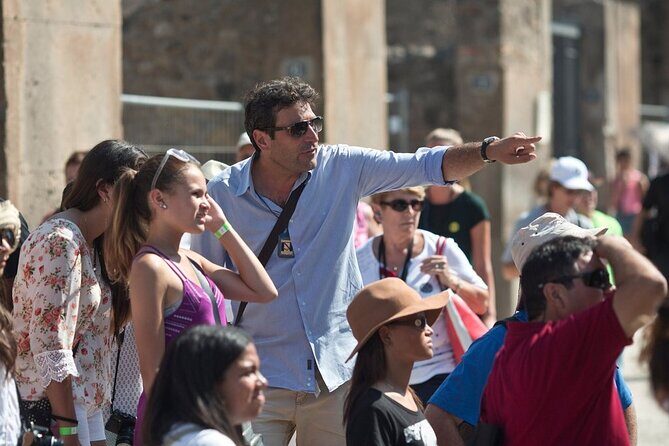
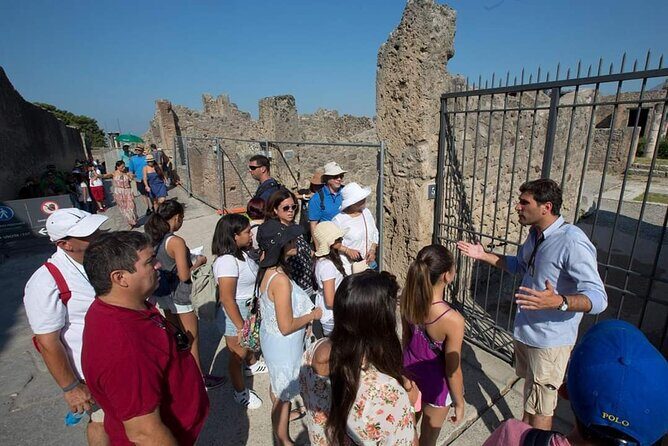
This is a private walking tour, and that matters more in Pompeii than people expect. The ruins are spread out, the ground can be uneven, and the sun is relentless in many areas. With just your group, you spend more time looking at the sites and less time waiting on a big herd.
You’ll meet at Via Villa dei Misteri, 1, 80045 Pompei (NA), Italy. From there, your guide meets you at the Pompeii archaeological park main entrance called Porta Marina Superiore, holding a sign with Askos Tours at the top. The tour ends at the same place.
Timing is also a big part of how this works. The tour lasts about 3 hours, so you’ll get a focused route rather than a take-your-time wander. That’s great if this is your one Pompeii stop, but it does mean you may not cover every single corner of the park in one go.
Practical bonus: at the meeting point, there’s a free luggage store. If you’re arriving with bags or you’re not ready to head back to your lodging yet, this helps you travel lighter while you’re walking.
Finally, the tour runs rain or shine. Pompeii doesn’t pause for weather, and neither do you. If rain hits, wear shoes with real grip.
Other archaeologist-led tours in Pompeii


First Stop: How Porta Marina Superiore Gets You Oriented
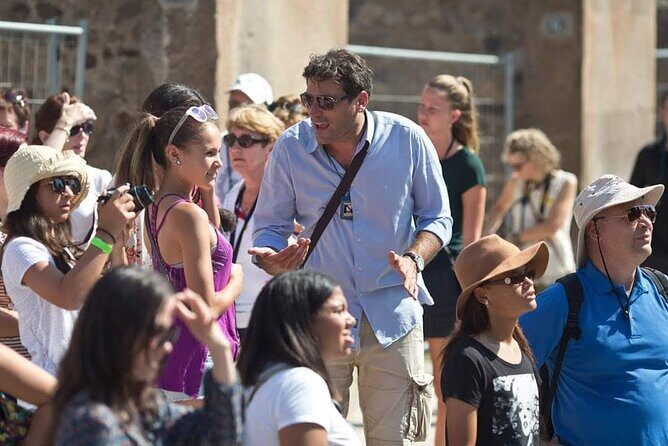
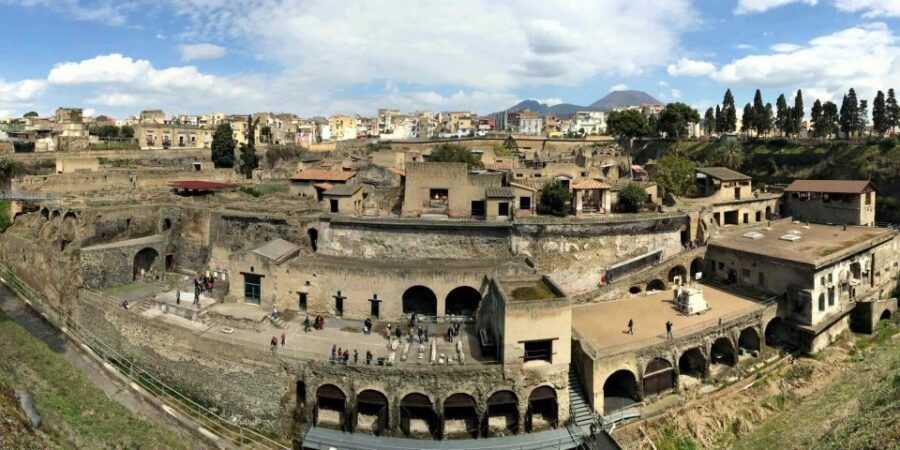
Your first stop is the Pompeii Archaeological Park at Porta Marina Superiore. This is a good opening because it sets the frame: you’re not just strolling ruins, you’re learning how the ancient city was laid out and used.
From the moment you’re gathered at the entrance, you’ll start moving with a plan. That matters because Pompeii can feel chaotic fast—streets, building walls, and doorways all look similar at a glance. A guide-led start helps you get your bearings fast and keeps your “what am I looking at?” questions from piling up later.
Also, because this is a private experience, the guide can shape early explanations to match what you care about most: Roman daily life, architecture, or what the city looked like right before the eruption.
Basilica and the Forum: Where Pompeii’s Public Life Happens
After you start out, the tour moves into the heart of civic space.
Stop 2: Basilica
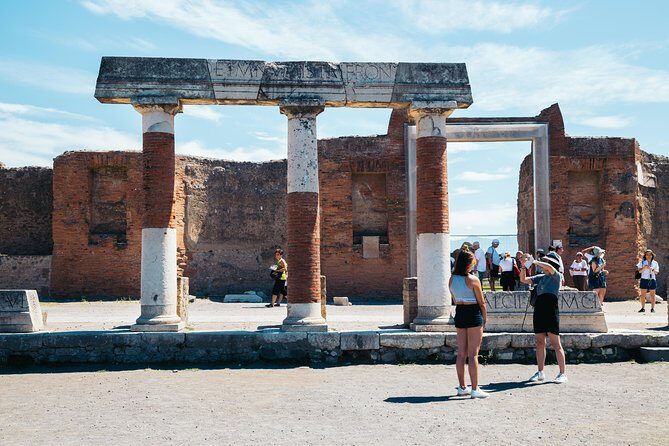
The Basilica here is more than a big building shell. It was an open portico that sheltered merchants and other activities. That detail helps you picture the forum as a working place, not a museum set. You can stand in the structure and imagine the foot traffic, the commerce, and the bustle of people using covered areas for deals and meetings.
Stop 3: Forum square
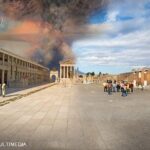
Next is the Foro de Pompeya, the ancient main square. This is where you connect the dots between everyday life and public space. The square gives you the sense of scale and importance—Pompeii’s core wasn’t hidden away; it was right in the center.
Other walking tours of the Pompeii ruins


Stop 4: Granaries of the Forum
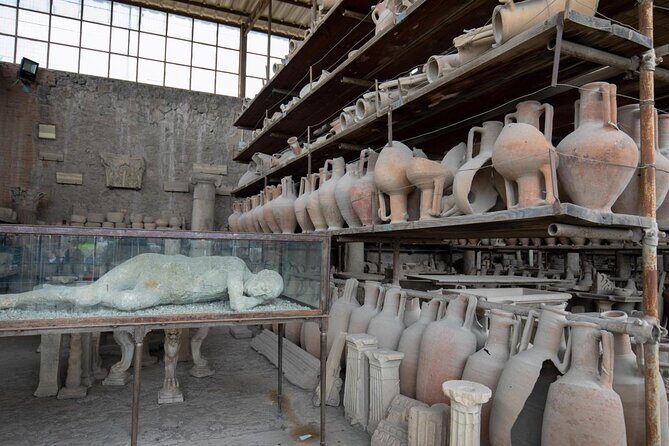
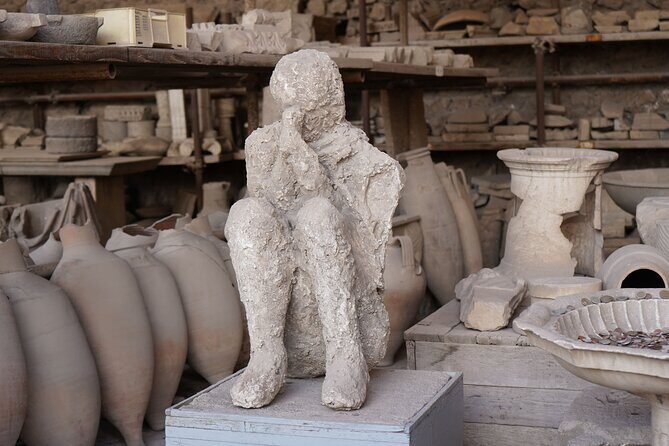
Then you reach the Granaries of the Forum, which add a darker emotional layer to the route. Inside, you’ll see marble tables and fountain-bath elements that once adorned house entrances. This is also where you encounter casts linked to the victims of the eruption. The site notes include casts of victims, plus details such as a dog and a tree.
This is one of the moments where a good guide really changes the experience. It’s easy to treat casts as “sad statues.” With the right explanation, they become a way to understand how people were caught and what remained visible in the aftermath.
Because this stop has admission fees included, it’s one of the stops where the tour structure clearly delivers.
Roman Homes You Can Actually Understand: Menander and the House of the Faun
Pompeii’s best storytelling often comes from houses. When you see domestic spaces after you’ve walked the forum, you start to understand the gap between public life and private life.
Stop 5: House of Menander
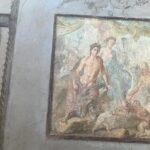
The House of Menander is described as one of Pompeii’s richest and most impressive residences, especially for its architecture, decoration, and contents. This stop helps you read the city like a social map. You see how wealth showed up in art, layout, and the way rooms connected.
What I like about this kind of home visit is that it’s not just about pretty mosaics. A strong guide explains what those features meant to the people living there, and how the design supported social routines and status.
Stop 8: House of the Faun
Later, you’ll visit the House of the Faun, which is described as one of the largest and most impressive private residences in Pompeii. Again, the goal is to help you visualize domestic power and how residents used space.
If you’re the type who wants Pompeii explained in plain terms, this pairing of Menander and the House of the Faun is effective. You get a comparison: different levels of grandeur, different ways of using a private residence.
Stabian Baths and the Lupanar: Daily Life, Public Want, and Heat
The middle part of the tour leans into habits—how people relaxed, cleaned up, met friends, and spent time.
Stop 6: Stabian Baths (Terme Stabiane)
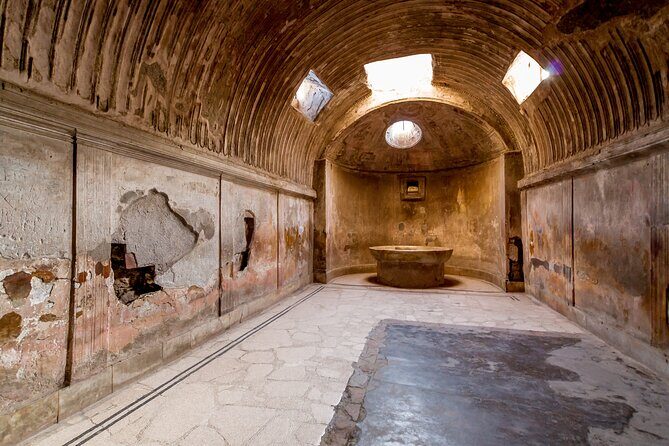
The Stabian Baths cover a vast area and are described as the oldest thermal complex in the city. There’s something grounding about starting with baths, because bathing was social. People didn’t treat it like a quick bathroom stop; they treated it like part of the day.
The tour’s description places these baths in relation to other parts of the city, between the Brothel lane, the Holconius crossroads, and the Via Stabiana. That kind of geographic anchoring helps you understand that Pompeii wasn’t a set of separate monuments. It was connected routines, repeated every day.
Stop 7: Lupanar
Then comes the Lupanar, the most famous brothel in the ruined Roman city of Pompeii. This is a stop that can feel shocking at first, mostly because modern visitors see it through a different lens. A guide’s job here is to keep it factual and grounded in how the Romans used spaces.
You also get a helpful “city rhythm” effect. When you jump from baths to the brothel, the message is clear: Pompeii’s public and semi-public life touched a lot of different needs—health, leisure, and entertainment.
This stop can be intense, so if you don’t like anything sexual or graphic in theme, you may want to mentally prep yourself for it. It’s part of the full Pompeii picture.
Theater Stops: Odeon (Teatro Piccolo) and Teatro Grande
No Pompeii route feels complete without theater spaces.
Stop 9: Odeon – Teatro Piccolo
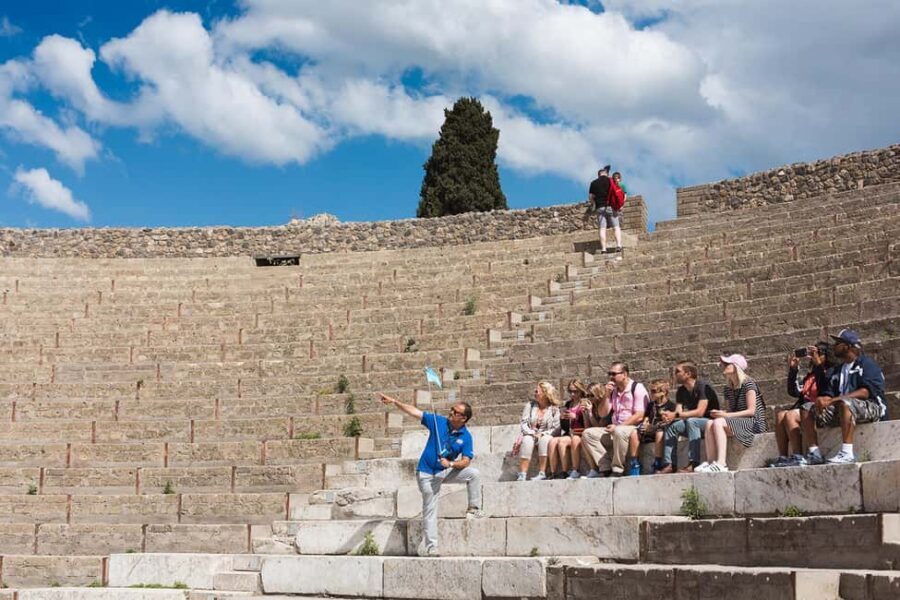
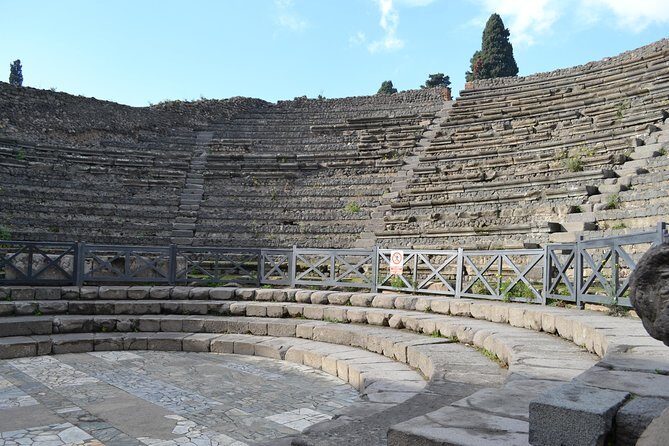
You’ll get a short look at the Odeon – Teatro Piccolo. Even with limited time here, it helps you see that Pompeii had performance culture close to daily life.
Stop 10: Teatro Grande
Then you visit the Teatro Grande, described as the most important theater in Pompeii. This is where the architecture and scale click into place. Standing inside or near theater spaces is a fast way to understand how Romans gathered for shows, speeches, and communal events.
If you like understanding the practical side of ancient design—how crowds moved, where people sat, how sound and sightlines worked—this is a strong closing sequence.
Value and Cost: Is $256.99 per Person Actually Fair?
Let’s talk money without pretending it’s cheap. At $256.99 per person, this is a premium-priced Pompeii tour. The right question is: what makes it worth paying that kind of price?
Here’s the case for value:
- You’re getting a professional archaeologist guide (with multiple guides praised for serious expertise, including people named like Daniela Mantice, Monica, Antonella, Anna Sorrento, Nicoletta, and Lia).
- Admission ticket fees are included for the stops that require it, so you’re not doing extra ticket math while you’re trying to enjoy the site.
- You get a tight route that still covers big-ticket Pompeii spaces: forum buildings, baths, the Lupanar, two major houses, and both theater stops.
- It’s private, so you’re not stuck behind a slow group or sprinting because someone else is late.
Here’s the reality check:
- It doesn’t include transportation to or from the attractions, so factor in how you’re getting there and back.
- Because it’s only about 3 hours, you’re choosing a curated slice of Pompeii rather than trying to see every building.
If you’ve got limited time in the Naples/Pompeii area and you care about understanding what you’re looking at, this style of tour can be a smart buy.
Who Should Book This Pompeii Archaeology Walk?
This tour is a great fit if:
- You want a focused introduction and explanation, not just photos.
- You like architecture, Roman civic space, and how daily life worked.
- You prefer the calmer pace of a private group.
It may be less ideal if:
- You want to linger for long stretches at every stop (the route is built for momentum).
- You’re sensitive to sun and heat, because the site is vast and very exposed with minimal shade.
- You’re traveling with kids who need frequent breaks. The tour says most people can participate and children must be accompanied by an adult, but Pompeii walking is still walking.
Pack like it’s a workout. Hat, sunscreen, water, and shoes you trust.
Should You Book Askos Tours for Pompeii?
If you want Pompeii explained in a way that makes sense—forum to homes to baths to theaters—this is a strong option. The biggest selling points are the guide quality (including multiple highly praised specialists by name) and the fact that you’re getting a private structure that keeps the experience moving without turning it into a checklist.
Book it if:
- Pompeii is your one major ruin visit and you want real context.
- You care more about understanding the place than collecting random stamps around the park.
- You’re okay paying a premium for expert-led time.
Skip it or consider a different style if:
- You’re on a strict budget.
- You plan to spend most of the day wandering freely at your own rhythm.
FAQ
How long is the Pompeii 3-hour walking tour?
The tour lasts about 3 hours.
Is this tour private?
Yes. It’s a private tour/activity, and only your group participates.
What language is the tour offered in?
The tour is offered in English.
Where do we meet the guide?
You start at Via Villa dei Misteri, 1, 80045 Pompei NA, Italy, and meet at the Pompeii archaeological park main entrance called Porta Marina Superiore. The guide holds an Askos Tours sign.
Are admission tickets included?
Admission ticket fees are included, and the tour information specifies admission ticket included for certain stops.
Is luggage storage available near the meeting point?
Yes. There is a safe luggage store at the meeting place for free.
Does the tour run if it rains?
Yes. The tour takes place rain or shine.
Is transportation included?
No. Transportation to/from attractions is not included.
Can children join?
Children must be accompanied by an adult.
Can I cancel for a full refund?
Yes. You can cancel up to 24 hours in advance for a full refund. If you cancel less than 24 hours before the start time, the amount paid is not refunded.