REVIEW · POMPEII
Pompeii Small Group Tour with an Archaeologist
Book on Viator →Operated by Askos Tours · Bookable on Viator
Pompeii makes more sense with a real archaeologist. This small-group tour brings you straight into the ruins from Porta Marina Superiore with skip-the-line access, then strings together the sites you actually need to see to understand what happened there. It’s a tight, story-led walk through the city’s civic center, daily life, and final moments.
I love how the tour focuses on the big landmarks you’d otherwise wander past in confusion. You’ll hit the Basilica and the Forum, then connect them to what you’re seeing in houses, baths, and even the brothel lane.
The main drawback is simple: it moves, and Pompeii is uneven underfoot. If you’re slower on steep steps and ramps, this format can feel like a sprint even when it’s well paced.
In This Review
- Key highlights that make this Pompeii tour worth it
- Walking into Pompeii with an archaeologist guide, not a map
- Starting at Porta Marina Superiore: where the tour really saves time
- The Basilica and Forum: Pompeii’s civic center explained in plain language
- Basilica
- Forum
- Granaries of the Forum and the plaster casts: when the story gets real
- Strolling the original paved roads: why the route matters
- House of Menander: the rich home that teaches you how Romans lived
- Stabian Baths: the oldest thermal complex vibe
- Lupanar brothel ruins: context helps you see more than shock
- House of the Faun and the theater side quest you’ll want
- How 2 hours can still feel like you saw a lot
- Price and value: what $35.67 gets you in real terms
- Meeting and movement: what to bring and how to stay comfortable
- Accessibility, scooters, and pets: know the limits before you go
- What kind of guide you’ll appreciate: archaeologists who tell human stories
- Should you book this Pompeii small-group archaeologist tour?
- FAQ
- How long is the Pompeii Small Group Tour with an Archaeologist?
- Where do we meet, and where does the tour end?
- Is the tour offered in English, and do I get a mobile ticket?
- Is an entrance ticket included, and do we skip the lines?
- How large is the group, and do you provide headsets?
- Is food or transportation included?
- What should I bring for the walk through Pompeii?
- Can I cancel for free?
Key highlights that make this Pompeii tour worth it
- Porta Marina Superiore start means you get into the site quickly and avoid early queue stress
- Skip-the-line Pompeii Express ticket included, so you’re spending time walking, not waiting
- Archaeologist-led storytelling that turns buildings into real people and real consequences
- Granai del Foro plaster casts let you stop and truly understand the eruption’s impact
- Major stops for a 2-hour visit: Basilica, Forum area, House of Menander, Stabian Baths, Lupanar, House of the Faun, and Teatro Grande
- Headsets for groups 16+, which helps a lot when you’re stopped in noisy, open spaces
Walking into Pompeii with an archaeologist guide, not a map
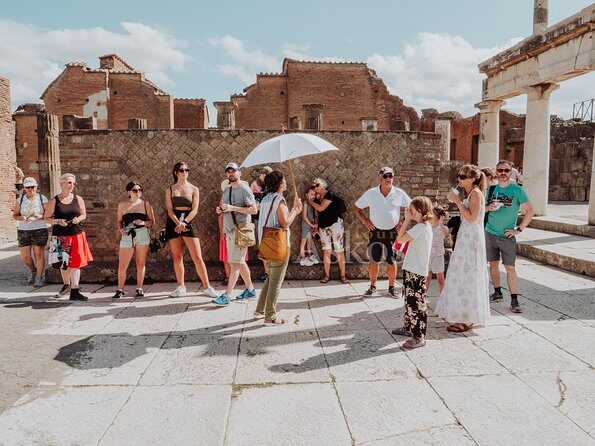
Pompeii can feel like a museum maze. Stones. Columns. Walls. If you don’t know what you’re looking at, you’ll spend a day “seeing stuff” but miss the meaning.
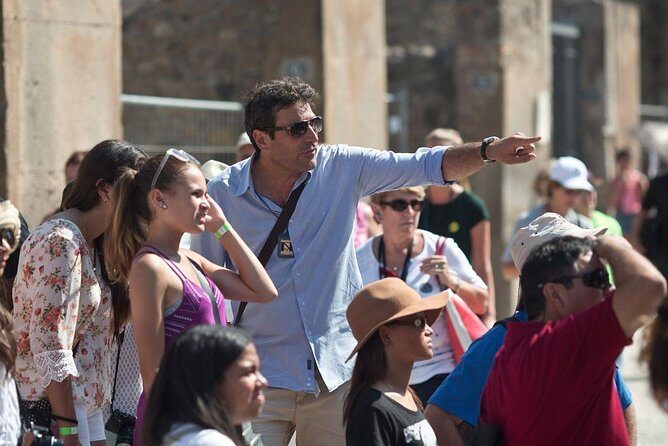
That’s where an archaeologist guide changes the whole experience. You’re not just getting a list of sites. You’re getting context—why the Basilica looked the way it did, what merchants and civic life were doing around the Forum, and how daily routines show up in places like bath complexes and decorated homes.
And the small-group cap matters. With up to 20 people per guide, you’re more likely to get real attention, clearer answers, and a pace that fits the route instead of everyone being squeezed into one generic slideshow. In the real world, that’s what turns Pompeii from overwhelming into manageable.
Other archaeologist-led tours in Pompeii


Starting at Porta Marina Superiore: where the tour really saves time
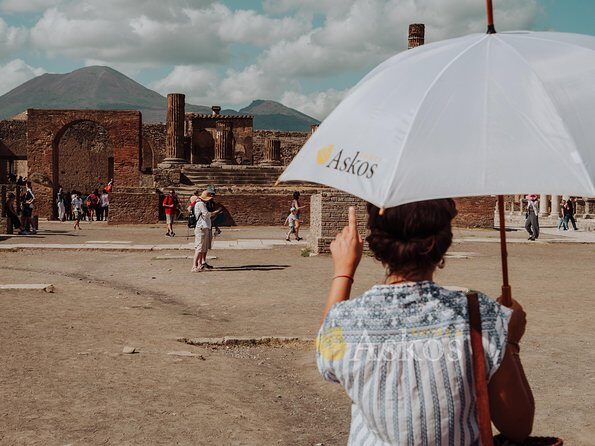
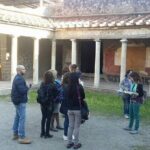
The tour meets at Porta Marina Superiore, with the guide holding a sign for Askos Tours. This is a smart move because it gets you into Pompeii right away instead of spending the first chunk of your visit figuring out entrances and logistics.
From a practical standpoint, it’s also a calmer start. You’re organized: meet the group, get set, then head inside. One of the toughest parts of Pompeii is not the walking—it’s the “where do we go now” uncertainty, especially when you’re standing at the wrong gate with a ticket that doesn’t match your confusion.
The Basilica and Forum: Pompeii’s civic center explained in plain language
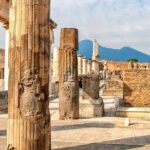
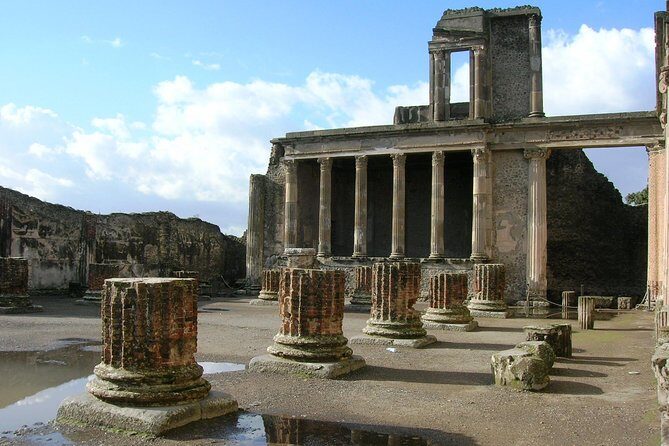
The tour begins with the Basilica and the Forum area. Think of this as Pompeii’s public living room—where commerce mixed with civic authority.
Basilica
You’ll see the Basilica as an open portico that gave shelter to merchants and other activities. That small detail helps you interpret what the structure was for. It’s not a “religious building” in the way people sometimes assume. It’s a functional space designed for business and public movement, protected from sun and weather.
Forum
Then you look at the ancient main square. Here’s the trick with Pompeii: the Forum doesn’t feel impressive if you only think of it as ruins. But when you understand it as a place of meeting, transactions, and announcements, it becomes clear why it sat at the center of the city’s life.
If you’re the type of traveler who likes to understand how cities worked, this is where the tour starts paying off fast.
Other small-group tours we've reviewed in Pompeii





Granaries of the Forum and the plaster casts: when the story gets real
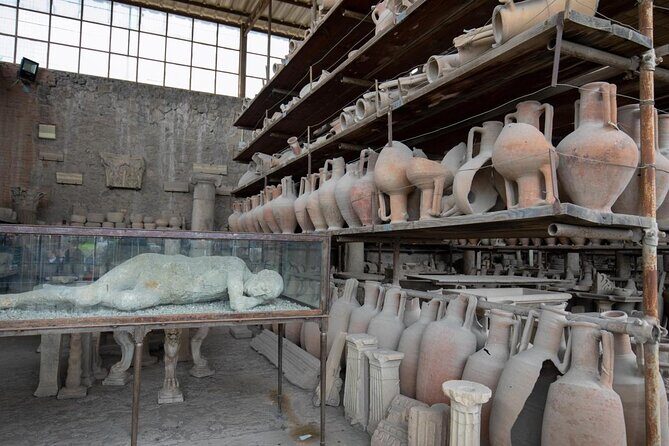
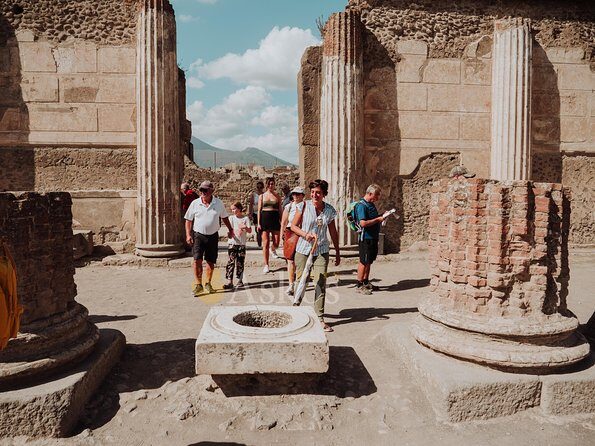
Next comes the Granaries of the Forum area. The setting is unforgettable: marble tables, and details connected to how public fountains and house entrances could be ornamented. It’s also where the tour slows down for something heavier.
You pause to ponder plaster casts of victims of the famous eruption that destroyed the city. The display isn’t just “sad statues.” It’s a direct, physical reminder that Pompeii wasn’t a distant tragedy. It was people—moving, trapped, and caught by catastrophe.
You’ll also see casts of a dog and even a tree. That mix matters. It prevents the tragedy from turning into a single-note story. It becomes a whole scene of life interrupted: humans, animals, and nature in one moment frozen in plaster.
I like that the tour builds in this emotional stop. If you rush past it, you lose the point.
Strolling the original paved roads: why the route matters
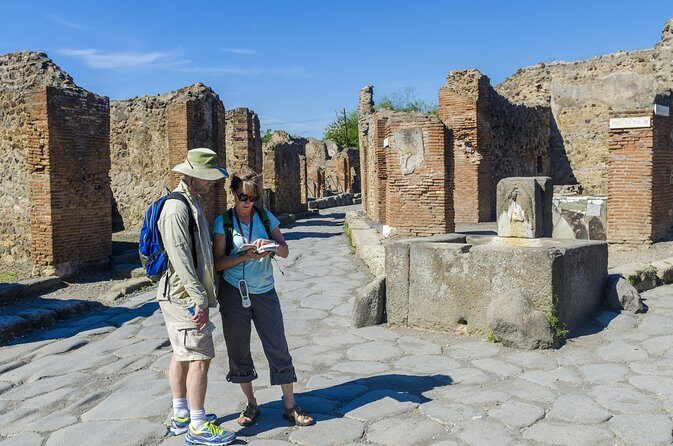
After the Forum area, you’ll walk along the original paved roads and stop to admire frescoes and mosaics in the interiors you visit. This is one of those tour details that makes a huge difference.
Mosaic floors and wall paintings can look like random decoration if you don’t know what kind of life lived in those rooms. But when you’re guided through in sequence—civic center to homes to baths—you start to see how Pompeii’s art worked as status, comfort, and identity.
This is also the section where you’ll feel the “Pompeii reality.” Ground can be uneven. Some areas have steps and ramps. You don’t need to be an athlete, but you do need stable shoes and patience.
House of Menander: the rich home that teaches you how Romans lived
The House of Menander is one of the richest and most impressive homes in Pompeii in terms of architecture and decoration. This stop matters because it gives you a window into how wealth expressed itself through space.
Here’s what I find useful: the guide doesn’t just point out pretty rooms. You get help connecting the layout and decorative choices to how owners displayed taste and status. Pompeii’s houses aren’t quiet little “homes.” They’re social statements with courtyards, reception areas, and artwork that makes everyday life look curated.
Even if you don’t love history, you’ll likely enjoy this one because it’s visual, detailed, and human.
Stabian Baths: the oldest thermal complex vibe
Then you move into the Stabian Baths (Terme Stabiane). These occupy a vast area between key crossroads and lanes, and they represent the oldest thermal complex in the city.
Baths in Roman life weren’t only for hygiene. They were social spaces. They were routine. They were leisure and status. When you see the scale of this complex, it becomes obvious how central bathing culture was.
One practical plus: bath complexes often give you a different kind of interior view than the houses. You get a sense of communal life, design for movement, and how public architecture shaped daily behavior.
If you’ve ever wondered why ancient cities felt so “designed,” this stop answers it.
Lupanar brothel ruins: context helps you see more than shock

Next is a look into the most famous brothel ruins in Pompeii, the Lupanar. This stop can be uncomfortable if you approach it like a tabloid stop. The value of having an archaeologist is that the site becomes part of a broader picture—urban life, entertainment, and how the city accommodated different parts of society.
You’ll still see the space, the layouts, and the surviving remains that make the Lupanar so famous. But the guide’s job is to give you context so you’re not just scanning for shock value.
If you’d rather avoid explicit details, you can ask the guide to emphasize the architecture and social context over anything graphic. The tour is built as a guided walk, so you can steer your attention.
House of the Faun and the theater side quest you’ll want
The route continues with the House of the Faun, one of the largest and most impressive private residences. This is another “power home” stop, and it helps you round out the earlier Menander home by showing how scale and design could vary in wealthy Pompeii.
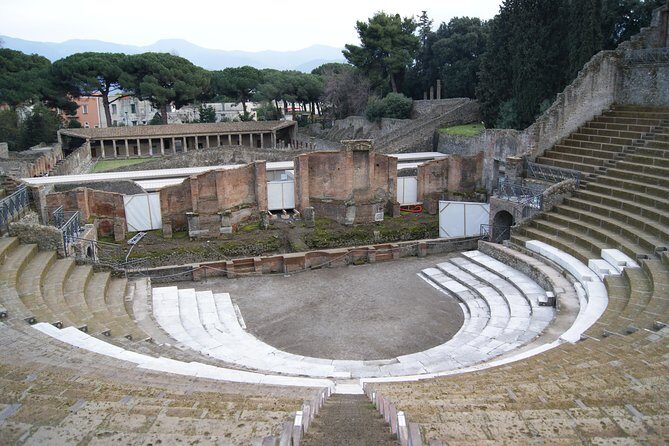
Along the way, you’ll also have a brief stop at the Odeon and get a look at the Teatro Piccolo. These are smaller compared to the grand finale, but they help you see that Pompeii wasn’t just markets and baths. It was also a city for performances and public gathering.
Then you end at Teatro Grande, the city’s largest theater. This is the crescendo. A guided explanation helps you understand the size and purpose, and it gives the whole day a sense of arc: civic center, domestic life, social life, and public entertainment.
How 2 hours can still feel like you saw a lot
The tour lasts about 2 hours. That’s not long on paper. In Pompeii, though, short can be perfect.
You’re not trying to “cover everything.” Instead, you’re getting the structure: key landmarks that anchor your understanding. By the time you reach Teatro Grande, Pompeii stops looking like random ruins and starts looking like a functioning city that stopped mid-routine.
One thing I’ll caution: since this is walking on uneven ground and includes multiple stops, you’ll feel the time in your legs. Bring water, take short breathers when offered, and keep your expectations realistic.
If you’re the type who hates schedules, this might annoy you. But if you want a focused hit of Pompeii with meaning, this timing works well.
Price and value: what $35.67 gets you in real terms
At $35.67 per person, you’re not paying for a private car or a half-day production. You’re paying for a guide with an archaeological background plus an entrance setup designed to reduce waiting.
What’s included matters:
- Licensed guidance for the entire duration
- A Pompeii Express ticket (skip-the-line style access)
- Small group size (maximum 20)
- Headsets for groups of 16+
- The core Pompeii route with major landmarks
When I look at value, I focus on whether the tour changes what you see. Here, it does. The biggest cost in Pompeii is time and comprehension. A good guide turns comprehension from “guessing” into “getting it.” You’re also more efficient because you’re following a route built around major sites.
Compared with trying to do Pompeii solo, this price feels fair, especially in high season when lines and decision fatigue can eat your day.
Meeting and movement: what to bring and how to stay comfortable
Pompeii is outdoors and exposed. The tour runs all year with rain or shine, so plan accordingly.
Bring:
- Comfortable shoes (not just “nice sneakers,” but something you trust on uneven stone)
- Sunglasses and sunscreen in summer
- A small bottle of water
If you’re traveling in hot months, prioritize shade breaks when your guide offers them. Also, don’t overpack. Your hands and pockets will matter when you need to steady yourself on stairs.
Accessibility, scooters, and pets: know the limits before you go
This tour isn’t set up for mobility scooters. The route includes steps and ramps, plus some steep climbs. If you have mobility issues or impairments, it’s not recommended based on the listed constraints.
Pets come with rules too:
- Service animals are allowed.
- Dogs are permitted only if they’re small: up to 10 kg and max height 40 cm.
- They must be on a leash and held in your arms inside the buildings, and you’re responsible for collecting excrement.
If any of this applies to you, it’s worth contacting the provider to ask about a suitable private tour format. Pompeii is a beautiful place, but it’s also physically demanding.
What kind of guide you’ll appreciate: archaeologists who tell human stories
A big part of this tour’s reputation is the guide style. I’ve seen names pop up repeatedly in people’s accounts, and they point to the same pattern: narrative clarity, pacing that works for mixed groups, and answers that go beyond the guidebook.
You might meet guides like:
- Teresa, praised for passion and thoughtful pacing
- Alfredo, noted for useful details
- Alessandra, described as postdoctoral in archaeology and focused on both context and tragedy
- Paolo, described as having hands-on archaeology experience tied to the site affected by the eruption
- Vincenzo and Antonio, highlighted for humor and making Pompeii feel less distant
- Amedeo/Amadeo, mentioned for engagement with families
Even when the tour is only two hours, the guide’s approach decides whether Pompeii becomes a blur or a set of clear scenes.
Should you book this Pompeii small-group archaeologist tour?
I’d book it if you want the smartest use of a short time in Pompeii. This is a good fit when you:
- Want a guided route through the Basilica, Forum area, Menander, baths, the Lupanar, House of the Faun, and Teatro Grande
- Like context that connects buildings to real lives, including the eruption’s human impact
- Prefer small groups and the practical boost of headsets (for larger groups)
- Want skip-the-line access so your visit doesn’t get eaten by queues
I’d think twice if you:
- Need a fully barrier-free route (mobility scooters aren’t allowed, and steps/ramps are part of the experience)
- Want a super-slow, unstructured walk with lots of free time at each stop
- Get stressed by schedules, because the tour is designed to cover major highlights efficiently
If you want Pompeii to click—fast—this is a strong choice.
FAQ
How long is the Pompeii Small Group Tour with an Archaeologist?
The tour lasts about 2 hours.
Where do we meet, and where does the tour end?
You meet at Porta Marina Superiore (the guide holds a sign with Askos Tours). The tour ends inside the ruins at the archaeological site.
Is the tour offered in English, and do I get a mobile ticket?
Yes. The tour is offered in English, and a mobile ticket is included.
Is an entrance ticket included, and do we skip the lines?
Yes. The tour includes the Pompeii Express entrance ticket designed for faster entry.
How large is the group, and do you provide headsets?
The group is limited to a maximum of 20 people per guide. Headsets are provided for groups of 16 or more.
Is food or transportation included?
No. Food and drinks are not included, and transportation is not included.
What should I bring for the walk through Pompeii?
Bring comfortable shoes, sunglasses, sunscreen in summer, and a small bottle of water.
Can I cancel for free?
Free cancellation is available if you cancel up to 24 hours in advance for a full refund. If you cancel within 24 hours, the amount paid is not refunded.