REVIEW · POMPEII
Pompeii Private Tour with an Archaeologist and Skip The Line – 3 hours
Book on Viator →Operated by ELIANA SANDRETTI · Bookable on Viator
Pompeii makes more sense with a guide. This private, archaeologist-led walk strings together Pompeii’s big public spaces and everyday places, from theatres and the Forum to bath life and mosaic floors. I like the structure of a 3-hour route that still leaves room for questions, and I like that you can get help with skip-the-line ticket timing on request.
Two things I really like are the focus on how Pompeii functioned day to day, not just what’s impressive to photograph, and the way your guide can adapt to how you’re doing on the ground. You’ll also get a clear walking plan that starts at Porta Marina Superiore and finishes at Porta Marina Inferiore, so you’re not zigzagging all over ruins. One possible drawback: you still need to plan for the park entry fee, plus Pompeii involves plenty of steps and uneven, sometimes slippery surfaces.
In This Review
- Key highlights I’d prioritize
- First things first: the Porta Marina start makes a difference
- Price and logistics: what you pay vs what you still buy
- The 3-hour route: what you’ll actually cover (and why it works)
- Stop 1 and the opening move: Porta Marina and the archaeological park flow
- The theatres segment: Odeon, Teatro Piccolo, and Teatro Grande
- Main street time: seeing Pompeii as a moving city
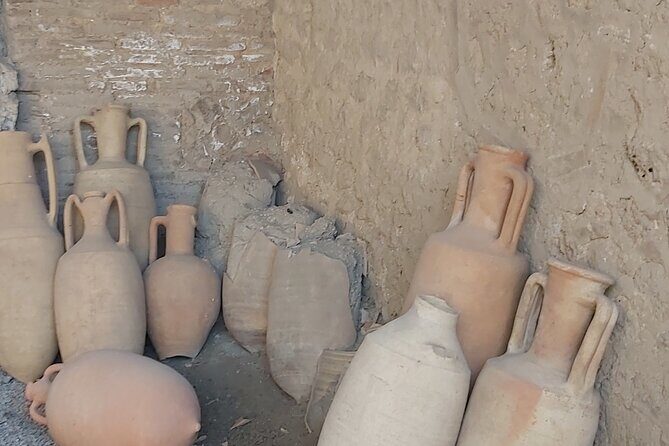
- Granai del Foro and the Foro zone: food, power, and crowd space
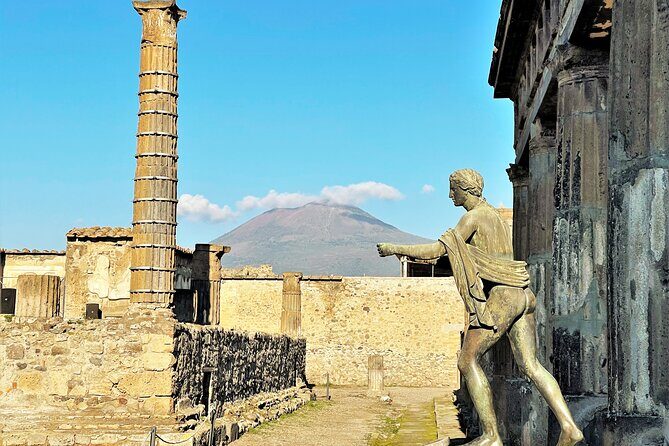
- Temple of Jupiter and the Quadriporticus of the theatres: religion meets public life
- Baths and beyond: Stabian Baths as the daily-life highlight
- Lupanar and Temple of Venus: sex, stigma, and sacred space
- The houses part: Casa del Poeta Tragico, mosaic details, and more
- Termopolio, Fullonica, and the “jobs Pompeii ran on”
- The ending temple moment: closing the loop on public identity
- What makes this tour feel worth the money
- Who this tour suits best (and who should plan differently)
- My booking advice: should you choose this private archaeologist tour?
- FAQ
- How long is the Pompeii private tour?
- Is this tour private?
- What language is the tour offered in?
- Where does the tour start and end?
- Are Pompeii entrance tickets included in the price?
- Is skip-the-line included?
- What’s included besides the guide?
- What should I bring or plan for during the walking route?
- Are meals included?
- What happens if the weather is bad?
Key highlights I’d prioritize
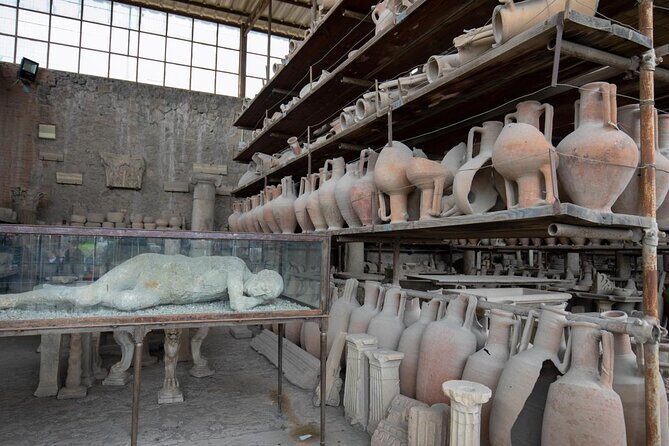
- Archaeologist-led storytelling that links buildings to daily life in AD 79
- Skip-the-line ticket office help on request in advance (ticket cost still needs your planning)
- Prime Pompeii hits in 3 hours: theatres, Forum, baths, markets, and major houses
- Private pace with time for questions and detours for comfort or views
- Stops built around people and jobs: bakers and laundry, sellers and crowds, baths and gossip
- Guides with standout energy, including names like Luisa and Eliana in past groups
First things first: the Porta Marina start makes a difference
This tour begins at Hortus Pompei, Restaurant & Garden Bar at Porta Marina Superiore. That matters more than it sounds. Pompeii is big, and having a clear start point helps you avoid the classic mistake of spending your limited time just figuring out directions.
You’ll walk through the archaeological park in one main flow, ending back near Porta Marina Inferiore. For a 3-hour visit, that “start here, end there” route is a big value. It keeps you focused on the ruins instead of spiraling into dead ends.
Since it’s private, it’s also easier to manage timing. If you want more time for a mosaic or a theatre view, you can ask for it. If you’re ready to move on quickly, your guide can keep things moving. Either way, you’re not waiting behind a crowd of strangers.
Other private Pompeii tours we've reviewed in Pompeii

Price and logistics: what you pay vs what you still buy
The rate is listed per group (shown as up to 1 participant on the option you may book). Because it’s private, you’re not paying for a “seat” in a bus tour style. You’re paying for guide time and a guided plan for the park.
Here’s the part that can trip people up: entry tickets to Pompeii are not included in the price. The tour includes assistance and ticket help, but you’ll still need to purchase the park entry ticket (the data notes pricing as 19 euros per adult and free entrance for under 18). You can also expect that the operator provides a link to buy entrance tickets in advance.
So think of it like this:
- You pay for the private archaeological guide experience.
- You separately pay the park entry fee.
- The “skip the line” benefit is about the ticket office process, and it’s only guaranteed on request in advance.
That’s exactly the kind of thing worth double-checking before you arrive. One frustrating scenario is booking the tour and assuming the park entry is bundled. If you’re clear ahead of time, you’re set.
The 3-hour route: what you’ll actually cover (and why it works)
A lot of Pompeii tours list stops. This one builds a story arc: public life first, then the spaces of work, then homes and the small everyday details that make the city feel human.
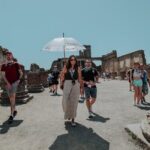
Expect a lot of walking. Pompeii is not flat, and your feet will meet steps and uneven ground. One mobility-related review flagged lots of steps and slippery surfaces, with moderate balance needed. If you’re bringing hiking poles or you know you tire fast on uneven stone, plan for slower moments. The good news is a private format makes it more workable to go at your pace.
Let’s break down the main segments you’ll see.
Stop 1 and the opening move: Porta Marina and the archaeological park flow
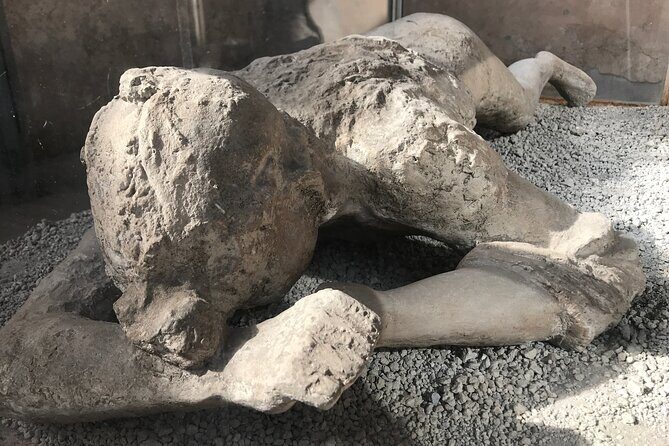
Your first stop is the Pompeii Archaeological Park, starting at Porta Marina Superiore. This is your warm-up in the best sense: your guide sets the map in your mind. Even if you’ve read about Pompeii before, seeing the entrances and the main routing helps you understand how people moved through the city.
This initial segment also gives you a quick orientation. From there, you’ll start hitting the big landmarks without feeling like you’re simply walking from one photo spot to the next.
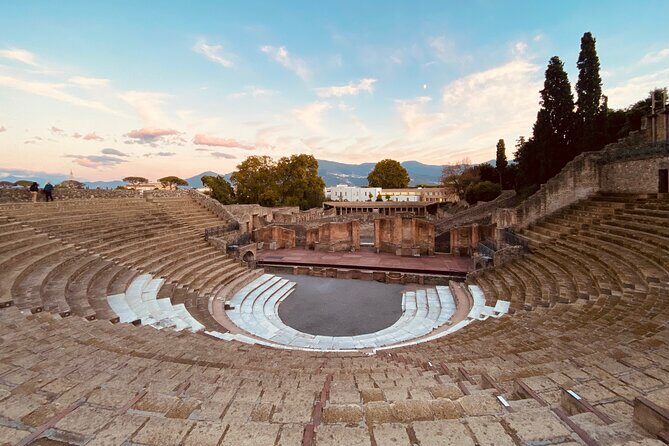
The theatres segment: Odeon, Teatro Piccolo, and Teatro Grande
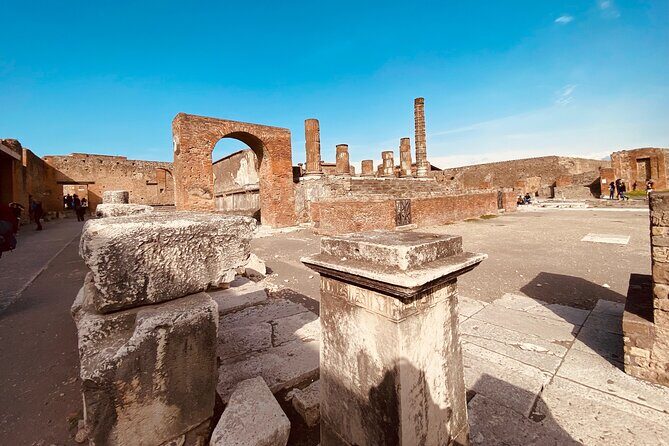
Next you’ll reach the Odeon (a small theatre) and then Teatro Grande (the large theatre). Pompeii’s theatres are more than architecture. They’re social machines: places where people gathered, listened, performed, and watched.
Your guide’s job here is to connect the building to the crowd. When the guide points out what audiences would have seen and where the drama would have landed, these theatres stop being just ruins and start feeling like a live civic space.
Practical tip: theatres give you some of your best “read the room” moments. If you’re going to ask one or two questions, this is a good time. Ask about crowd movement, entrances, and how performances might have worked.
Other skip-the-line Pompeii tours in Pompeii



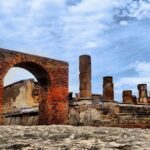
Main street time: seeing Pompeii as a moving city
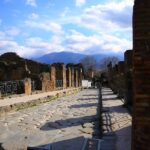
Then you’ll walk the main street of Pompeii. This part is where your understanding typically jumps. A city street is not just movement; it’s commerce, noise, passing conversations, and daily errands.
Your guide helps you notice patterns you’d likely miss on your own: where buildings face the street, how activity zones are clustered, and how the city’s layout supports public life.
This segment is also a good checkpoint for your stamina. If you’re managing energy, you can take a short pause here and reset your pace before heavier stops.
Granai del Foro and the Foro zone: food, power, and crowd space
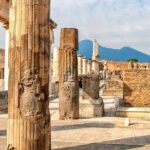
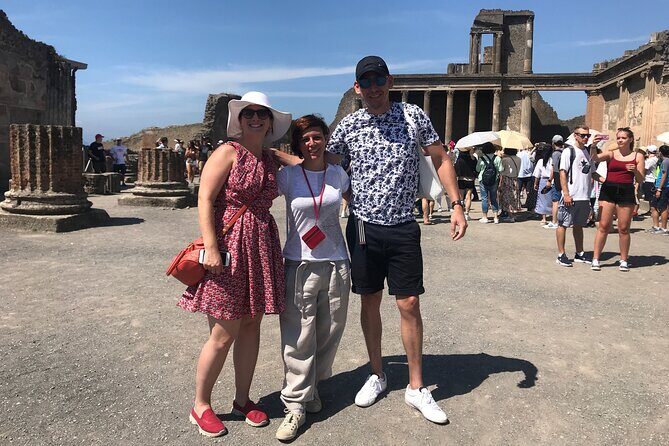
Granai del Foro (archaeological deposit) comes next, then the Forum and Pompei La Basilica (court of justice). This is the heart of civic life.
You’re not just looking at stone columns. You’re getting the logic of the city:
- granaries and storage tie into how a city feeds itself
- the Forum connects to politics, law, and public gatherings
- the basilica area points to how justice and civic administration functioned
Your guide’s explanations matter a lot here. Without them, the Forum can feel like a set of large spaces. With them, it becomes a system.
If you’re someone who likes to understand how people lived, this is one of the most rewarding stretches.
Temple of Jupiter and the Quadriporticus of the theatres: religion meets public life
After the main civic core, you’ll visit the temple of Jupiter and then the Quadriporticus of the theatres, described here as the gladiators’ barrack area.
That pairing is smart. It shows how different kinds of public ritual and spectacle touched the same zones of the city. Gladiators trained and prepared near the theatre world, and temples anchored civic identity. The guide should help you connect the “who” and “why” behind each space, not just describe what you can see.
This is also a good area for photos with context. You’ll understand what you’re photographing instead of capturing random ruins.
Baths and beyond: Stabian Baths as the daily-life highlight
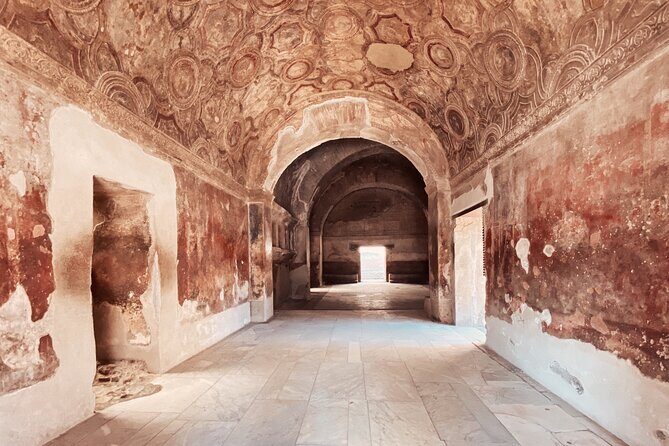
The Stabian Baths (Terme Stabiane) are next, framed as the first baths of Pompeii. Baths are a great lens because they show daily routines: hygiene, social time, and status.
When your guide explains the bath layout and how people would have used the space, you start to recognize Pompeii as a living community. It’s not just tragedy and destruction. It’s routine life—then and now.
Comfort note: baths are useful stops for learning because they often feel more “human scale” than massive temples. But you still need to watch your footing like the rest of Pompeii.
Lupanar and Temple of Venus: sex, stigma, and sacred space
Then you’ll hit the Lupanar (brothel/prostitution area) and later the Temple of Venus.
This is one of those sections where a good guide keeps things respectful while still explaining what the space was for. The value here is context: why this existed, how it fit into the city’s social structure, and what kinds of signs or layouts you’re seeing.
Afterward, the Temple of Venus brings contrast—another public identity space, but with a different purpose. Together, these stops help you understand how Pompeii held everyday realities alongside sacred and civic spaces.
If you’re sensitive about content, you can flag that to your guide. A private tour makes it easier to steer the tone and pacing.
The houses part: Casa del Poeta Tragico, mosaic details, and more
You’ll then visit Casa del Poeta Tragico, known in your itinerary notes for the cave canem mosaic. This is the kind of detail that makes Pompeii feel personal. A mosaic isn’t just decoration. It’s a message—often playful, sometimes cautionary—right at the threshold.
From there, you’ll go to Macellum (meat and fish market), Edificio di Eumachia (wool market), and then into Casa del Menandro with frescos and mosaics.
Here’s what this sequence does well:
- It shows daily work and trade (markets)
- Then it moves you into elite domestic art (homes)
- And it lets you compare what “a good life” looked like on different sides of the city
If you love art and small details, Casa del Menandro is likely to be a standout. The key is the guide’s pointing—what to look for, how the rooms were used, and what the art says about status and taste.
Termopolio, Fullonica, and the “jobs Pompeii ran on”
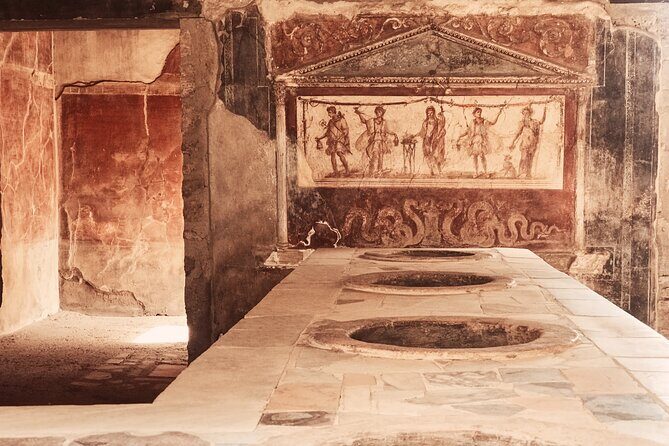
Next comes Termopolio di Vetuzio Placido, described as a take-away shop and fast food spot. Then you’ll visit Fullonica di Stephanus, the laundry.
This is where Pompeii becomes real in a way ruins alone rarely do. Food stalls and street-level commerce show what people grabbed quickly. Laundry spaces show the behind-the-scenes labor that kept clothing clean enough for daily life.
One practical win: these stops break up the more formal civic spaces. They feel like living neighborhoods, not just monumental sites. If you’re worried a tour will be all big buildings with no variety, this segment helps.
The ending temple moment: closing the loop on public identity
The itinerary includes a final “Temple” stop after the laundry area. The exact name isn’t spelled out in your notes, but the idea of the final segment is consistent: wrap up Pompeii’s public and sacred themes before you head back.
Ending near Porta Marina Inferiore also helps. You don’t have to guess how to exit or how to return. It’s built into the flow.
What makes this tour feel worth the money
For me, the value of a private Pompeii tour comes down to three things:
- time (you don’t waste it finding the right viewpoint or waiting in lines)
- context (stones become stories)
- pace control (you can slow down where it matters)
This experience leans hard into context with an archaeologist guide. Multiple guide names appear as favorites in the information you provided, including Luisa, Eliana, Amadeo, Mariagrazia, and Roberto. Across those names, the common thread is strong storytelling tied to architecture and everyday life.
You’ll also likely feel the difference compared with self-guided roaming. Pompeii is overwhelming if you’re trying to build meaning on your own, especially on a limited time window. With a guided route, your questions fit into the city’s layout instead of feeling random.
Who this tour suits best (and who should plan differently)
This is a great fit if:
- you want a structured route in about 3 hours
- you like your history explained through how people lived, not just dates
- you want to ask questions without group pressure
- you’d rather walk with purpose than wander
Plan carefully if:
- you have limited mobility or balance. Pompeii involves steps and uneven ground, and surfaces can be slippery
- you’re expecting entrance fees to be included in the tour price. They aren’t
- you’re arriving without tickets pre-planned. The skip-the-line ticket office help needs request timing in advance
My booking advice: should you choose this private archaeologist tour?
If you care about understanding Pompeii and you only have a half-day, I’d book this. The route hits theatres, baths, the Forum area, key houses with mosaic and fresco work, and market and street-life spots. That variety is exactly what makes Pompeii memorable instead of overwhelming.
Before you confirm, do one checklist item:
- buy the Pompeii entry ticket separately (the tour helps with skip-the-line ticket office timing on request, but entry fee is not included)
If you do that, you’ll spend your energy on the ruins where it counts.
FAQ
How long is the Pompeii private tour?
It’s listed at about 3 hours.
Is this tour private?
Yes. It’s a private tour, and only your group participates.
What language is the tour offered in?
It’s offered in English.
Where does the tour start and end?
It starts at Hortus Pompei, Restaurant & Garden Bar near Porta Marina Superiore. The activity ends back at the meeting point.
Are Pompeii entrance tickets included in the price?
No. The park entry tickets are not included, and the data notes 19 euros per adult and free entrance for under 18.
Is skip-the-line included?
Skip the line at the ticket office is included only on request in advance. The tour also provides a link to buy entrance tickets in advance.
What’s included besides the guide?
You get assistance before and during the tour, a private archaeologist guide, help with the main attractions, and ticket-related help such as a mobile ticket.
What should I bring or plan for during the walking route?
Expect plenty of walking, steps, and surfaces that can be slippery. Moderate balance may be needed.
Are meals included?
No. Meals and food and drinks are not included.
What happens if the weather is bad?
The experience requires good weather. If it’s canceled due to poor weather, you’ll be offered a different date or a full refund.