REVIEW · POMPEII
Pompeii Small Group with an Archaeologist and Skip The Line
Book on Viator →Operated by ELIANA SANDRETTI · Bookable on Viator
Pompeii moves fast. This small-group tour helps you see the key sights without wasting hours in line, and it’s guided by an archaeologist like Eliana Sandretti. You’ll use skip-the-line tickets and get real interpretation, not just a checklist.
I especially love the pacing. In about 2 hours you hit the big locations that usually take far longer to piece together on your own, and the group size stays small enough that questions feel normal. I also like that the tour is designed around major places with clear themes, from entertainment to homes to daily life.
The only real catch is time. Two hours is perfect for highlights, but you do not have the luxury of lingering deeply at every stop. If you want slow wandering and lots of stops for photos, you’ll probably feel a bit rushed.
In This Review
- Key highlights worth planning for
- Skip-The-Line Entry at Pompeii’s Gate, Then Get Moving
- Meet Your Archaeologist Guide (Eliana and the Stand-Ins)
- A Quick Route Through Pompeii’s Entertainment Spaces
- Small theater for music and singing
- Teatro Grande: Greek-Roman comedies and tragedies
- The Main Street Colors and the Forum Barns of the Eruption
- Cross the main street for the colors
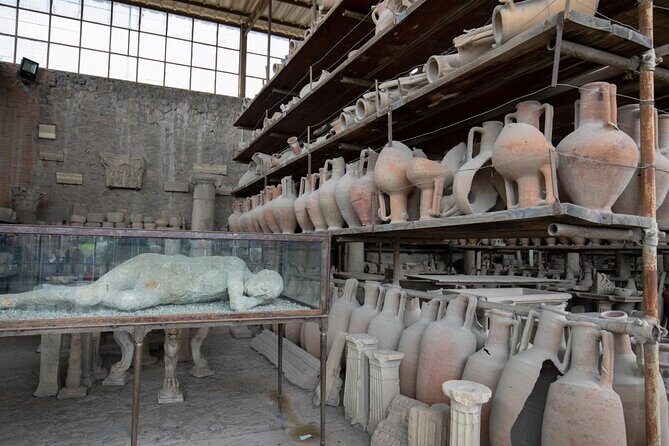
- Granai del Foro: the barns and casts of victims
- Stabian Baths Frescoes: Pompeii Through the Lens of Daily Routine
- Forum of Pompeii, Basilica, and the Temple of Jupiter Backdrop
- Foro di Pompei: the main square
- Pompei La Basilica: justice and the court seat
- Temple of Jupiter with Vesuvius in the background
- Quadriporticus and Gladiator Barracks: Training, Housing, and Reality
- Gladiator Barracks and apartments where they trained
- Lupanar and Temple of Venus: Sex, Religion, and Social Order
- Lupanar: what prostitution looked like in the city plan
- Temple of Venus: the city’s spiritual center
- Casa del Fauno: Why the Tour Ends at a Luxury Home
- Is This Pompeii Tour Worth $217.69? My Take on Value
- Who Should Book This Tour (and Who Might Feel Limited)
- Should You Book It?
- FAQ
- How long is the Pompeii small group tour?
- Is skip-the-line access included?
- Is the entrance ticket included?
- Who provides the guiding?
- How big is the group?
- Where do we meet for the tour?
- Is the tour offered in English?
- Do I need a printed ticket?
- Is food or drinks included?
- What is the cancellation policy?
- Are service animals allowed?
Key highlights worth planning for
- Archaeologist-led perspective with guides who can explain the why behind what you’re seeing
- Skip-the-line entry so you spend your energy inside Pompeii, not at the gate
- A tight route through major districts including baths, forum buildings, theatres, and homes
- Thoughtful stops tied to the eruption at places like the casts of victims in the forum area barns
- Small group size (up to 10) for a calmer experience and more back-and-forth with your guide
- Entertainment, religion, and everyday life in one pass including Teatro Grande, the lupanar, and the Temple of Venus
Skip-The-Line Entry at Pompeii’s Gate, Then Get Moving
Pompeii is famous, which means it’s crowded. What I like about this tour is that you start by taking the sting out of the day. Your ticket is handled up front, and you skip the line at the entrance, so you can get walking while your timing is still good.
The tour runs about 2 hours and loops through several high-impact areas. That matters because Pompeii is a big park, and the distance between major sites adds up quickly. When you’re on your own, it’s easy to spend half your time crossing the city and half trying to decide where to go next. Here, the route keeps the momentum.
You’ll also get a mobile ticket, and the tour ends back at the meeting point. That’s practical if you’re trying to connect with dinner plans afterward or you’re coming from nearby transport.
One more real-world detail: this is offered in English, and it’s built for most visitors. If you’re visiting with a stroller or you need smoother navigation, a small group often makes it easier to pause and regroup when the ground is uneven.
Other skip-the-line Pompeii tours in Pompeii


Meet Your Archaeologist Guide (Eliana and the Stand-Ins)
Pompeii makes more sense when someone points out the patterns. That’s the core value here: an archaeologist guide who can translate buildings and spaces into how people lived.
Eliana Sandretti is the named provider in the tour information, and multiple guides are mentioned as taking over when schedules shift. In at least a few cases, tours have been led by stand-ins such as Dario or Francesco. The important takeaway for you is this: you’re not just hiring someone to read signs. You’re getting someone who can explain what you’re looking at and answer questions while you’re still standing in front of it.
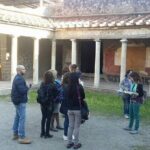
In the real world, this means you get more than dates. You get how the space worked: where people gathered, where entertainment happened, how public justice ran, what bath life looked like, and how houses reflected wealth and status. And because the group is small (up to 10), you’re more likely to get your specific questions answered instead of being politely ignored until the tour is over.
Possible listening tip: one review mentioned that it can be hard to hear at times due to surrounding noise or if the guide is further away. If you know you have hearing challenges, pick a position closer to the guide and don’t hesitate to ask them to repeat something.
A Quick Route Through Pompeii’s Entertainment Spaces
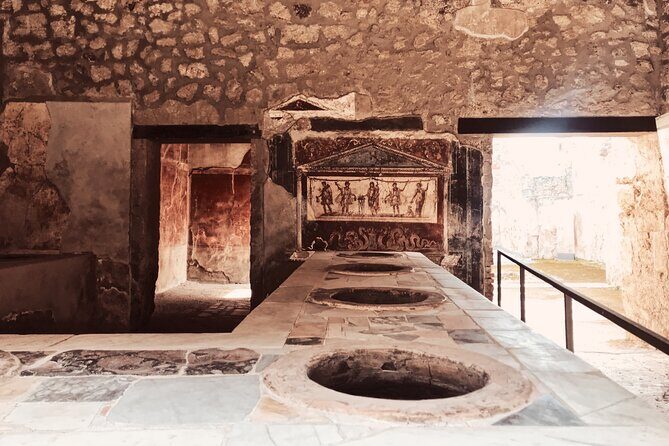
The tour starts by getting you inside Pompeii, then it moves into places that make the ancient city feel alive fast.
Small theater for music and singing
One early stop is the small theater, described as a space for musical and singing performances. This is a good first stop because it sets the tone: Pompeii wasn’t just streets and shops. It had a culture of performance, and this site helps you picture the city at night, not only in daylight.
Even if you’re not a theater person, it’s worth paying attention here. Look at the layout and imagine the scale. A small theater can feel more intimate than the big venues later on, and that’s often the point: different audiences, different kinds of events.
Teatro Grande: Greek-Roman comedies and tragedies
Next comes Teatro Grande, where Greek-Roman comedies and tragedies were performed. This is the step that turns the tour from interesting to memorable because it gives you a clear link between Pompeii and the wider Roman world.
You don’t get unlimited time at each stop, but you do get enough time to understand what kind of performances took place here and why theatres mattered socially. People came for entertainment, sure. But they also came for shared experience—an event that brought a city together.
Drawback to know: with a fast schedule, you’ll get the big story at each location, not the full museum experience. If you like reading every inscription, you’ll have to save that for later when you can slow down.
Other archaeologist-led tours in Pompeii





The Main Street Colors and the Forum Barns of the Eruption
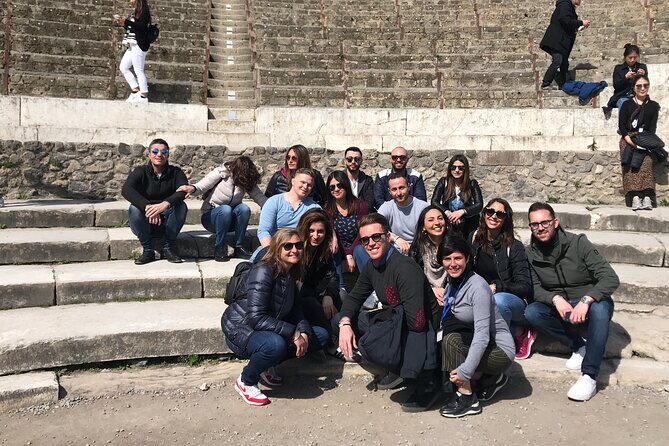
After the entertainment stops, the tour shifts into daily life and the shock of 79 AD.
Cross the main street for the colors
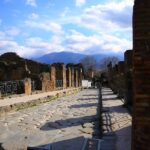
You’ll cross the main street to admire its colors. This might sound like a simple sightseeing moment, but it’s one of the best parts of any Pompeii visit because the pigments help you remember that this was not a gray ruin. When you see color still holding on to walls and facades, it resets your expectations.
It also helps you connect the city visually before you enter the darker stops later. In a short tour, building that contrast makes the emotional parts land harder.
Granai del Foro: the barns and casts of victims
One of the most powerful stops is at the Granai del Foro, the forum-area barns where there are casts of victims who died during the eruption of 79 AD. This stop is short, but it tends to be the kind you remember for years.
I recommend going in calm. Don’t rush your eyes. Take a moment to process what you’re seeing before your guide moves you on. A good guide can help you understand why the casts exist and what they reveal about the eruption’s impact.
If you’re traveling with younger kids, this is the stop where you might want to pause and decide how much detail your family is ready for. The tour moves on quickly, so plan your tone before you arrive.
Stabian Baths Frescoes: Pompeii Through the Lens of Daily Routine
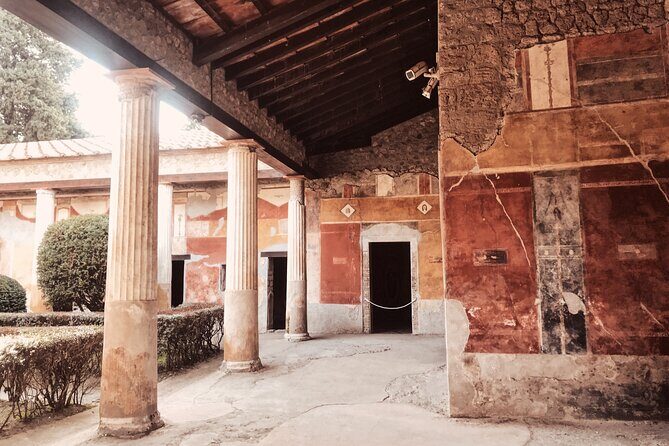
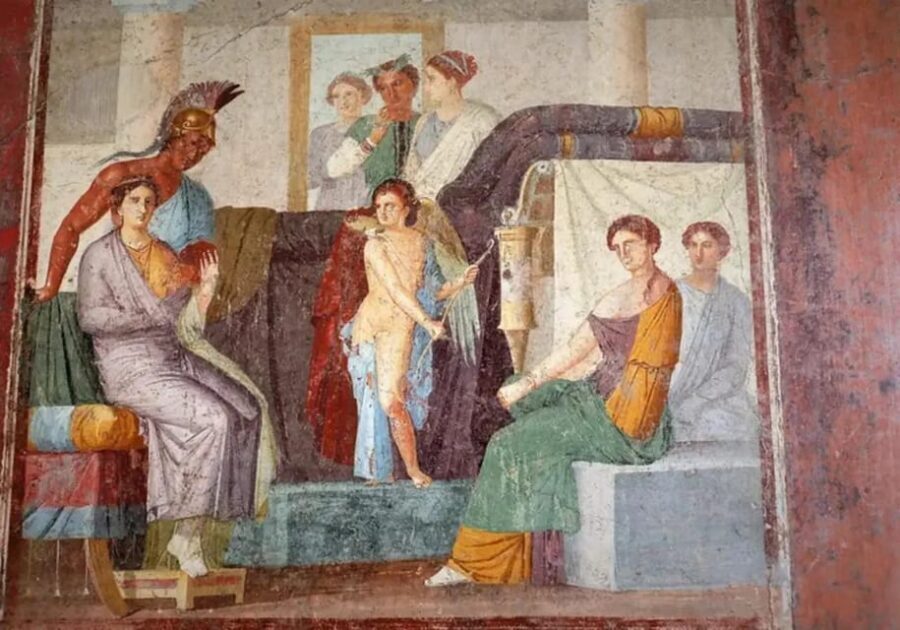
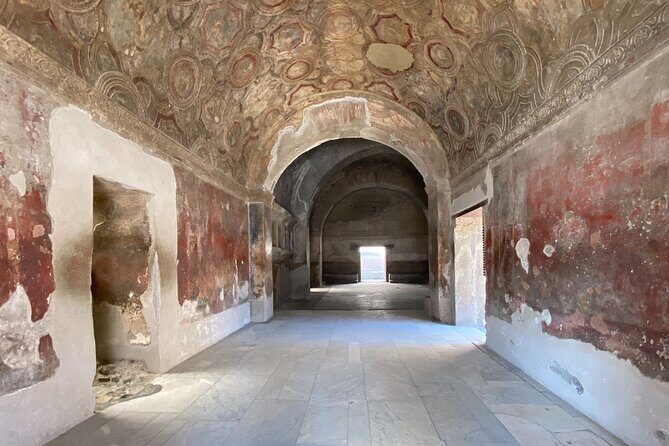
Next you’ll visit the Stabian Baths (Terme Stabiane), famous here for colorful frescoes. Baths are a great topic for a guided tour because they mix art and function. You’re not just looking at decoration. You’re looking at a place where people gathered, washed, and socialized.
The time at this stop is brief, so it’s not about staring at every inch. It’s about recognizing what the frescoes communicate and how the bath spaces shaped daily routine. It’s also a relief after some of the heavier forum material—this is a human-scale stop that feels closer to everyday life.
Practical note: Roman baths can involve uneven ground and busier foot traffic in peak season. A small group helps because you’re more likely to move smoothly together.
Forum of Pompeii, Basilica, and the Temple of Jupiter Backdrop
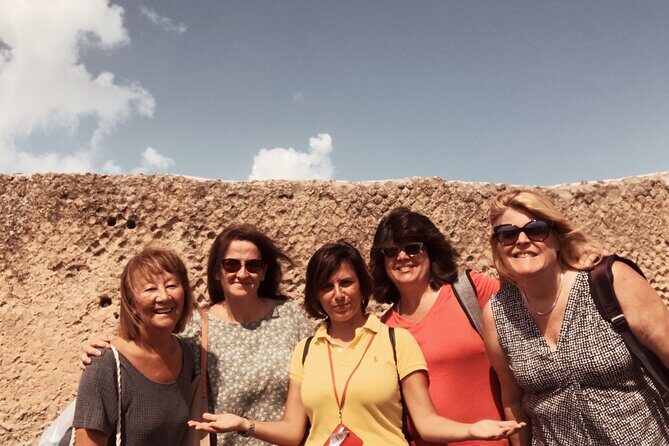
Now the route tightens around the city’s public center: where people talked, argued, judged, and worshipped.
Foro di Pompei: the main square
You’ll visit the Foro di Pompei, the ancient forum and main square. In a short tour, this is essential. Forums are the stage where civic life played out, and they help you understand the city’s priorities.
Standing in the forum area makes the rest of the tour click. You start seeing connections: entertainment districts near public life, religion woven into public spaces, and homes that reflected social ranking.
Pompei La Basilica: justice and the court seat
Next comes the Basilica of Pompeii, described as the ancient seat of the court where justice was administered. This is a stop that feels surprisingly modern. If you like the idea that the Roman world was organized and procedural, this is where you see it.
Pay attention to how a basilica functions in layout and purpose. It’s not just a big building—it’s a place built for administration and public flow. Even in ruins, you can sense the movement patterns.
Temple of Jupiter with Vesuvius in the background
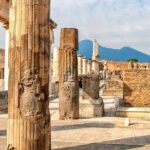
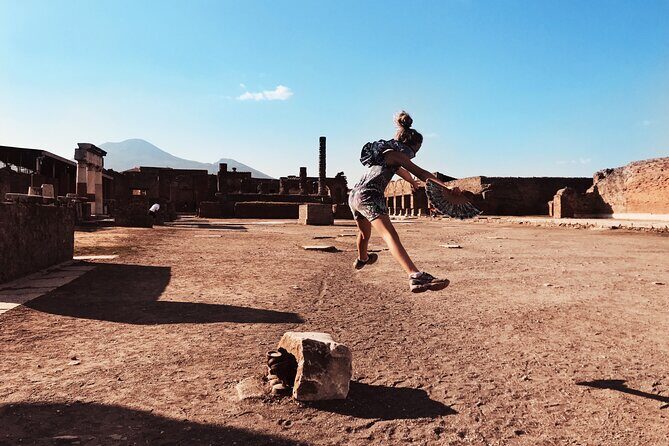
Then you’ll reach the Temple of Jupiter, with Vesuvius as the backdrop. That’s not just scenery. It helps you understand how Pompeii viewed its environment—powerful, threatening, and part of daily worldview.
This stop is short, but it’s one of your best photo moments because it gives you a clear visual anchor for why this city is always talked about in connection with the volcano.
Quadriporticus and Gladiator Barracks: Training, Housing, and Reality
The route then moves into the theatre quarter, including the Quadriporticus of the theatres and the gladiator barracks.
Gladiator Barracks and apartments where they trained
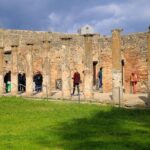
You’ll visit the gladiator barracks, where apartments and training spaces are described. This is a high-value stop because it turns gladiators from movie characters into real workers with routines, living quarters, and training schedules.
A good guide helps you imagine the daily mechanics. Where would people sleep? Where would they train? How did the spaces support discipline? Even with limited time, you can grasp the point: these weren’t fantasy arenas. They were jobs, with logistics.
If you like people-focused history, this is where you’ll feel the city as something human, not just architecture.
Lupanar and Temple of Venus: Sex, Religion, and Social Order
The tour doesn’t shy away from Pompeii’s contradictions. You’ll see the Lupanar, described as the old Red Light District, and later the Temple of Venus, where the city’s divinity was venerated.
Lupanar: what prostitution looked like in the city plan
The lupanar is understandably sensitive, and this stop can be a bit uncomfortable. But it’s also exactly why Pompeii feels real. It shows you that cities included commerce, exploitation, and social structures—not just temples and villas.
I’d treat this like an interpretive stop. The value isn’t in shock. It’s in understanding how the city layout handled this kind of activity and what it suggests about public vs private life.
Temple of Venus: the city’s spiritual center
Then the route brings you to the Temple of Venus. This is a nice counterweight because it restores the civic-religious side of Pompeii. If you’ve been mentally filing the ruins into categories like entertainment or homes, this helps you reconnect everything into the city’s belief system.
Even if you only get a quick look, the Temple of Venus gives you a sense of what people were worshipping and why it mattered socially.
Casa del Fauno: Why the Tour Ends at a Luxury Home
The final notable stop is the Casa del Fauno, one of the richest and most luxurious residences in Pompeii. This is a strong ending because it shows the other side of the city: wealth, status, and the built environment of elite life.
If you’re wondering how Pompeii could look so grand and so practical at the same time, this stop answers that. You’re no longer seeing public or semi-public areas. You’re seeing what top residents wanted for comfort, display, and identity.
This is also a good moment to review what you learned. After baths, justice spaces, theatres, and public squares, a grand home can feel like the final puzzle piece. It’s the place where you can start comparing lifestyles in your head.
One practical consideration: because the tour is timed, you won’t get the long-stay experience. But you will get the big-picture understanding needed to enjoy Pompeii later if you return on your own.
Is This Pompeii Tour Worth $217.69? My Take on Value
At $217.69 per person for about 2 hours, this is not a budget tour. So you have to buy something beyond basic access.
Here’s what you’re paying for, in real terms:
- Skip-the-line entry, which saves energy and time when Pompeii is crowded
- An archaeologist-led narrative, which turns ruins into a story you can follow
- A route that hits the highest-impact places without forcing you to plan every step
- A small group (up to 10), which helps you ask questions and move at a calmer pace
If your goal is to see Pompeii’s top ruins quickly and understand them, it’s strong value. If your goal is to wander slowly for hours, reading everything and taking many detours, you might feel better with a less structured approach.
Also, if you’re visiting during hot months, a timed route can help you manage energy. Reviews mention the heat directly, and practical prep like water, sunscreen, and a hat or umbrella can make a big difference.
Who Should Book This Tour (and Who Might Feel Limited)
This tour fits best if you:
- Have only a short window in Pompeii
- Want an expert guide instead of piecing clues together solo
- Like asking questions and getting answers while you’re standing in front of the ruins
- Appreciate a calmer pace with a small group
You might feel limited if you:
- Want to spend long hours in just one or two areas
- Prefer total freedom to go at your own speed with no planned stops
- Need very quiet, low-stimulation environments at each location (noise and hearing can vary by spot)
If you’re the type who loves planning for the best light and fewer crowds, you can also adjust your day by choosing a quieter time to roam on your own after the tour. (One tip from the wider Pompeii universe: late-day visits can feel more breathable, depending on the season.)
Should You Book It?
I think this is a great booking when you want a smart, guided hit of Pompeii’s core sights. The archaeologist approach is the main reason to go, and the skip-the-line entry is the practical reason you’ll feel glad you booked.
One last note: the tour information says weather can affect operations, and cancellation refunds are available under the stated rules. If you’re flexible and you want the biggest value for your limited time, this one is an easy yes.
If your schedule is tight, your patience for lines is low, and you want Pompeii explained clearly while you walk through it, book this tour and spend your energy inside the ruins where it counts.
FAQ
How long is the Pompeii small group tour?
The tour is about 2 hours.
Is skip-the-line access included?
Yes. The tour includes fast-track skip-the-line tickets for entry.
Is the entrance ticket included?
Yes. Admission tickets are included for the stops listed on the tour route.
Who provides the guiding?
An authorized tourist guide is included, and the experience is described as having an archaeologist guide.
How big is the group?
The group is small, with a maximum of 10 travelers.
Where do we meet for the tour?
The meeting point is Ristorante Suisse, Piazza Esedra, 10/13, 80045 Pompei NA, Italy.
Is the tour offered in English?
Yes. It is offered in English.
Do I need a printed ticket?
No. A mobile ticket is included.
Is food or drinks included?
No. Food and drinks are not included.
What is the cancellation policy?
You can cancel for a full refund up to 24 hours before the experience’s start time, following the rules provided.
Are service animals allowed?
Yes. Service animals are allowed.