REVIEW · POMPEII
Pompeii Skip-the-Line Tour – Private and limited group options
Book on Viator →Operated by Towns of Italy · Bookable on Viator
Pompeii is a time machine, and this tour works fast. You get skip-the-line entry and an English-speaking archaeologist guide who turns a huge site into a clear walking route. It’s a practical pick when you want the big highlights without losing your day in lines.
Two things I especially like: the guide-led focus on what you’re seeing, and the tight timing. You don’t just wander. You get stops that help you understand streets, public buildings, homes, and the story of 79 AD.
One possible drawback: even with skip-the-line access, there’s still a compulsory security check, so plan for a little friction at entry. And Pompeii is large, so 2 hours means you’ll need to accept that you’re seeing the main thread, not every square meter.
In This Review
- Quick highlights to know before you go
- Pompeii in about 2 hours: what you can realistically see
- Skip-the-line entry, then reality: security still takes time
- The walk inside Pompeii: gates, streets, Forum, baths, and theaters
- The story of Pompeii: why the ruins look so intact
- After the 2-hour route: where to go once the tour ends
- Who the tour format fits best (and who might feel rushed)
- Value check: is $40.43 worth it?
- Practical rules you should follow so you’re not turned away
- Guide quality: what makes this tour feel smooth
- Should you book this Pompeii skip-the-line tour?
- FAQ
- FAQ
- How long is the Pompeii skip-the-line tour?
- What does the tour cost?
- Is the tour offered in English?
- Do I get skip-the-line access?
- Is there still a security check?
- Where does the tour start?
- Where does the tour end?
- What should I wear or bring for the visit?
- Are backpacks allowed?
- Do I need identification?
- Is this tour suitable for everyone?
Quick highlights to know before you go
- Skip-the-line ruins entry plus an archaeologist guide for better context
- Small-group feel (including max 16 participants options and even private options)
- Audio devices for groups up to 5 so you can actually hear the explanations
- A route built around major zones like the Forum, theaters area, and key landmarks
- Real Pompeii perspective: ash and lapilli burial and what remains today
- Useful after-tour tips to help you explore other areas on your own
Pompeii in about 2 hours: what you can realistically see
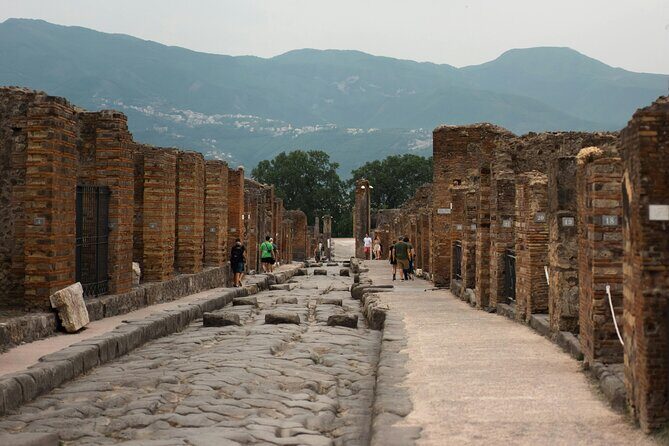
This is a focused 2-hour Pompeii walk. That time window matters because Pompeii is massive. In this format, the goal is not to hit everything. It’s to help you understand what you’re looking at, from major public spaces to residential streets.
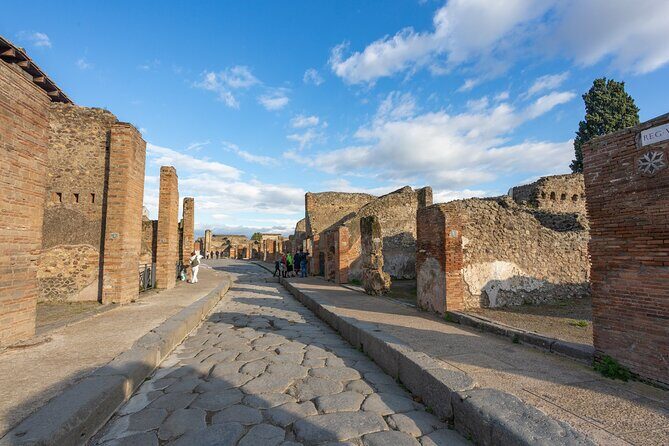
You start inside the excavated core and spend your time moving along ancient routes where buildings still show how Romans actually lived. The route is designed to give you a mental map fast—so you don’t leave Pompeii feeling like you saw a pile of old walls.
Because the tour is guided and time-limited, you get a better payoff than a casual stroll. The explanations help you connect the sights: gates, temples, workshops, civic spaces, and entertainment areas all start to look like a functioning city, not random ruins.
Other skip-the-line Pompeii tours in Pompeii


Skip-the-line entry, then reality: security still takes time

The main promise is expedited entry with skip-the-line access. That’s a big deal in Pompeii because lines can eat up your energy. It’s also why I like this tour for first-timers: it reduces the “where do we stand?” chaos and gets you moving toward the ruins sooner.
Still, Pompeii runs a compulsory security check even for skip-the-line ticket holders. So if you’re the kind of traveler who hates waiting, keep a small buffer in your mind. This isn’t a dealbreaker, just a realistic heads-up.
Practical tip: go in prepared for the rules at the gate so the check runs smoother. You’ll want your ID or passport, and you should pack smart (more on that next).
The walk inside Pompeii: gates, streets, Forum, baths, and theaters
The tour begins with Pompeii itself: the excavations and the unusually good preservation of buildings after the 79 AD burial. The guide ties that preservation to the way Pompeii was covered under ash and lapilli—reported here as up to 6 metres high. That detail matters because it explains why you can still read parts of daily life in walls, floors, and objects.
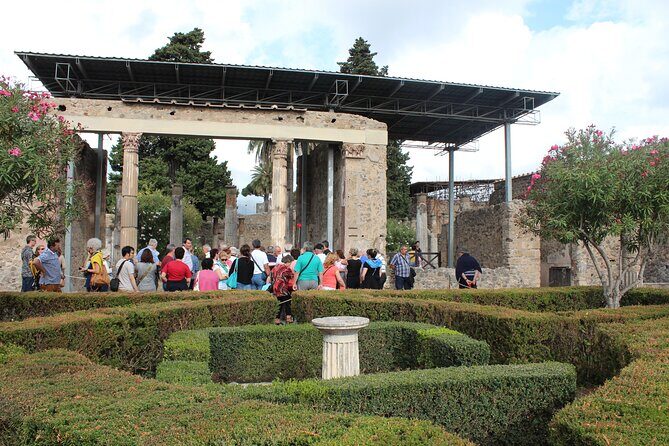
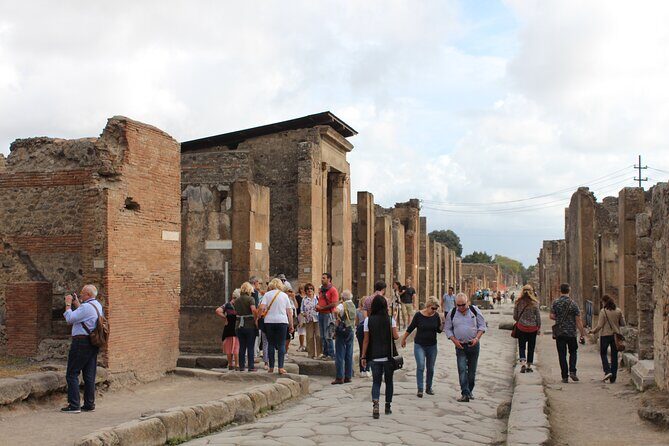
A key area you’ll move through is around major entry points and landmarks, including the Ercolano Door and the Temple of Iside area. Walking those ancient routes is where Pompeii starts to feel real. You’re not just looking at artifacts behind glass. You’re seeing the spaces they belonged to.
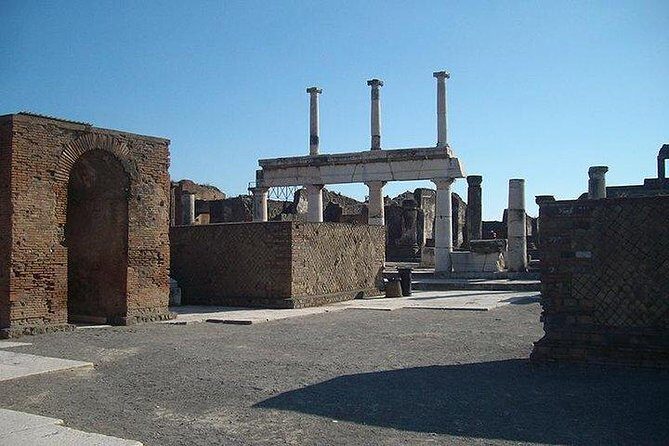
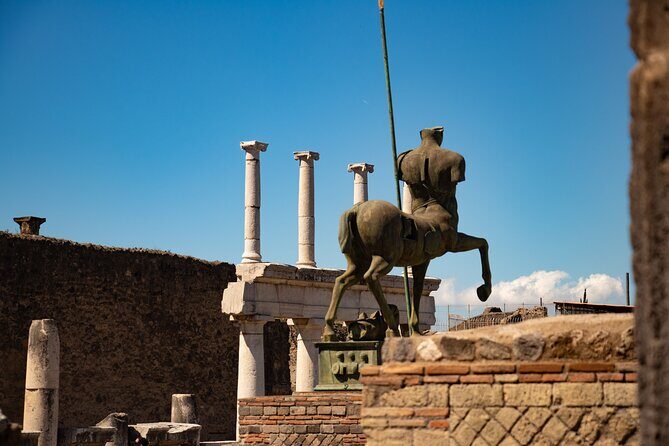
As you continue, you’ll cover a stretch that brings you past everyday Roman features: houses and workshops, public buildings, and sacred spots. You also get time in the Forum, which is where civic life focused—so it helps you understand what the city valued: governance, commerce, and community events.
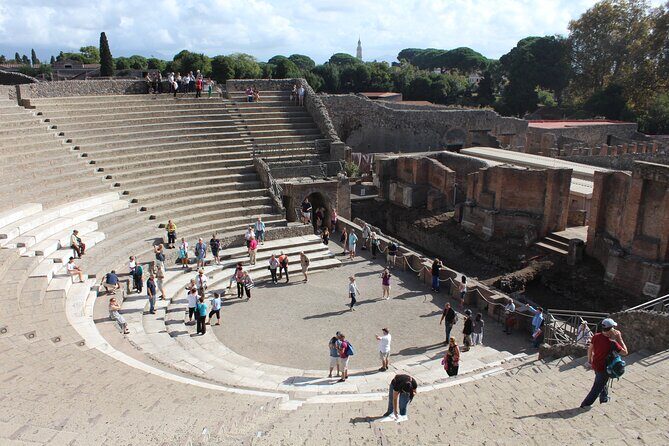
Then the tour shifts toward leisure and spectacle: the baths, the theatres area, and the amphitheatre. These stops are great because they show how social life worked. You see how Romans gathered, not just how they built.
One note on pacing: this route is built for understanding, not for slow photo stops. If you love lingering on details, you’ll need to add that time after the tour.
The story of Pompeii: why the ruins look so intact
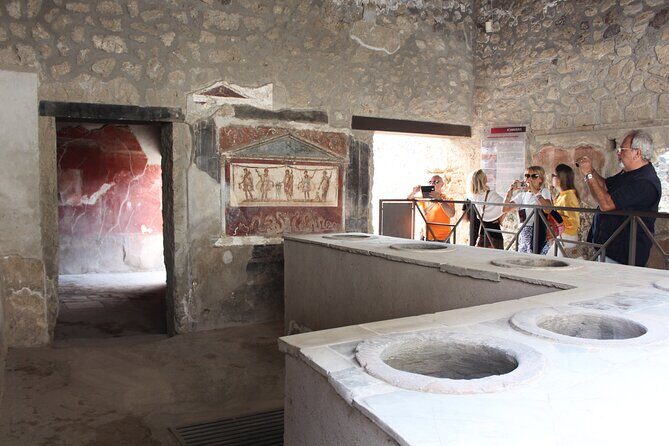
The tragedy of 79 AD is the backbone of the whole visit. Here’s the takeaway you should walk away with: Pompeii wasn’t just buried. It was buried in a way that froze the city’s physical layout and many elements of daily life.
That’s why you’ll hear about the city’s remarkable state of preservation. Many things in Pompeii weren’t carried off or destroyed by time in the same way you’d see at other sites. Instead, the burial protected them long enough for excavation to recover buildings, street layouts, and a snapshot of life.
Even though this tour is about seeing Pompeii on-site, you’ll also get context about where the best-preserved finds ended up. Evidence from Pompeii—like furnishings, mosaics, paintings, and statues—is preserved in the Antiquarium of Boscoreale and the Archaeological Museum of Naples. That’s useful to know. It helps you understand why some of what you might wish to see is actually housed in museums rather than sitting on the street.
And yes, Pompeii is UNESCO World Heritage, which is another reason the site gets protected so carefully.
After the 2-hour route: where to go once the tour ends
This tour ends back at the meeting point, so you’re set up to explore on your own right after. What’s smart here is that a good guide doesn’t just send you off with a shrug. In the experience I’m describing, the archaeologist shared recommendations beyond the exact walking loop—so you can choose where to spend extra time based on your interests.
If you want more than the core city, you’ll often hear about areas that sit outside the main excavated footprint, like four necropolises with monumental tombs and the Villa dei Misteri. Even if you don’t cover those in the scheduled time, knowing they exist helps you plan your own add-on route instead of randomly wandering.
A good mindset: treat the tour like a guided first draft of Pompeii. Then you return to the parts you personally care about most.
Other private tours in Pompeii





Who the tour format fits best (and who might feel rushed)
This one works especially well if you want:
- A short, guided orientation to Pompeii
- Expert explanation in English
- A group experience that stays manageable
Small group options matter here. The tour notes maximum 16 participants for a more personal feel, and there’s also a private option. For groups up to 5, you get audio devices, which is a practical win when you’re trying to hear a guide while walking.
It’s less ideal if:
- You need a fully accessible route (the tour is not suitable for guests with impaired mobility)
- You have heart-related concerns (not suitable for heart patients as stated)
- You dislike any security delay at entry
And because Pompeii is huge, if you’re the type who wants to photograph every corner, you may feel the schedule is tight. The upside is that you’ll leave with a clear direction for where to go next.
Value check: is $40.43 worth it?
At $40.43 per person for about 2 hours, the value comes from what’s included rather than the headline price. You’re paying for:
- Skip-the-line access to get into the ruins faster
- An expert archaeologist guide (not just a casual sightseeing guide)
- Audio devices for small groups (up to 5)
- A monolingual experience in English (or Spanish, depending on what you book)
- A more controlled group size experience (private or limited group options)
Also important: the tour lists admission as effectively free on the included ticket line (so you’re not paying separately for basic entry in the way you might on some tours).
Is it the cheapest way to see Pompeii? Probably not. But it is often a smarter way to get meaning. When the guide can explain why buildings look the way they do—thanks to ash and lapilli burial, and how public and private spaces connect—you feel your time is used well.
If you only have a short window in the area, the math gets easier: you’re buying time back, plus expert interpretation.
Practical rules you should follow so you’re not turned away
These are the “avoid a stress spiral” details. Pompeii has a dress code for entry to the Archaeological Park. That means no shirtless and no disrespectful clothing, and your entry can be refused if you don’t comply.
You’ll also want good walking shoes—skip flip-flops. Pompeii means uneven ground and long stretches on foot. Bring a hat and sunscreen, because the sun can be intense and the shade isn’t always where you want it.
Bring an ID card or passport. The tour notes that you need one for entry.
Bags matter too. You can’t bring a big backpack or intrusive objects. The limit given here is max 30x30x15, and anything outside the allowed size must be deposited in the cloakroom.
And just to avoid a surprise: pets aren’t allowed, and you can’t bring things like drones or professional optical/audio equipment. You also shouldn’t bring scooters or other unauthorized transportation.
Guide quality: what makes this tour feel smooth
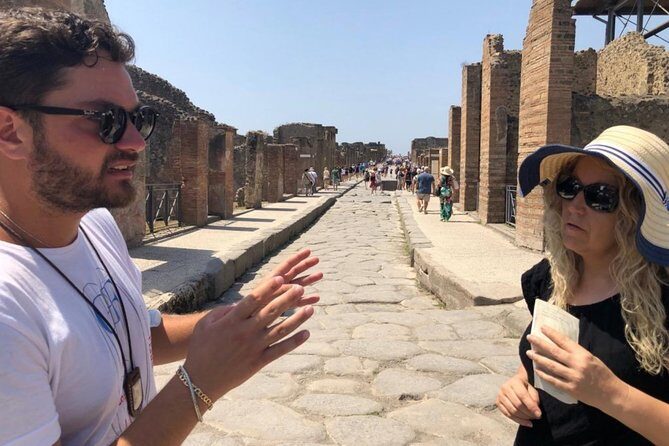
The biggest “make or break” factor in a guided Pompeii visit is the guide. In this experience, the archaeologist guidance is consistently described as clear and professional, with a fast, agile route through the site.
One guide name that comes up is Marina. The feedback around her is strong: she’s described as highly professional, with explanations that are easy to follow while still staying active on your feet. That’s exactly what you want. Pompeii can overwhelm you if the tour turns into a slow lecture. A good guide keeps you moving and keeps you oriented.
There’s also an important lesson here: tour start timing can be impacted by late participants at the beginning. One example included a delay where the group waited for late arrivals, which then pushed the start time. If you can, arrive at the meeting point with extra buffer.
Should you book this Pompeii skip-the-line tour?
Book it if you want a guided Pompeii visit that makes the site make sense in a short time. It’s a good fit for first-timers, people who want English-language expert context, and anyone who prefers a small-group experience with audio support.
Skip it or consider a different approach if you’re seeking full-day wandering, or if you have mobility or heart concerns noted as incompatible. Also, if you hate any form of waiting at security, you should know skip-the-line still doesn’t mean zero delays.
My practical take: if you have about half a day, this tour gives you the backbone of Pompeii—streets, civic spaces, entertainment zones, and the 79 AD story—so you can spend the rest of your time choosing what you want more of.
FAQ
FAQ
How long is the Pompeii skip-the-line tour?
It runs for about 2 hours.
What does the tour cost?
The price is $40.43 per person.
Is the tour offered in English?
Yes. It’s listed as offered in English, and the experience is described as monolingual in English (or Spanish).
Do I get skip-the-line access?
Yes, you get expedited entry with skip-the-line access to the Pompeii ruins.
Is there still a security check?
Yes. Even with skip-the-line entry, there is a compulsory security check that may cause some delays.
Where does the tour start?
The meeting point is Piazza Esedra, 80045 Pompei NA, Italy.
Where does the tour end?
The activity ends back at the meeting point.
What should I wear or bring for the visit?
Wear good walking shoes and plan for sun exposure with a hat and sunscreen.
Are backpacks allowed?
Big bags are not allowed. The limit given is max 30x30x15, and larger items must be left at the cloakroom.
Do I need identification?
Yes. You need an ID card or a valid passport.
Is this tour suitable for everyone?
No. It’s not suitable for guests with impaired mobility and/or heart patients, and pets are not allowed.