REVIEW · SORRENTO
Guided Tour of Pompeii and Herculaneum with Lunch and Ticket
Book on Viator →Operated by Buyourtour di Amo Italy Travel · Bookable on Viator
One day, two ancient cities, real wow factor. This guided trip is built around Pompeii and Herculaneum back-to-back, with admission included and expert storytelling that makes the ruins feel like lived-in places. I also like the Vesuvius winery lunch and tasting, because it breaks up the walking and turns the day into something you can actually taste and remember.
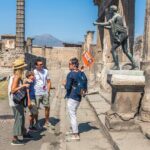
My favorite part is how the guides focus on daily life, from Pompeii’s Forum and markets to Herculaneum’s preserved houses and mosaics, with guides like Celsestina in Pompeii and Diana in Herculaneum calling out the differences that matter. Just be aware the day is intense: even with a good plan, Pompeii is famous for crowds and lines, and you’ll cover a lot of ground in summer heat.
In This Review
- Key Highlights You’ll Care About
- Pompeii and Herculaneum From Sorrento: What This Day Really Gives You
- Price and Value: $192.22 and What You’re Paying For
- Pompeii’s Forum and Civic Power: The City’s Daily Command Center
- Archaeological Park of Pompeii: the big picture, fast
- Foro de Pompeya: administration, justice, business, worship
- Tempio di Giove Capitolino: power with Vesuvius as the backdrop
- Macellum: the Roman market you can almost smell
- Via dell’Abbondanza: the main spine of the city
- Pompeii’s Social Oddities: Baths, the Lupanar, and Teatro Grande
- Stabian Baths (Terme Stabiane): daily routines in architecture
- Lupanar: Pompeii’s best-known brothel
- Teatro Grande: public entertainment with real scale
- Lunch, Wine, and Vesuvius Views: The Sorrentino Winery Break
- Switching to Herculaneum: Why This Ruin Feels Different
- House of the Deer: sea views and a name with teeth
- Casa di Nettuno e Anfitrite: mosaics made of glass paste
- Casa dello Scheletro: the skeleton house mystery
- Frescoes and Fresco-Like Drama: Augustales and the Largest House
- Sacello degli Augustali: Hercules meets Olympus in fresco form
- House of the Hotel: big enough to feel public
- Casa del Salone Nero: the black-painted party hall and tablets
- What to Wear and How to Survive the Day (Without Being Miserable)
- Who This Tour Fits Best (and Who Should Skip It)
- Should You Book Pompeii and Herculaneum With Lunch and Tickets?
- FAQ
- How long is the Pompeii and Herculaneum tour?
- Is lunch included, and what’s in it?
- Are admission tickets included for the archaeological sites?
- What language is the tour offered in?
- Do I get a mobile ticket?
- What winery stop is included?
- Is there a weather requirement?
Key Highlights You’ll Care About
- Two sites, one guided flow: Pompeii first, then Herculaneum, so you can compare immediately.
- Admission included at most stops: you spend less time hunting tickets and more time looking.
- Lunch plus wine tasting in the Vesuvius area: practical break, local flavors, and good pacing.
- Pompeii’s everyday details: baths, a brothel (yes), a market, and major streets in one sweep.
- Herculaneum’s preservation advantage: houses, mosaics, and fresco fragments still feel personal.
- Small-group feel (up to 100): not tiny, but built to keep you moving.
Pompeii and Herculaneum From Sorrento: What This Day Really Gives You
This is the kind of day trip that makes sense if you’re short on time but hate the idea of choosing only one site. Pompeii gives you scale—big streets, major civic buildings, and the city’s layout on display. Herculaneum is smaller, but its preservation is the star. Put them together and the contrast lands fast.
The tour runs about 9 hours, and the pacing is designed around two main ruin blocks: roughly 2 hours in Pompeii and 2 hours in Herculaneum. That means you’re not stuck in one place staring at the same courtyard too long. You’ll see the big highlights, plus enough texture to feel like you understand what you’re looking at.
You’ll also start from Sorrento, which is convenient if you’re staying there (or nearby). The itinerary is operated in English, and a guide may be multilingual. Plus, you’ll have a mobile ticket, which is handy when you’re juggling heat, photos, water, and your brain trying to remember which century you’re in.
If you're still narrowing it down, here are other tours in Sorrento we've reviewed.


Price and Value: $192.22 and What You’re Paying For
At $192.22 per person, this isn’t a bargain-style outing. You’re paying for two things: (1) guided entry and interpretation across two major archaeological parks, and (2) lunch with a structured winery stop.
Here’s what helps the value feel real:
- Tickets/admission are included for the listed sights (with a couple stops marked free).
- The day includes a winery visit plus a tasting.
- Lunch is covered, with a set menu and a glass-like tasting structure (Prosecco plus red and white).
- The schedule is built to keep you from spending hours planning routes between Pompeii, Herculaneum, and lunch.
If your goal is to maximize your time—especially if this is your first visit—this price starts to feel fair. If you prefer slow, self-guided wandering and you’re the type who reads every plaque for an hour, you might find the structure a bit “busy.” For most people, it lands right.
Pompeii’s Forum and Civic Power: The City’s Daily Command Center
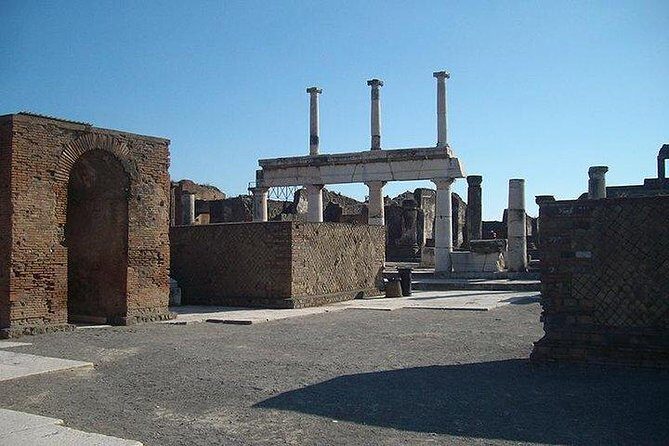
Pompeii hits hardest when you understand it wasn’t just houses and streets. The tour starts you where the city ran: the Forum and surrounding civic spaces.
Archaeological Park of Pompeii: the big picture, fast
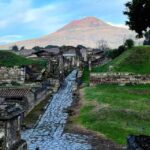
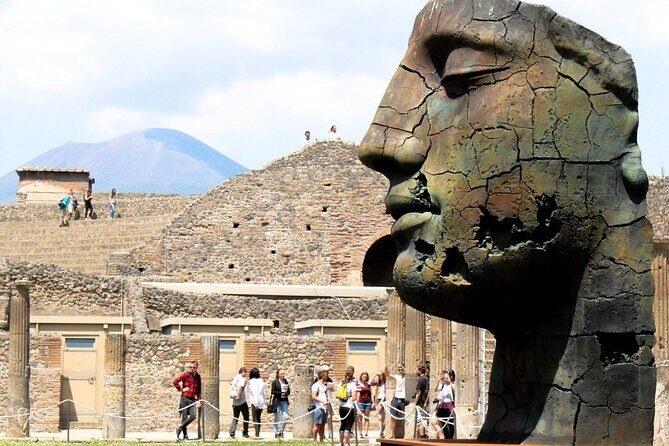
You begin in the Archaeological Park, where the city was buried after the eruption of Mount Vesuvius in 79 AD. The site sprawls, but guided time helps you avoid the common mistake: wandering without a sense of what matters first. With a guide calling out the layout, you’ll spend your energy on the places that explain how Pompeii worked.
The included ticket here is important. The park can be crowded, and you don’t want to lose your momentum waiting. Even when crowds happen, the group format helps you enter and orient efficiently.
Foro de Pompeya: administration, justice, business, worship
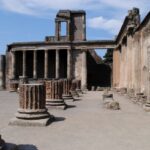
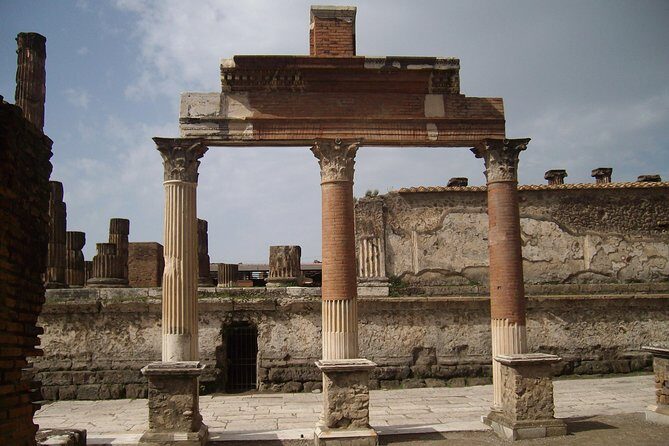
Next comes the Foro de Pompeya, the civil forum that served as the heart of daily life. This is where public administration, justice, and business activities were managed, with markets and worship areas nearby. The main lesson: Pompeii’s civic space wasn’t separate from everyday life—it was everyday life.
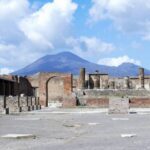
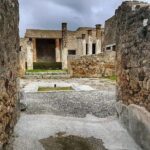
Tempio di Giove Capitolino: power with Vesuvius as the backdrop
Then you move to the Temple of Jupiter (Tempio di Giove Capitolino). What’s striking is the visual setup: Jupiter’s temple on the Forum’s northern side, with Vesuvius rising behind it. The temple was renovated after the colony period (around 80 BC) and became a kind of local Capitolium, with cult statues of Jupiter, Juno, and Minerva placed on a high base so they could be seen across the Forum square.
If you like symbolism and how buildings communicate authority, this stop is worth pausing longer. Even a short pause here helps the rest of Pompeii click.
Macellum: the Roman market you can almost smell
The Macellum was the city market. The layout includes a tuff quadri-porticus (a four-sided portico) and an elevated hall for worship aligned with the entrance. Markets can sound boring until you realize this one was designed to handle crowds without turning the Forum into a traffic jam.
One of the best practical details: the portico walls were decorated with scenes of daily selling—think fish and poultry—plus mythological subjects. It’s where food, commerce, and culture all mixed in one place.
Via dell’Abbondanza: the main spine of the city
Finally, the tour covers Via dell’Abbondanza, Pompeii’s main street connecting the Forum to the Amphitheatre. It’s basically your “walk the city’s rhythm” moment. If you want a sense of motion—how people moved from civic life to entertainment—you’ll feel it on this stretch.
Pompeii’s Social Oddities: Baths, the Lupanar, and Teatro Grande
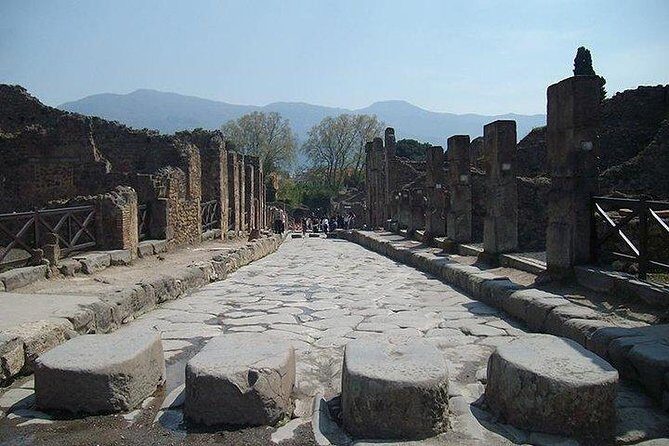
This is the part where Pompeii stops being abstract and turns human. Not gentle human. Human with opinions, gossip, exercise, errands, and yes, sex work.
Stabian Baths (Terme Stabiane): daily routines in architecture
The Stabian Baths show how bathing was more than hygiene. The baths had phases of construction going back to the 4th century BC, and the surviving major structure you see is from later building and renovation, including a major wave around the 2nd century BC.
You’ll learn how people moved through bathing zones: from the apodyterium (changing) to the frigidarium (cool room), then tepidarium (warm), and finally the calidarium (hot). Heating came from pipes in the walls and hot air circulating through double floors, fed by furnaces and braziers.
The tour’s description also makes a key point: people didn’t just bathe. They discussed politics, battles, trials, and women. So when you stand in a bath complex, you’re standing in a social network too.
Practical note: baths are physical spaces. Even with guides, it’s still walking. Good shoes matter.
Lupanar: Pompeii’s best-known brothel
Then comes the Lupanar, Pompeii’s brothel with erotic paintings. It has two floors: living spaces for the owner and enslaved workers at the top, and built-in bed rooms below. The building name connects to the Latin word for prostitute (lupa).
This stop can be intense if you’re not expecting it. But it also explains why Pompeii still feels like real life instead of staged history. You’re seeing how different social systems worked—harshly, directly, and without modern euphemism.
Teatro Grande: public entertainment with real scale
The day continues to Teatro Grande, built around the mid-2nd century BC and restored in the Roman style. It hosted comedies and tragedies from Greek-Roman traditions. A neat bonus detail: it was one of the first large public buildings freed from eruption deposits, so it offers a strong sense of scale and design.
If you’ve ever wondered how “public life” looked in ancient cities, this is your answer. It’s not a private house. It’s a community stage.
Lunch, Wine, and Vesuvius Views: The Sorrentino Winery Break
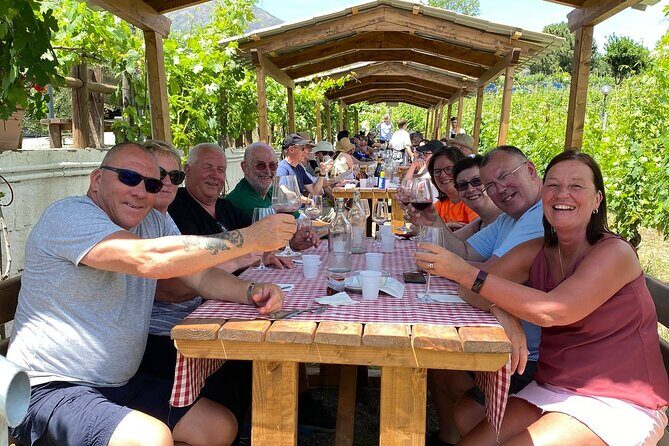
At some point you need food and a reset. That’s where the Sorrentino winery stop fits the day. It’s also where you get the Vesuvius connection in a way ruins alone can’t.
Sorrentino Vini was founded in 1990 by Paolo Sorrentino and now has 35 hectares of property within the Vesuvius National Park. The tour notes Lacryma Christi as the most famous wine from Vesuvius, and that it’s the only DOC product produced on Vesuvius.
Lunch is part of the package, and it’s not just a random sandwich:
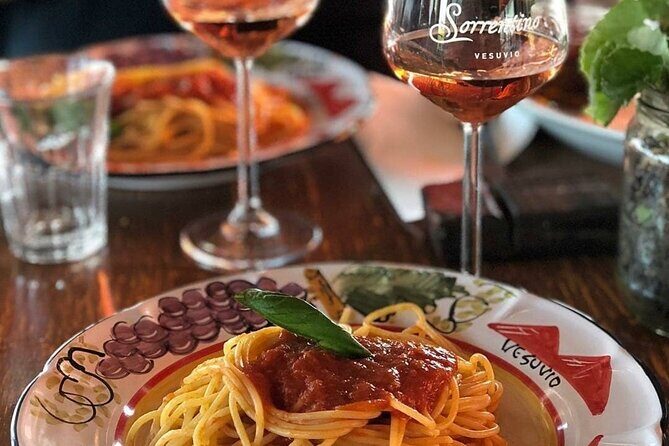
- Starter: bruschetta, cured meats, cheeses, and seasonal vegetables
- Wine tasting: Prosecco plus red and white
- Main: pasta with Piennolo cherry tomatoes, a local specialty
- Dessert: traditional homemade dessert
This stop also helps you later in Herculaneum. When you’ve eaten and had water, the ruins stop feeling like a marathon and start feeling like an experience.
Switching to Herculaneum: Why This Ruin Feels Different
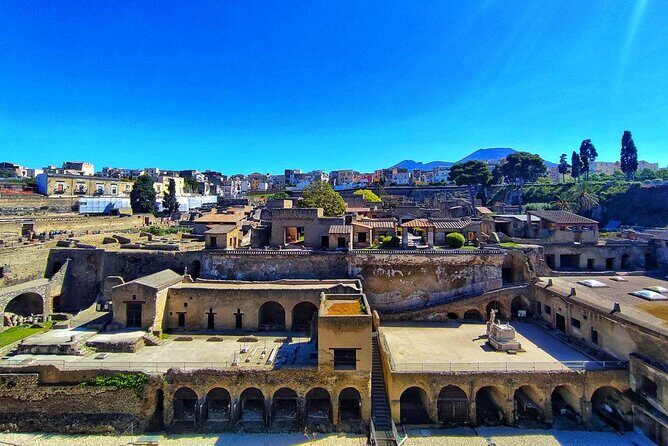
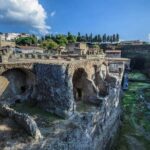
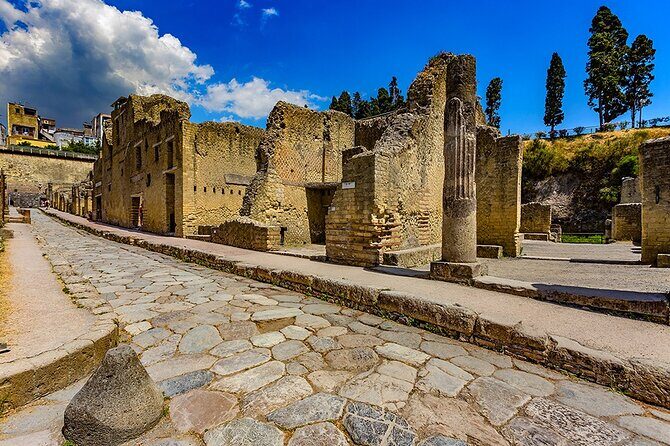
When you move from Pompeii to Parco Acheologico Di Ercolano, the mood changes. Herculaneum was also buried after the eruption, but the site is described as still perfectly preserved and that’s the point. The streets, houses, and villas are there in a way that feels more intimate.
Also, the scale is different. Herculaneum is easier to “read” with a guide because the preserved elements can be more specific to daily living and interior design.
House of the Deer: sea views and a name with teeth
In Herculaneum you visit the House of the Deer, a luxurious home with a sea-view terrace. It belonged to Q. Granius Verus, a slave freed shortly before the city’s destruction. The house gets its name from garden statues of deer being assaulted by dogs.
This is one of those stops where you’ll notice the emotion in the art. It’s not just decoration. It’s storytelling you can walk around.
Casa di Nettuno e Anfitrite: mosaics made of glass paste
Next is Casa di Nettuno e Anfitrite, known especially for mosaics in glass paste—expensive for the time. You’ll see floral and hunting scenes, plus a central mosaic featuring Neptune and Amphitrite.
This is where you learn something important about ancient taste: this wasn’t minimal living. Even wealthy visitors valued visual impact and color effects.
Casa dello Scheletro: the skeleton house mystery
The Casa dello Scheletro is named for human remains found in 1831 in a second-floor room. The site’s explanation says it likely came from combining three smaller buildings. So the house itself is a clue: not only about the household, but about the way structures evolve.
If you like archaeological detective work, this stop gives you a narrative hook.
Frescoes and Fresco-Like Drama: Augustales and the Largest House
Herculaneum also includes more civic-religious spaces, plus the kind of grand home that changes your idea of what “normal” was.
Sacello degli Augustali: Hercules meets Olympus in fresco form
The Sacello degli Augustali sits near the forum and was built when Emperor Augustus was still alive. It has a quadrangular plan and preserves frescoes showing Hercules entering Olympus alongside Jupiter, Juno, Minerva, and Hercules against Achelous.
The tour notes something eerie: a janitor’s skeleton was found in his room lying on the bed. It’s a stark reminder that these buildings weren’t “sets.” People lived here, and the end was sudden.
House of the Hotel: big enough to feel public
Then you visit the House of the Hotel, located on the edge of the hill for a panoramic position. The house is described as the largest house of Herculaneum discovered so far, at about 2,250 square meters, and it was considered like a hotel at first because it owned a spa district.
This stop is a good reality check: wealth and status in Roman towns weren’t only about art on walls. It was also about space, facilities, and amenities.
Casa del Salone Nero: the black-painted party hall and tablets
The day ends with Casa del Salone Nero, famous for a party hall painted entirely in black with geometric patterns. The tour also points you to an archival clue: waxed tablets of L. Venidius Ennychus, said to be the supposed owner, were found there.
Those tablets speak of eligibility for Augustale, the purchase of a slave, and the birth of a daughter. That last part matters. It turns the art and architecture into a story about decisions, status, family, and law.
What to Wear and How to Survive the Day (Without Being Miserable)
This kind of day trip rewards preparation. The summer advice is simple and it works:
- Wear comfortable shoes
- Bring sunglasses and sunscreen
- Expect heat and walking, especially in Pompeii
- Plan for the day’s duration and timing to vary due to local traffic conditions
Also, since you’ll be moving between parks and a winery, bring a small day bag with essentials. You want to stay flexible if the schedule shifts by a bit.
One more practical thought: Pompeii is known for crowds. Even with good ticketing setups, you may still run into bottlenecks. Your best defense is mental. Don’t fight the line. Use the time to get oriented, then commit when you’re inside.
Who This Tour Fits Best (and Who Should Skip It)
This tour is a strong match for you if:
- You want to see both Pompeii and Herculaneum and you have one full day
- You like guided interpretation that explains daily life, not just ruins
- You appreciate a planned break with lunch and wine tasting
- You’re okay with a full itinerary where you’ll see many highlights rather than deep study of one building
It may be less ideal if:
- You hate rushed walking and want a slow, self-paced visit
- You’re especially sensitive to crowded sites (Pompeii can be intense)
- You strongly prefer to avoid adult subject matter like the Lupanar
Should You Book Pompeii and Herculaneum With Lunch and Tickets?
I’d book it if your priority is maximum value from a single day. Two major sites, structured pacing, and included entry are the big wins. Add lunch plus a winery tasting on the Vesuvius side, and you’re not just doing ruins—you’re doing a full local day.
I’d think twice if you’re the type who wants to linger for hours in one place or you know you hate crowds and don’t cope well with heat. In that case, a slower plan might suit you better.
Bottom line: if you want an efficient, well-explained day that covers the essentials of Pompeii and the preservation magic of Herculaneum, this is a solid choice.
FAQ
How long is the Pompeii and Herculaneum tour?
The tour runs about 9 hours.
Is lunch included, and what’s in it?
Yes. Lunch includes bruschetta, cured meats, cheeses and seasonal vegetables; a tasting of three wines (Prosecco, red, and white); pasta with Piennolo cherry tomatoes; and a traditional homemade dessert.
Are admission tickets included for the archaeological sites?
Admission tickets are included for most listed stops, with a few stops marked free.
What language is the tour offered in?
The tour is offered in English, and it may be operated by a multilingual guide.
Do I get a mobile ticket?
Yes. The tour includes a mobile ticket.
What winery stop is included?
You’ll visit Sorrentino Winery, where the tour notes the Lacryma Christi wine and provides tastings as part of the lunch experience.
Is there a weather requirement?
Yes. The experience requires good weather. If it’s canceled due to poor weather, you’ll be offered a different date or a full refund.