REVIEW · POMPEII
Pompeii tour with archaeologist
Book on Viator →Operated by Pina Esposito · Bookable on Viator
Pompeii clicks when you hear the archaeology. This tour strings together the Forum, the big public buildings, and the private houses so you don’t just see ruins, you understand how Pompeii worked right up to 79 AD. I especially like the small group size (max 15) and the way the guide connects what you’re standing in front of to daily life and the eruption story. The main catch: the schedule is packed, with many stops at 5 to 15 minutes, so you’ll have to accept a brisk pace and pick where you want more time.
At $42.01 per person for roughly 2 hours 30 minutes, it’s a solid value if you want structure instead of wandering and guessing. You’ll get a mobile ticket and guidance in English (also Italian or German). One consideration: entrance fee and meals aren’t listed as included, so you should plan your budget around Pompeii admission and bring water for the walk.
The good part for independent explorers is where it ends. The tour finishes at the Pompeii Forum, so if you want, you can stay inside the excavations and keep going at your own speed after your guided route ends. Since the experience depends on weather, aim for a day with good visibility so details don’t get lost in glare or rain.
In This Review
- Key highlights to notice on the walk
- Why a Pompeii archaeologist guide makes the ruins make sense
- Route overview: Villa dei Misteri start and Forum end
- Foro di Pompei: the civic heart and the 79 AD story
- Granaries del Foro: stored goods and the plaster-cast evidence
- Basilica and Temple of Apollo: power, religion, and monumental design
- Hotel Vittoria gateway and the Cave Canem mosaic
- Casa del Fauno: the bronze dancing Faun and the Battle of Alexander mosaic
- Thermopolium: ancient fast-food and what people actually ate
- Temple of Vespasian, imperial cult, and Via dell’Abbondanza street planning
- Teatro Grande and Teatro Piccolo, plus older temples and the Doric layer
- Stabian Baths and the Lupanar: relaxation and scandal with context
- Price and what’s actually included for $42.01
- Who should book this Pompeii archaeologist tour
- Should you book this Pompeii tour with an archaeologist?
- FAQ
- How long is the Pompeii tour?
- What does the tour cost?
- What languages are available?
- Where do we meet and where does the tour end?
- What ticket type is used?
- Is the entrance fee included?
- What happens if the weather is poor?
Key highlights to notice on the walk
- Pina Esposito as the archaeologist guide: a teacher-style approach that makes the site easier to follow.
- Foro di Pompei + Granai del Foro: the civic center plus the storage area tied to major eruption evidence, including victim plaster casts.
- Big-ticket houses and mosaics: the House of the Faun with the bronze dancing Faun and the Battle of Alexander mosaic.
- Everyday-life stops: a well-preserved thermopolium (ancient fast-food) and the city’s street plan along Via dell’Abbondanza.
- Public entertainment and older layers: Teatro Grande/Teatro Piccolo, plus the Doric Temple and the Triangular Forum.
- A full range of Pompeii life: from the Stabian Baths to the Lupanar, with historical context rather than shock value.
Why a Pompeii archaeologist guide makes the ruins make sense
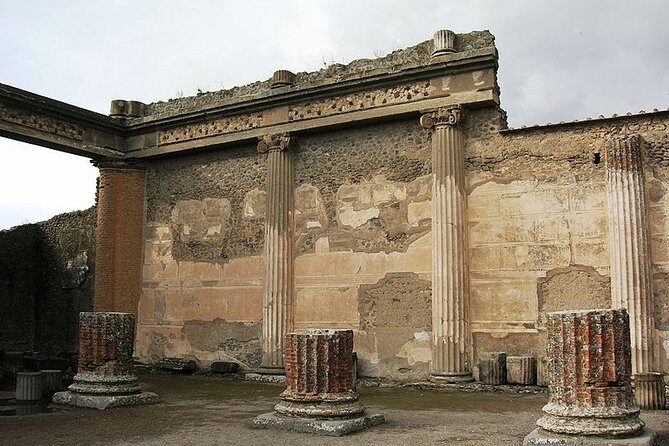
Pompeii can feel like a maze. Even if you love history, the stones don’t automatically explain themselves. A trained archaeologist guide helps you read the site like a city, not a pile of leftovers.
This tour is built around interpretation. You’ll hear what each space was for, who used it, and how the eruption changed everything. That matters because Pompeii is not one single story. It’s politics and religion, shopping and food, leisure and social status, all in the same compact footprint.
I also like the teaching style that keeps things accessible. Expect clear narration and plenty of chances to ask questions. One reason this tour gets such strong praise is that the guide doesn’t just point. She explains what you’re looking at, then helps you connect the dots so the place feels coherent.
Finally, the pacing is realistic. You get to cover a lot of ground in 2 hours 30 minutes, but the stops aren’t random. Each one supports the next, so you don’t leave with a list of famous monuments. You leave with a better sense of how Pompeii functioned as a living city.
Other archaeologist-led tours in Pompeii

Route overview: Villa dei Misteri start and Forum end
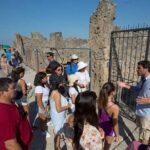
Your meeting point is at Pompei Scavi (Villa Dei Misteri area), and the tour ends at the Forum. That single fact changes how you plan your day. You’re not starting at the main square and then backtracking across half the site. Instead, you move through Pompeii’s most interpretive zones and then finish where you can continue exploring on your own.
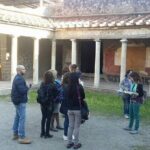
Group size is capped at 15 travelers, which is a big deal here. Pompeii can get crowded, and narrow walkways slow larger groups down. A smaller group tends to keep momentum, so you can actually cover all the planned highlights.
The tour is also designed for a “you want the essentials” visitor. In a single morning/afternoon block, you’ll hit major civic spaces, key temples, household masterpieces, and daily-life corners like baths and a thermopolium. If you try to do all of that on your own, you usually end up stuck in the weeds of signage and endless plaques.
One practical note: with several stops around 10–15 minutes, you’ll want to be ready to move. If you love ultra-slow museum-style viewing, treat this as a foundation tour. Then, after you finish at the Forum, you can circle back to your favorite area.
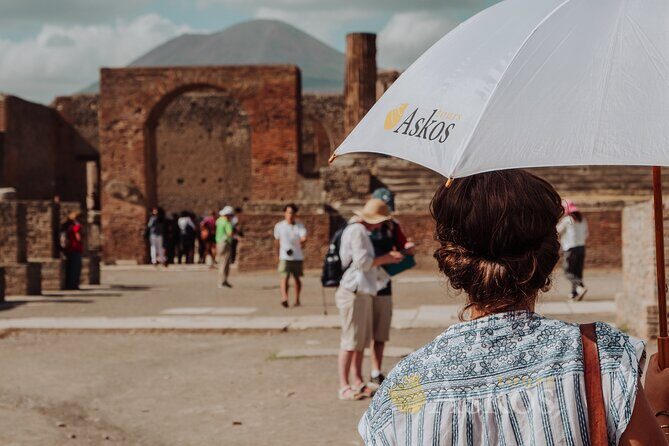
Foro di Pompei: the civic heart and the 79 AD story
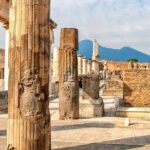
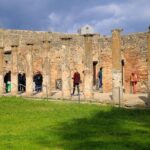
The tour kicks off at Foro di Pompei, the city’s public center. This is where you get the big timeline: Pompeii’s origins, its rise as a Roman town, and the eruption in 79 AD that turned everyday streets into preserved evidence.
Here’s what I’d watch for if you’re the type who likes to “read” architecture. The Forum is not just dramatic because it’s famous. It’s dramatic because it shows the city’s hierarchy—where authority expressed itself, where public announcements and ceremonies would have played out, and where people moved between civic life and commerce.
This stop works best if you let the guide set the frame before you start zooming in on details. If you jump straight to one corner monument, it’s easy to miss how the Forum functioned as a hub that connected everything else you’ll see later.
The main drawback of a Forum-first approach is that it can feel abstract if you’re still orienting yourself. Stay patient. Once you’ve heard how the public spaces connect, the later stops—basilica, temples, street layout—become much easier to place.
Granaries del Foro: stored goods and the plaster-cast evidence
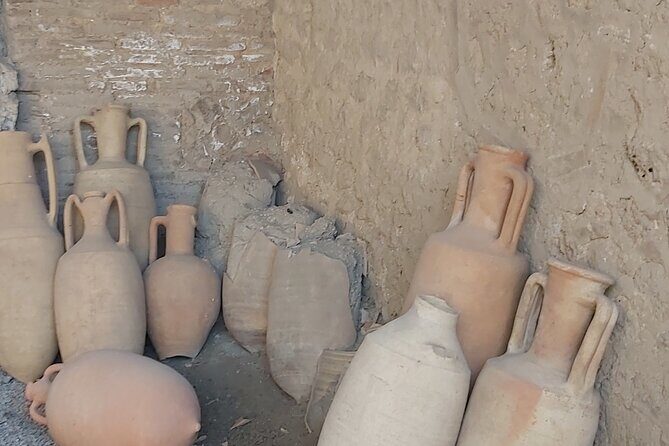
Next comes Granai del Foro, the Granaries of the Forum. This area is useful because it shifts you from ceremonies to logistics. A city survives on systems: storage, transport, and distribution. Granaries were essential infrastructure, and Pompeii’s preserved material helps explain how that system worked.
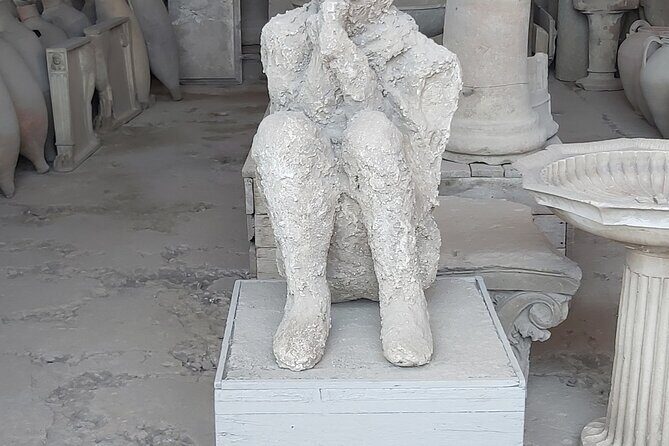
You’ll also learn about finds associated with the space, including amphorae and other objects, plus inscriptions and sculptural elements. The standout, though, is the guide’s explanation of the plaster casts of victims. It’s heavy material, and you’ll want the context to avoid gawking or numbness.
What I appreciate about covering this early is that it gives a human anchor. After that, when you look at daily-life scenes—food, baths, entertainment—you understand those were lived realities, not just background for tragedy.
Basilica and Temple of Apollo: power, religion, and monumental design
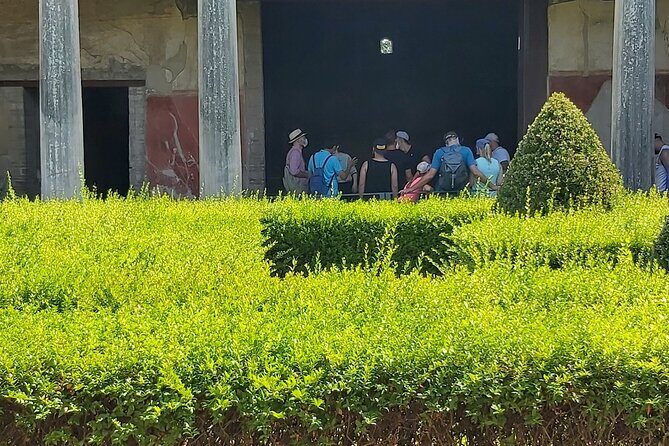
The tour moves to Pompei La Basilica, one of the most spectacular monumental buildings in the city. A basilica in Roman urban life wasn’t just about worship; it’s tied to administration and civic business. You’ll hear what it was used for and why its scale mattered.
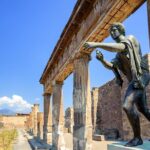
Then it’s off to the Temple of Apollo, a site rich in original finds. You’ll get a guided look at elements such as sculptures and altar features, plus inscriptions and columns. Even if you don’t catch every label, the key idea is this: Roman religious architecture wasn’t just spiritual decoration. It helped stage public identity and community beliefs.
If you like architecture, this is a good section to slow down mentally. Think about how people would have approached the temples, where visibility mattered, and why sundials and fountain-like features weren’t random extras. The guide’s job here is to connect function and symbolism, and it’s one of the most satisfying parts of the route.



Hotel Vittoria gateway and the Cave Canem mosaic
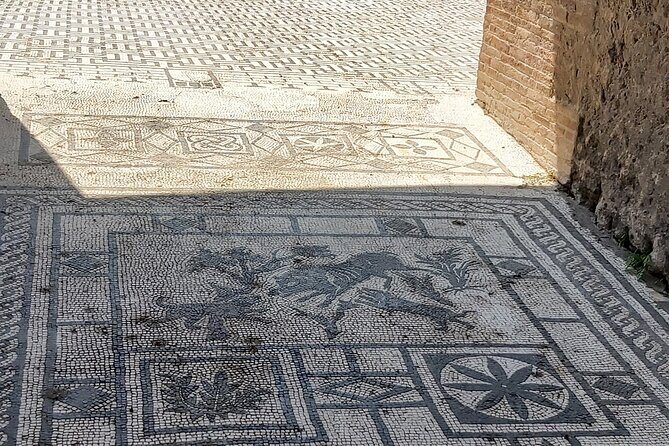
A shorter stop comes next at Hotel Vittoria, described as an ancient gateway to the city and the surrounding area. Even with a brief time slot, a gateway stop helps you understand movement. Pompeii wasn’t a set of disconnected monuments. It was a street system with thresholds.
After that, you’ll see the mosaic of the Cave Canem at the entrance of the House of the Tragic Poet. This is one of those Pompeii moments that makes you smile, even though you might also feel the context creep in. The warning against a dog isn’t only funny; it’s a glimpse of domestic identity and the language of household space.
This is also a great stop for learning how to look at mosaics in general. Don’t just note the image. Notice where it sits and what it would have meant to visitors entering a home. A mosaic at a doorway isn’t neutral. It’s a message.
Casa del Fauno: the bronze dancing Faun and the Battle of Alexander mosaic
If there’s one stop that Pompeii fans talk about for a reason, it’s Casa del Fauno. This is the largest house in Pompeii, and it’s a heavy hitter for both art and scale.
You’ll hear about the history of the house and the masterpieces found there, including the bronze sculpture of the dancing Faun. That alone is worth the detour because it’s the kind of object that turns a “ruins day” into a “wow, art traveled through time” day.
Then there’s the Mosaic of the Battle of Alexander, made with more than a million tiny colored tiles. The guide’s explanation helps you understand why this isn’t just a famous picture. It’s also a technical achievement, and it says something about taste and status in Pompeii’s upper circles.
Practical advice: this is the place to ask questions if you’re unsure about what you’re seeing. A good guide can translate mosaic storytelling—who’s where in the action, what the composition suggests, and why the level of detail mattered.
Thermopolium: ancient fast-food and what people actually ate
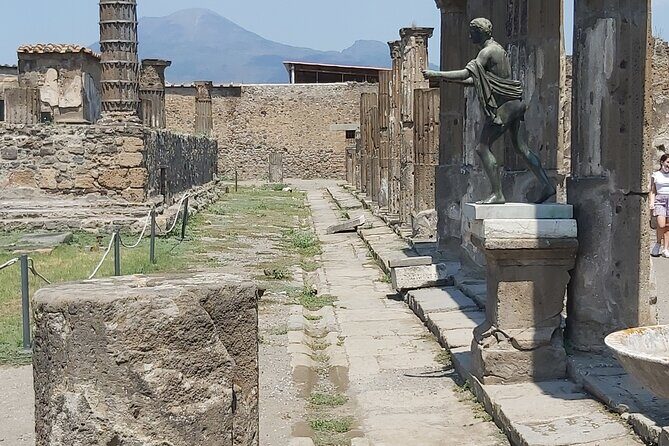
The tour continues with Thermopolium evidence, one of the best preserved examples of this type. A thermopolium functioned like an eatery where people could grab food and drink without cooking at home.
This stop is valuable because it grounds Pompeii in routine. It’s easy to get trapped in big monuments, but the thermopolium reminds you that daily life revolved around eating, chatting, and moving through the city.
You’ll learn about social life and nutrition as connected to these spaces. That doesn’t mean you’ll get modern meal recipes. It means you’ll understand how food culture worked on the street level, and why certain goods show up in preserved contexts.
If you’re visiting during a hot part of the day, this stop also gives your brain a break. You can rest your eyes on a calmer scene compared with temples or theaters, and it helps reset attention.
Temple of Vespasian, imperial cult, and Via dell’Abbondanza street planning
Next up is Temple of Vespasian, also known as the temple of Genius Augusti. This is one of those stops that can either feel like a label list or become a turning point. With a good archaeologist, it becomes the story of the Roman imperial cult—how loyalty and power were shown through religious practice.
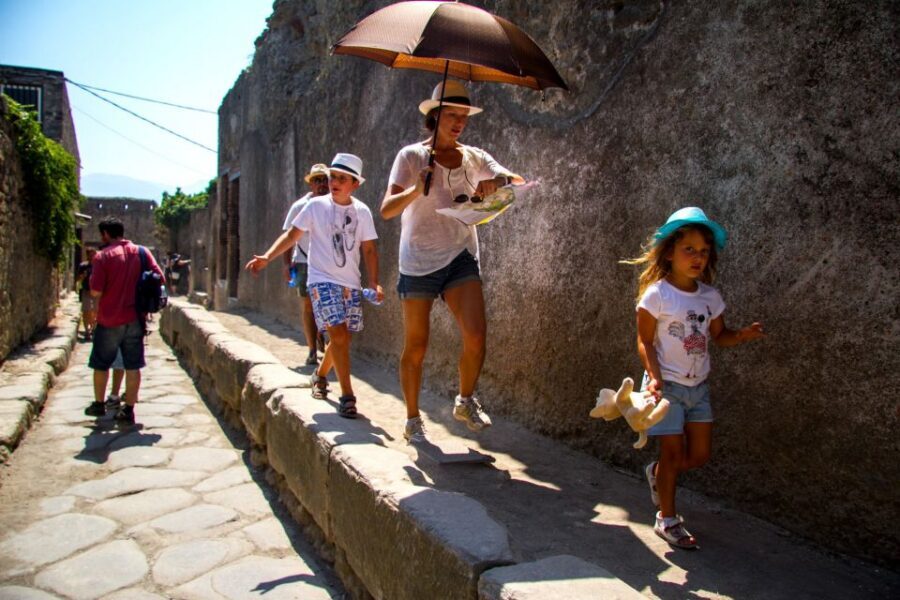
After that, you’ll walk Via dell’Abbondanza, which helps you understand Pompeii’s road network and urban plan. This matters because streets are the skeleton. When you grasp the layout, you stop thinking of Pompeii as isolated attractions and start seeing how neighborhoods connected.
Look at road alignments and think about flow: where people would gather, where traffic might slow, and how the city’s grid supported commerce and social movement. This is the “navigation lesson” portion of the tour, and it makes everything you see afterward easier to interpret.
Teatro Grande and Teatro Piccolo, plus older temples and the Doric layer
The tour then hits the theater district, including Teatro Grande, Teatro Piccolo, and the Quadriportico dei Teatri. Theaters in Pompeii weren’t just entertainment. They were public spaces where community identity formed. A guide’s explanations help you understand what different areas were used for and why the district was arranged the way it was.
After the theater zone, you’ll also see the Doric Temple, described as the oldest temple in Pompeii, plus the so-called Triangular Forum. This is a smart pairing because it shows how religious life evolved over time. You’re not only seeing the later, flashier Roman layer. You’re also seeing older structures that hint at earlier priorities.
If you’re the type who gets overwhelmed by time periods, this section helps you sort “older vs later” without needing to memorize a textbook.
Stabian Baths and the Lupanar: relaxation and scandal with context
To round out the day, you’ll see two very different aspects of Pompeii’s social life: the Stabian Baths (Terme Stabiane) and the Lupanar.
The Stabian Baths are an extraordinary example of an ancient thermal building. Baths were a social institution. You’d use them to clean up, but also to talk, meet, and pass time. This stop is worth it because it shows comfort and routine—Pompeii wasn’t only temples and fear. It was people living their afternoons.
Then comes the Lupanar, Pompeii’s famous brothel. The guide explains it as a very well preserved example, with bedrooms and erotic frescoes depicting different amorous positions. This section is sensitive. Treat it the same way you’d treat any historical evidence: with context, not curiosity for shock.
The value of including the Lupanar is that you get a fuller picture of what the city contained. Pompeii wasn’t polite in the modern sense. It held pleasure, commerce, and power dynamics in the same physical landscape as religious and civic life.
Price and what’s actually included for $42.01
This tour costs $42.01 per person, and it runs about 2 hours 30 minutes. The price makes sense when you consider what you’re getting: an archaeologist-led narrative, a route with many major stops, and a group cap of 15 travelers that helps keep attention on you instead of on the crowd.
What’s included is the guided tour with an archaeologist in Italian, English, or German, plus a mobile ticket. What isn’t included is food, drink, and tips, and the entrance fee is not listed as part of the tour price.
So here’s the simple way to plan: budget for Pompeii admission separately if it’s required for your booking, and show up with comfortable shoes and water. Even if the stops are short, Pompeii adds up fast.
Also, keep weather in mind. This experience requires good weather, so if conditions are poor, expect itinerary adjustments or a date change/refund rather than a full cancellation of your day out.
Who should book this Pompeii archaeologist tour
Book this if you want Pompeii to feel organized and human. It’s ideal for first-timers who get overwhelmed on their own, and it’s a good pick for history lovers who want context, not just names.
It’s also a strong choice if you like variety. You’ll move from civic centers to temples, from wealthy household art to street-level food, from baths to the theater district, and you’ll end where you can keep exploring.
If you’re very photo-focused and want long quiet time inside each site, you might find the stop durations a bit tight. In that case, use this as your structured “orientation tour,” then spend your extra time after the Forum on the places you loved most.
Should you book this Pompeii tour with an archaeologist?
I’d book it if your goal is understanding more than checking boxes. The route is built around high-impact places: the Forum, the granaries with victim casts, Casa del Fauno with the bronze dancing Faun and the Battle of Alexander, plus everyday-life stops like the thermopolium and baths.
The price feels fair for a guided experience with an archaeologist and a small group cap. The biggest reason to hesitate is also the biggest reason it works: it’s a full highlight run, not a slow wander. If you like taking your time, plan to extend your visit after it ends at the Forum.
If you want Pompeii explained in plain terms while you’re walking through it, this is the kind of tour that saves you from confusion and makes the ruins feel like a real city.
FAQ
How long is the Pompeii tour?
It lasts about 2 hours 30 minutes.
What does the tour cost?
The tour price is $42.01 per person.
What languages are available?
The guided tour is offered in Italian, English, or German.
Where do we meet and where does the tour end?
You start at Pompei Scavi Villa Dei Misteri (80045 Pompei) and the tour ends at the Foro di Pompei (Via Villa dei Misteri, 2, 80045 Pompei NA, Italy).
What ticket type is used?
You receive a mobile ticket.
Is the entrance fee included?
Food, drink, tips, and the entrance fee are not listed as included.
What happens if the weather is poor?
The experience requires good weather. If it’s canceled due to poor weather, you’ll be offered a different date or a full refund.