REVIEW · POMPEII
Pompeii Small Group Tour with an Archaeologist
Book on Viator →Operated by Askos Tours · Bookable on Viator
Pompeii feels personal when a real archaeologist talks. This small-group Pompeii walk (max 20) uses skip-the-line entry and a licensed guide to connect the big sights to real people, including the victims cast at the Granaries of the Forum and the city’s most famous theater. You’ll move fast enough to feel like you got Pompeii, but slow enough to understand what you’re looking at.
Two things I really like: first, the storytelling is built for the site, not generic facts. Names you might hear from guides include Alessandra, Teresa, Paolo, Alfredo, and Amadeo, and each one seems to turn stone corners into living context. Second, the format removes the usual frustration—skip-the-line entry plus headsets for larger groups helps you stay with the guide instead of chasing voices across a crowd.
One consideration: Pompeii is ancient, and the ground is uneven with steps and ramps. Mobility scooters aren’t allowed, and the route isn’t ideal if you have trouble with stairs or steep climbs. Comfortable shoes, water, and sunscreen matter more than you’d think.
In This Review
- Key highlights that matter in the real world
- Entering Pompeii Fast: Porta Marina Superiore and Pompeii Express tickets
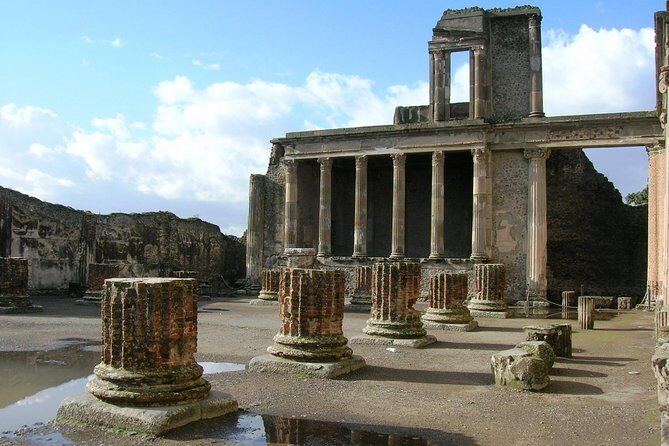
- Basilica and Forum: the quickest way to understand Pompeii’s layout
- Granaries of the Forum: plaster casts and the human cost
- House of Menander: how wealthy spaces explain Pompeii
- Stabian Baths: oldest thermal complex, everyday routine
- The Lupanar brothel: shock value with context
- House of the Faun, the Odeon, and Teatro Piccolo
- Teatro Grande: the big finish that makes everything click
- The 2-hour reality check: walking, heat, and how to avoid fatigue
- Who should book this archaeologist-led Pompeii tour?
- Price and value: why this tour often beats DIY planning
- Should you book Askos Tours with an archaeologist?
- FAQ
- Where does the tour meet?
- How long is the Pompeii small group tour?
- What language is the tour offered in?
- Does the tour include admission tickets?
- Is there a small group size limit?
- Are headsets provided?
- What should I bring and wear?
Key highlights that matter in the real world
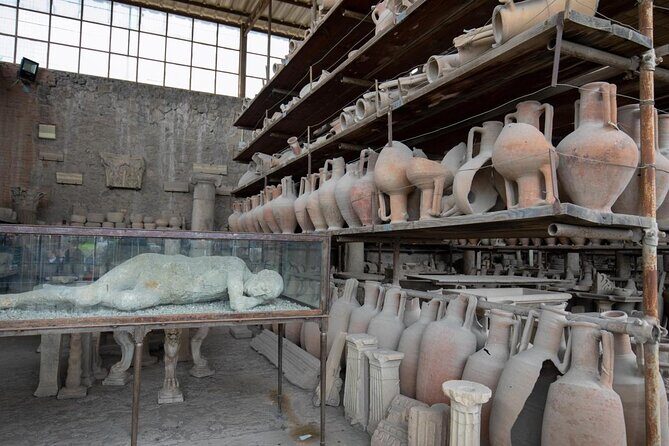
- Porta Marina Superiore start: you meet the guide at the main entrance and head straight inside with skip-the-line tickets.
- Basilica + Forum orientation: you get the city’s “main street” logic fast, before you move into details.
- Granaries of the Forum plaster casts: you pause for the famous eruption aftermath, including casts of victims plus a dog and a tree.
- House-to-baths-to-brothel route: you see how Pompeii mixed wealth, daily routine, and shocking survival-era reality.
- Teatro Grande finish: you end at the biggest theater, a strong closer for the social life of ancient Rome.
- Headsets when needed: for groups of 16+, you get audio support so you don’t lose the guide.
Entering Pompeii Fast: Porta Marina Superiore and Pompeii Express tickets
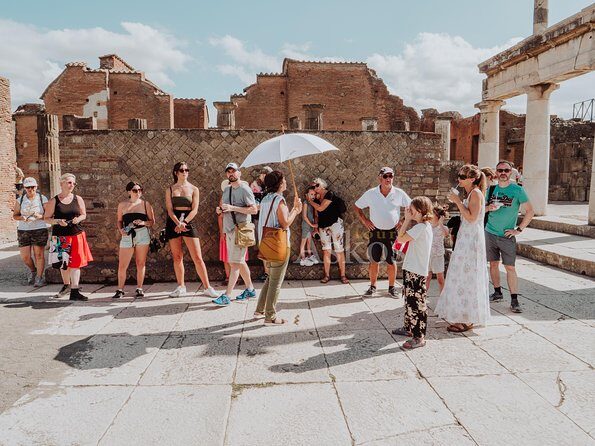
If you’ve ever tried to “do Pompeii on your own,” you know the main time sink isn’t the sightseeing. It’s the start. This tour tackles that with skip-the-line entry and what’s called the Pompeii Express ticket.
You’ll meet at Via Villa dei Misteri, 2 (look for the guide sign), then the group heads to the Porta Marina Superiore entrance, where the archaeologist guide holds an Askos Tours sign. From there, you walk right into the ruins with your ticket already handled.
This matters because Pompeii is huge. Two hours sounds short until you’re on uneven paving, weaving between walls, and trying to find the right building with a phone screen that doesn’t always behave in the ruins. Getting inside quickly lets the clock work for you instead of against you.
Also note the group size: maximum 20 people per guide. When you’re in a group that small, the guide can point out what to notice, not just where to stand for photos. If your group is on the bigger side (16+), you’ll use headsets, which make a real difference when the route forces you to spread out.
If you're still narrowing it down, here are other tours in Pompeii we've reviewed.


Basilica and Forum: the quickest way to understand Pompeii’s layout
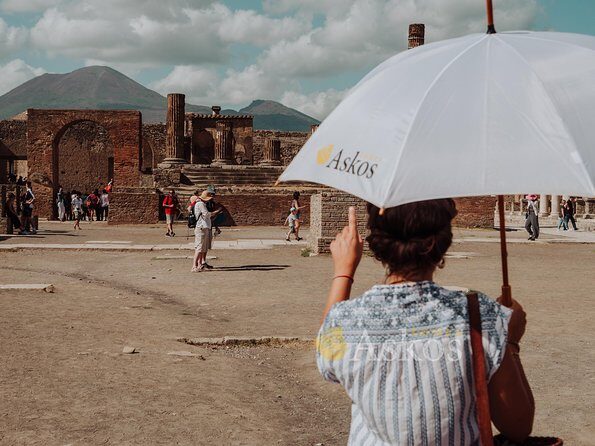
Your tour begins with Pompeii’s civic and commercial heart: the Basilica and the Forum.
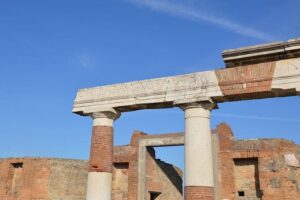
First up is the Basilica, described as an open portico that sheltered merchants and everyday activities. This is where the tour helps you read the site like a map. A lot of visitors see columns and walls and think, okay, it’s Roman. With the guide’s framing, you start noticing how people would have used space: moving, trading, gathering, waiting under cover when needed.
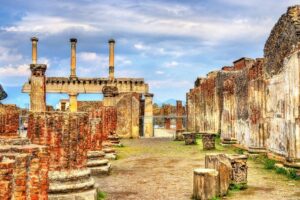
Then you hit the Foro de Pompeya, the ancient main square. This isn’t just a dramatic open area. It’s the key to everything that follows. Once you understand the Forum as the city’s central stage, the rest of Pompeii feels less random. Houses, baths, theaters, and even the more scandalous bits snap into a believable social pattern.
Time at each stop is controlled, which is smart for a 2-hour visit. You won’t get stuck at one building long enough to lose the whole tour, but you also won’t skip the orientation piece. If you’re seeing Pompeii for the first time, this sequencing is the difference between a checklist and an actual experience.
Granaries of the Forum: plaster casts and the human cost
Next comes one of the most emotionally charged stops in the Pompeii story: the Granaries of the Forum.
Here you’ll see marble tables and features linked to baths or fountains that adorned house entrances. That’s the “life and beauty” side of Pompeii. Then the tour pivots to the famous plaster casts of victims inside the granary area. You’ll also encounter casts that include a dog and a tree.
This stop is powerful because it interrupts the usual museum feeling. Pompeii isn’t a set of lifeless ruins. It’s a moment frozen in time by disaster. The guide’s job is to explain what you’re seeing—why casts look the way they do, and what the eruption changed in minutes.
Practically, you’ll want to slow down here. The site makes it easy to rush on to the next photo spot. But this is where your brain catches up to what the buildings were for.
House of Menander: how wealthy spaces explain Pompeii
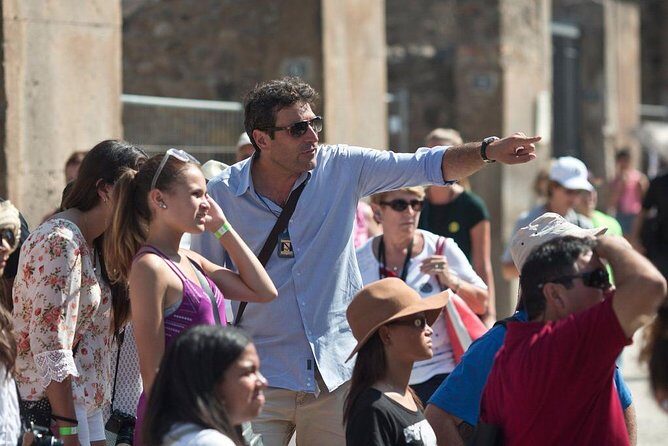
After the Granaries, you walk along the original paved roads and move into residential Pompeii. The first big highlight is the House of Menander.
This house stands out because it’s described as one of the richest residences in Pompeii, with impressive architecture, decoration, and contents. That’s the polite version. The real value is that you’re not just staring at ruins—you’re learning what wealthy Pompeians chose to display and how those choices worked as social signals.
The tour also ties this to what you see on the route: frescoes and mosaics you can spot inside certain buildings. Those details are easy to miss when you’re moving too fast or treating Pompeii like a background photo set. With a guide, you’re given a reason to look closer, even if your time is limited.
One drawback of any highlight tour is that you can’t read every surface. But for a short visit, you get the best odds of “I understand this” rather than “I think I saw something.”
Stabian Baths: oldest thermal complex, everyday routine
Then you step into Stabian Baths (Terme Stabiane), a vast thermal area that’s described as the oldest thermal complex in the city. It sits between key crossroads and lanes, so it’s a major part of the daily rhythm of Pompeii.
This is where Pompeii becomes more than a story about a disaster. Baths were social spaces. They were also part of the maintenance of body and routine—how people met, chatted, and passed time. The guide’s context helps you connect the building’s size and layout to how often people would have used it.
You’ll have time to appreciate the scale without feeling like you’re being dragged. Still, it’s worth remembering: this is a walk on uneven ground with some steps. Even when the stops are carefully timed, you’re moving between them, and the Pompeii surface can be tougher than you expect.
If you’re the type who loves everyday life in the ancient world, this is one of the stops that delivers.

The Lupanar brothel: shock value with context
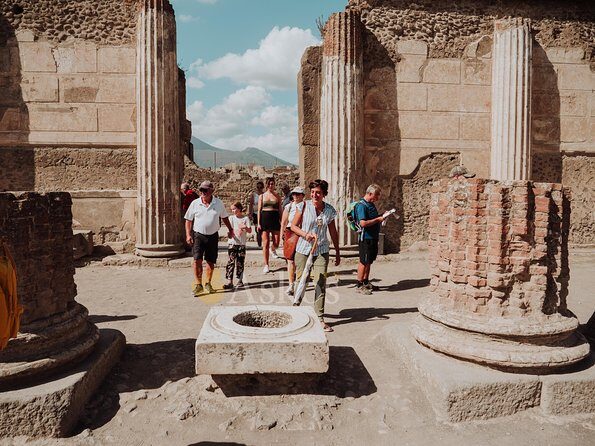
Pompeii includes something that surprises almost everyone: the Lupanar (the most famous brothel in the ruined city). This is one of the city’s most recognizable social sites, and this tour includes a peek at the brothel ruins.
This stop can be a lot for first-timers, depending on your comfort level. The good news is that the guide’s approach helps keep it from being only shock. The goal is to explain how the site reflects the realities of Roman urban life, not just the lurid details.
I’d treat this stop like a lens, not a spectacle. Ask questions if you want the why behind the layout and what the building tells you about the people who used it. In a small group, you’re more likely to get answers instead of a quick wave and on we go.
House of the Faun, the Odeon, and Teatro Piccolo
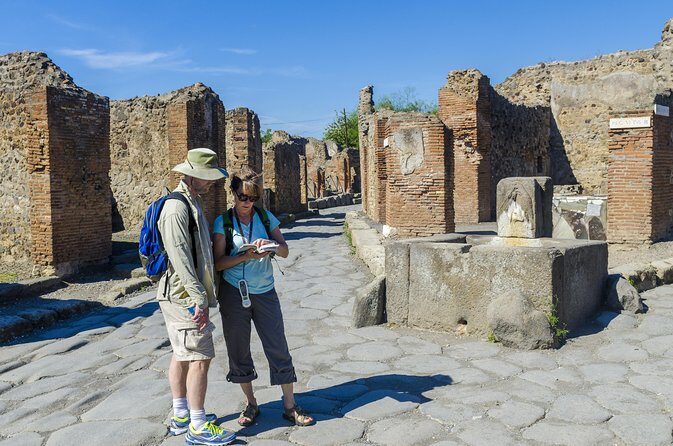
As the tour continues, it moves back toward major private and public spaces.
You’ll see the House of the Faun, described as one of the largest and most impressive private residences in Pompeii. Like the House of Menander, it’s a showcase of how elite homes expressed wealth through space and decoration. The tour doesn’t just point out what’s left. It links it to how Pompeians lived and what “important” meant in a city that was intensely social.
Then there’s a brief stop at the Odeon, a smaller theater space. After that, you’ll have a look at the so-called Teatro Piccolo. This sequence gives you a sense of Pompeii as a place that organized leisure and performance at multiple scales.
A quick note on pacing: these stops are short by design. You won’t get a museum-length explanation of each stone corner. The tradeoff is you’ll cover more of the site in two hours, and you’ll end with a strong finale.
Teatro Grande: the big finish that makes everything click

You end at Teatro Grande, described as the most important theater in Pompeii and also the city’s largest theater.
Ending here works for two reasons. One, it’s visually dramatic. Two, it’s conceptually satisfying. When you’re standing in a major Roman performance space, you can better understand how public life worked. Even if you visited just a few buildings earlier, the theater ties them together as parts of one city system: governance, religion, commerce, leisure, and daily life.
If you’re a theater nerd, this stop delivers. If you’re not, it still helps you feel what the ancient city was built to do: gather people and turn ideas into public events.
The 2-hour reality check: walking, heat, and how to avoid fatigue
Two hours in Pompeii is plenty to learn the essentials and see key sites. It’s not enough for a full “wander until you’re tired” day. You also need to plan your body for the terrain.
Here’s what I’d prepare for:
- Uneven ground and steps. This is an archaeological park, not a flat museum floor.
- Sun and low shade. In summer, bring sunglasses and sunscreen, plus a small bottle of water.
- Comfortable shoes. The route uses old paving and areas that can feel slippery or hard on feet.
The tour runs all year around with rain or shine. That means you should also expect the ground to change when it’s wet. Sturdy footwear is the real hero item.
One more practical tip: if you want to keep exploring afterward, ask the guide (at the end) for a simple route plan. Some people find the park layout tricky once the official timing ends. You’ll get more out of your free time if you know which direction to head.
Who should book this archaeologist-led Pompeii tour?
This tour is a great fit if you want:
- A guided orientation to the big Pompeian places fast
- Human stories, not just dates and labels
- A structured route that covers a range: civic center, homes, baths, and public leisure
It’s also a strong choice for families with teens, since the pacing and storytelling are designed to keep people engaged without turning into a lecture marathon.
It may not be the best fit if:
- You have mobility limitations that make steps and ramps hard
- You rely on a scooter (they’re not allowed)
- You want a slow, unhurried day with lots of time sitting and reading every detail
Price and value: why this tour often beats DIY planning
At $35.67 per person for about 2 hours, this is one of those tours that can feel like good value once you add up what you’re getting.
You’re not just paying for walking. You’re getting:
- Licensed guidance with an archaeological background
- A Pompeii Express entrance ticket handled for you
- Skip-the-line entry
- A small group capped at 20
- Headsets if your group is 16+
And then there’s the intangible value: someone points out what matters. Pompeii can be overwhelming without that filter. You can absolutely do it solo, but you’ll likely spend time guessing, backtracking, or missing the connections that make the site feel like a real city.
If you’re balancing costs, you can also think of this as buying time and understanding for a short window in your day. Pompeii is one of those places where context turns stone into story fast.
Should you book Askos Tours with an archaeologist?
Book it if you want a smart, efficient Pompeii day that hits the big landmarks and adds explanation where it counts. This is especially true if it’s your first time at Pompeii and you want to leave feeling like you truly understood what you saw, from the Forum to the baths, the brothel, and the Teatro Grande finish.
Skip it (or consider a different format) if you need a more accessible route, or if you know you’ll struggle with uneven surfaces and steps. Also consider booking a different day or adding extra time if you want to linger in fewer places.
If you’re deciding in one sentence: this tour is for people who want Pompeii’s highlights explained with real archaeological context, without turning your visit into a long, exhausting day.
FAQ
Where does the tour meet?
The tour starts at Via Villa dei Misteri, 2, 80045 Pompei NA, Italy. The meeting at the archaeological park is at Porta Marina Superiore, where the guide holds an Askos Tours sign.
How long is the Pompeii small group tour?
It’s about 2 hours.
What language is the tour offered in?
The tour is offered in English.
Does the tour include admission tickets?
Yes. It includes the Pompeii Express entrance ticket, and you also get skip-the-line entry.
Is there a small group size limit?
Yes. The group is capped at a maximum of 20 travelers per guide.
Are headsets provided?
Headsets are provided for groups of 16 or more.
What should I bring and wear?
Wear comfortable shoes. In summer, bring sunglasses and sunscreen, and bring a small bottle of water. The tour runs rain or shine, so plan for that too. Service animals are allowed, and children must be accompanied by an adult.