REVIEW · POMPEI CAMPANIA
Pompeii: Guided Tour and Skip-the-Line Ticket
Book on GetYourGuide →Operated by IAMME IA! - Gray Line Amalfi Coast · Bookable on GetYourGuide
Seeing Pompeii with a guide changes everything.
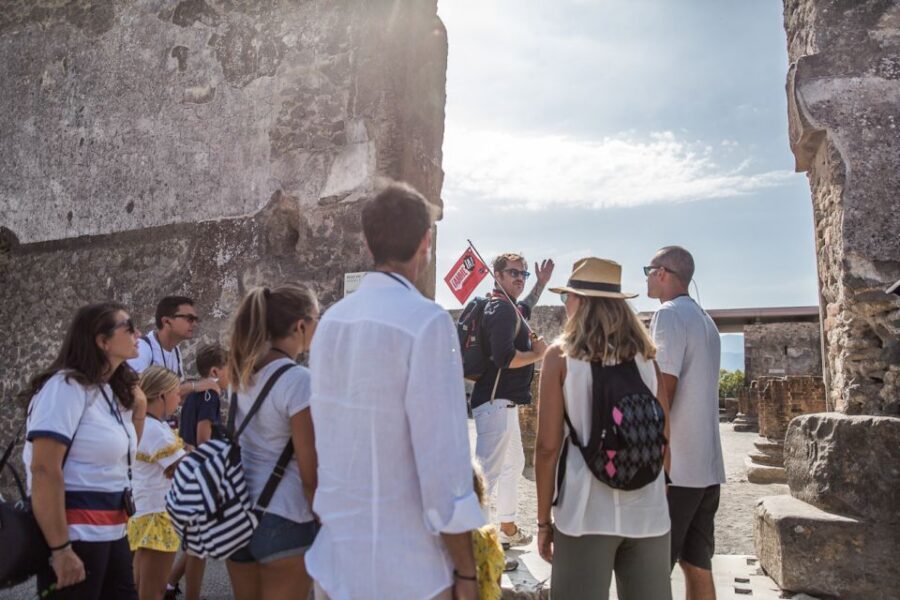
This Pompeii tour is designed to skip the ticket line and get you walking fast, with a local expert who explains what you’re actually looking at. I especially like the way it connects big landmarks to day-to-day life, from gates and forums to homes and food shops, plus the tour is short enough to stay sharp without turning into a slog. Even better, you’ll likely hear English and other languages spoken clearly by guides such as Melania and Annarita, who earned strong marks for keeping the story moving.
Two things I really like about this experience: first, the priority access lets you beat the worst bottlenecks at the entrance, so you spend more time inside the ruins. Second, the route hits the city’s main “life zones,” not just a few random highlights—think Civil Forum, Theater District, baths, street-food stops, and the House of the Faun. In a place this big, that kind of structure matters.
One possible drawback to keep in mind: the tour is about 2 to 2.5 hours, so you won’t see everything Pompeii offers. Also, site rules can mean groups are split into smaller parties with separate licensed guides, and some optional stops (like the Lupanare) may depend on time and queues.
In This Review
- Key things to know before you go
- Why Pompeii makes more sense when someone narrates the city
- Fast-track entry at Porta Marina: how it changes your timing
- Porta Marina to the Civil Forum: the political and religious heart
- Via dell’Abbondanza and the Theater District: street life and public entertainment
- Forum Baths and the Roman wellness habit
- Thermopolium and Pistrinum: how Romans grabbed food on the go
- The Lupanare and the question of what you might skip
- The House of the Faun and the Alexander Mosaic moment
- Macellum of Pompeii: the market where daily life added up
- Plaster casts: the human scale of 79 AD
- How long is enough for Pompeii: the 2–2.5 hour pace
- What you’ll pay $43 for: value that’s more than the ticket
- Quick check: is this Pompeii tour a good fit for you?
- Should you book this guided skip-the-line Pompeii tour?
- FAQ
- How long is the Pompeii guided tour?
- Does this ticket include skip-the-line entry?
- Where do we meet for the tour?
- What’s included in the price?
- Is transportation to and from Pompeii included?
- Are audio headsets provided?
- What languages are available?
- Is the tour suitable for wheelchair users?
- Can unaccompanied minors join?
- What should I bring for Pompeii?
- Is priority entrance always guaranteed on the first Sunday?
Key things to know before you go
- Skip-the-line entry starts you at Porta Marina quickly, reducing waiting when the ruins get busy.
- Live licensed guide makes Pompeii’s layout make sense, including what happens in public buildings and private homes.
- Audio headsets are provided for groups of 8+, which helps when you’re spread out across the site.
- A tight 2–2.5 hour route is ideal if you want the essentials without losing the day.
- You may miss one stop if queues or scheduling push the timing, especially at the Lupanare.
- Heat and exposure are real, so plan footwear and sun protection (sunscreen is specifically suggested).
Why Pompeii makes more sense when someone narrates the city
Pompeii is one of those rare places where everything looks important, but not everything is obvious. A guide helps you read the stones like a map. You start at Porta Marina and move through the city’s core—so you’re not just collecting photos, you’re learning the “why” behind each neighborhood.
I like that the tour’s storytelling stays grounded in everyday life. You’ll pass through Pompeii’s political and religious center at the Civil Forum, then the Basilica where legal and business activity used to happen. Those aren’t just impressive ruins; they’re the engine room of how the city ran. When your guide explains what took place there, it feels less like sightseeing and more like time travel without the sci-fi.
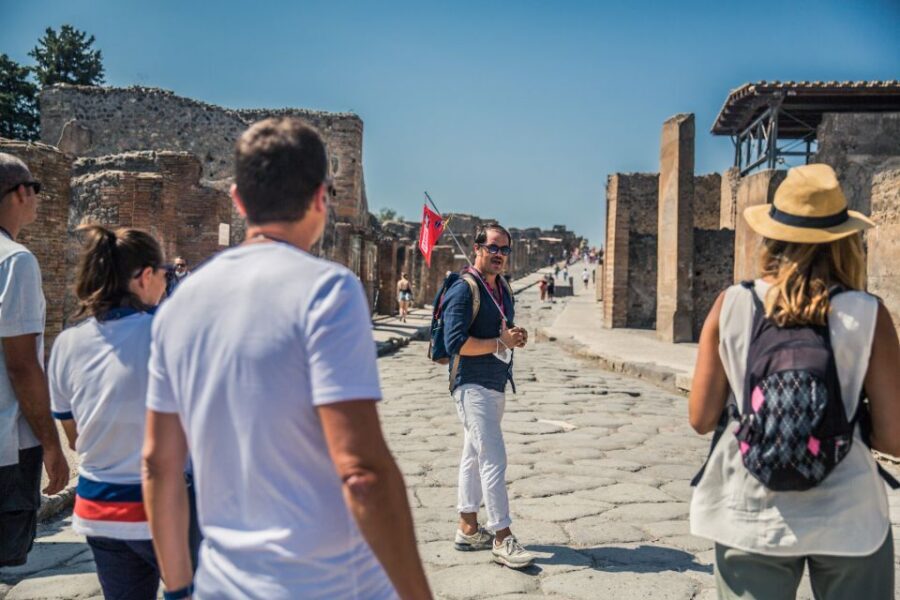
Guides named Melania, Annarita, Mariella, Natalia, and others were repeatedly praised for friendly, clear explanations and for answering questions as you walk. Even when there’s a language accent (one review noted English understanding was a bit challenging for a specific guide), most of the experience still works because the tour route is structured and the stops are straightforward to follow.
If you're still narrowing it down, here are other tours in Pompei Campania we've reviewed.


Fast-track entry at Porta Marina: how it changes your timing
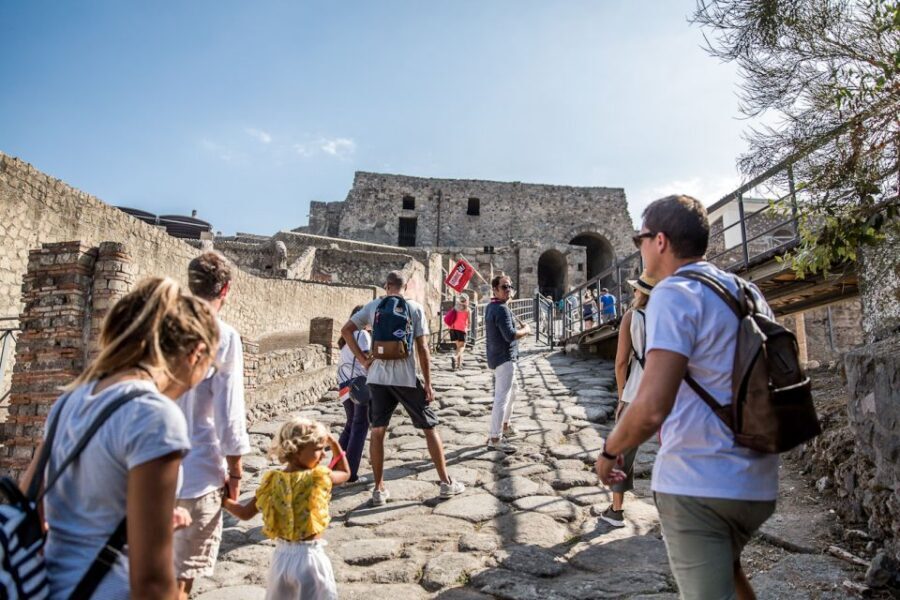
The big practical win here is priority access to the Pompeii Archaeological Site. That’s what keeps your start from turning into an endurance test. You meet for a fast-track start right at the entrance area for the ruins, and the tour begins with Porta Marina as the entry point.
Why does that matter? Because Pompeii isn’t only crowded—it’s also big. If you lose time at a ticket office, you lose it everywhere else. Priority access helps you spend more of your limited tour window actually moving through the city.
Two timing notes to plan around:
- On the first Sunday of each month, priority entrance may not be available and is determined by crowd levels at the ticket office.
- Due to site regulations, your group may be divided into smaller parties with separate licensed guides. That’s usually fine—just know it’s a reality of Pompeii operations, not a personal mix-up.
Porta Marina to the Civil Forum: the political and religious heart
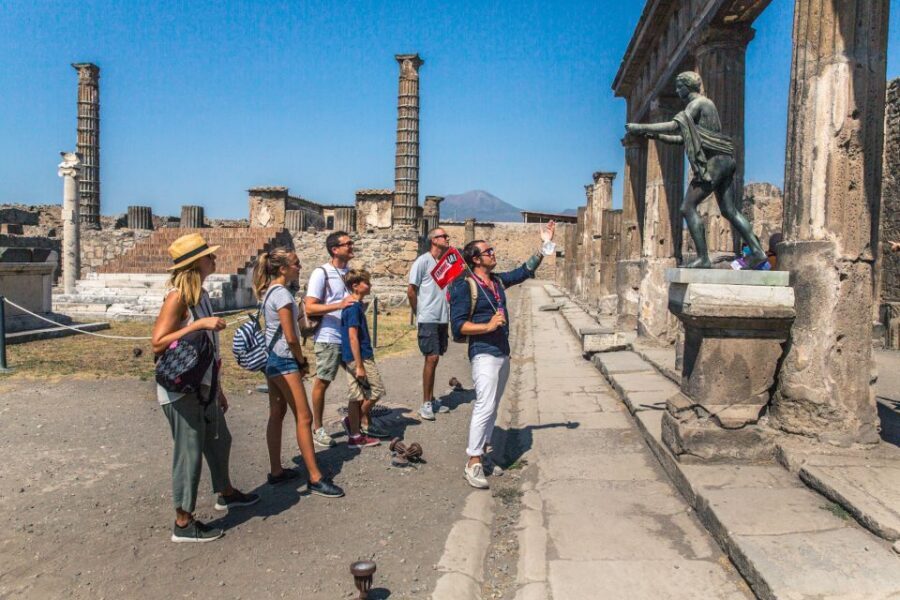
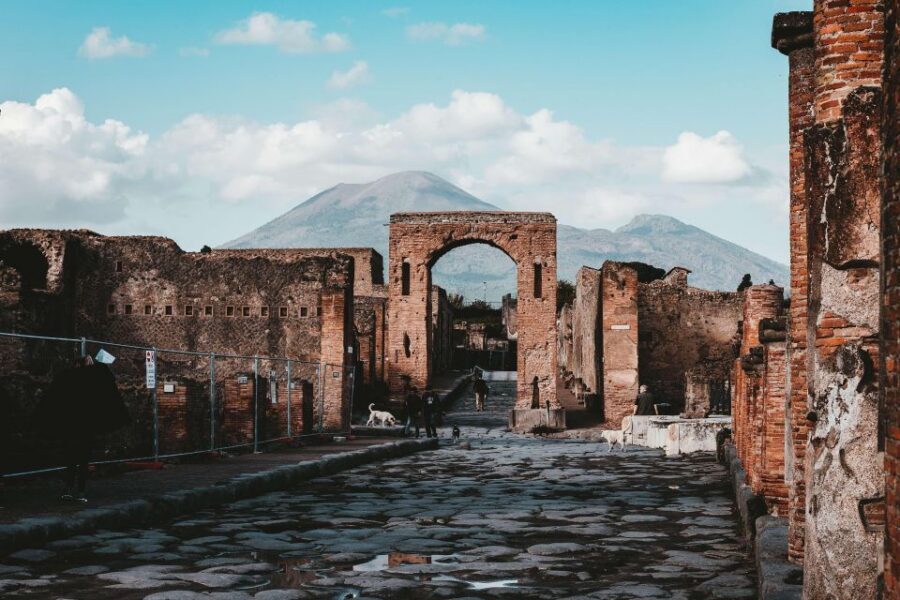
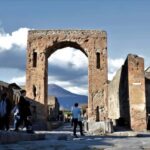
Your walk begins at Porta Marina, one of Pompeii’s original gates. That opening stop matters because gates set the tone: you’re entering a city with boundaries, schedules, and routes people actually walked every day.
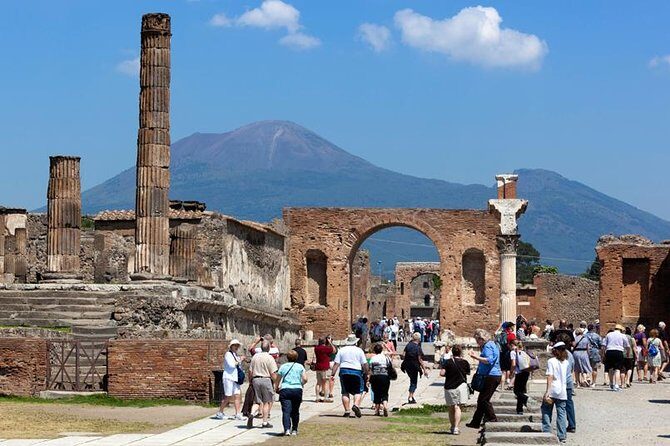
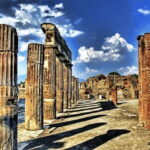
From there you move into the Civil Forum, Pompeii’s “main hub” where politics, religion, and commerce overlapped. You’ll see grand public buildings and temples, and you’ll also learn how they functioned as a social stage. The Civil Forum can look like a cluster of stone on your own; with a guide, it becomes a system—who gathered, why they gathered, and how authority was displayed in public space.
Nearby sits the Basilica, used for legal affairs and business dealings. This is one of those spots where a little context goes a long way. The architecture tells you it wasn’t a casual meeting point—it was built for formal decisions, transactions, and public interaction.
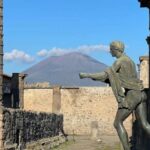
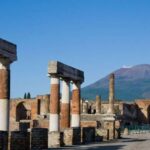
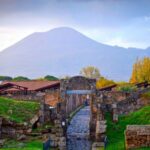
Also pay attention to the way Mount Vesuvius looms in the background. The tour’s framing of Vesuvius as the silent force behind Pompeii’s sudden end helps you understand why the city feels frozen rather than merely old.
Via dell’Abbondanza and the Theater District: street life and public entertainment
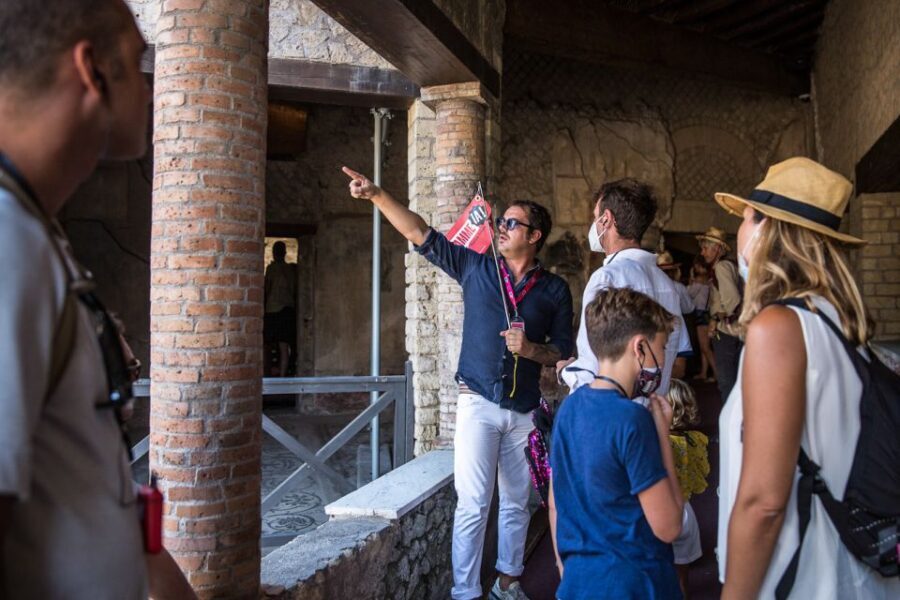
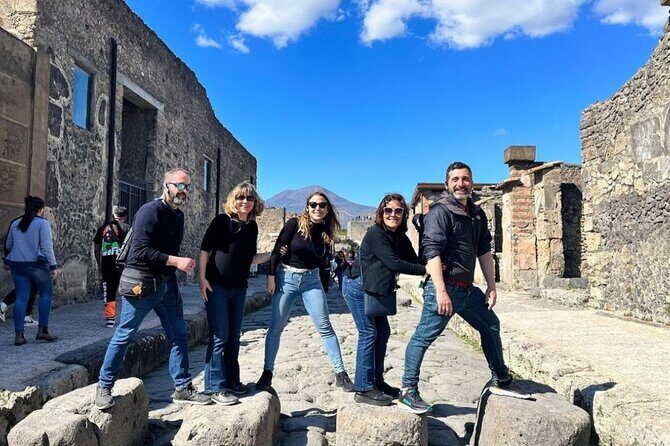
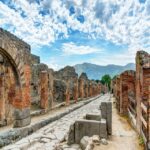
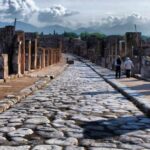
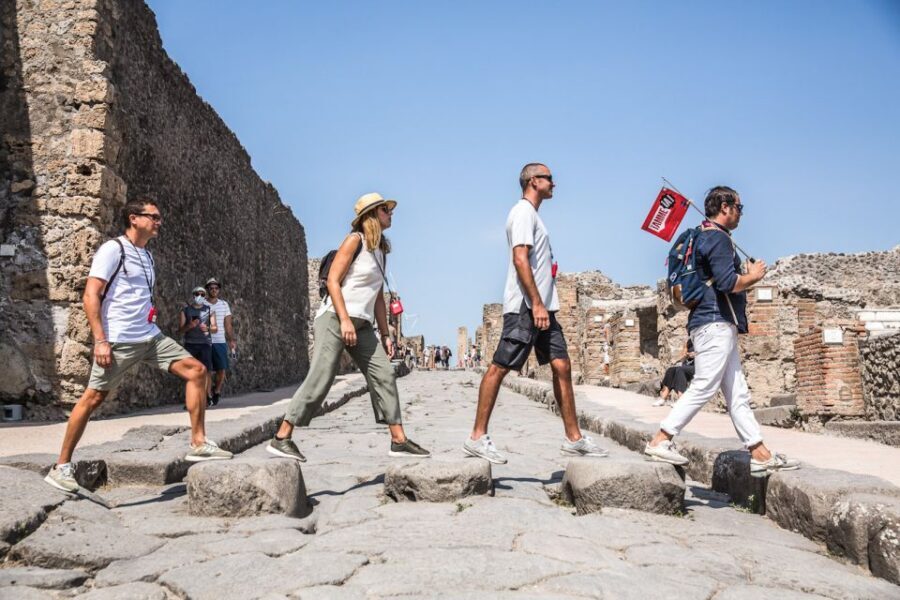
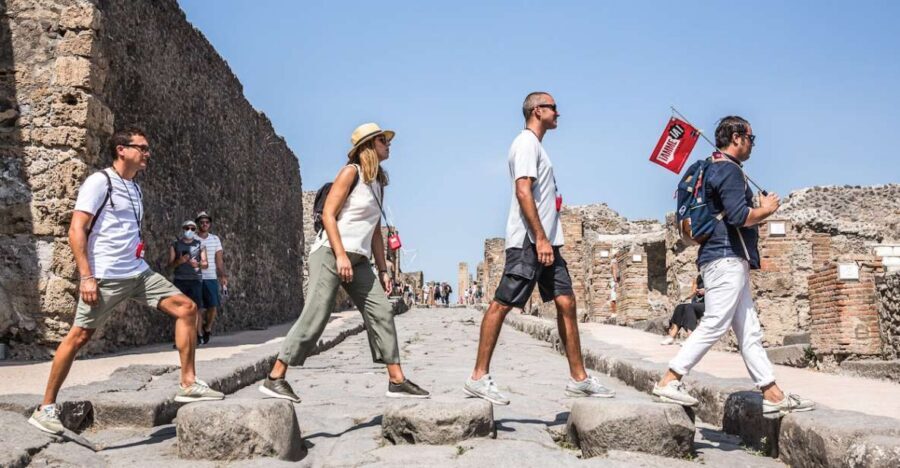
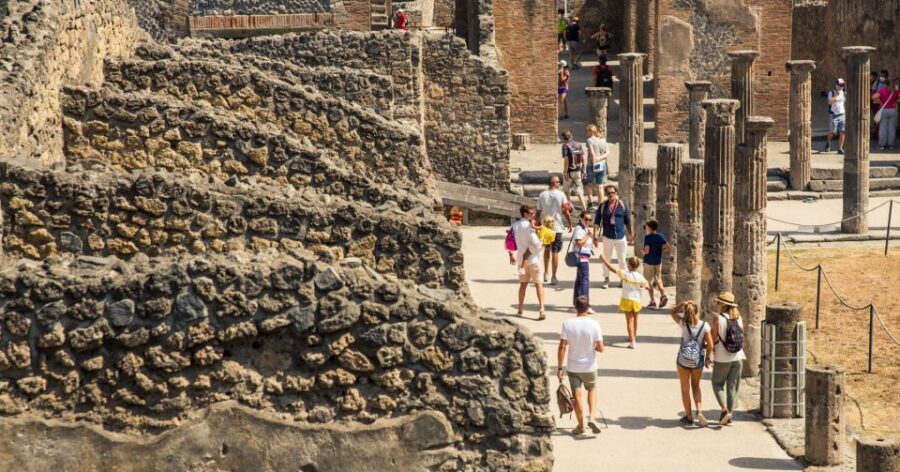
After the forum area, you walk down Via dell’Abbondanza, Pompeii’s main street. The street is famous for the grooves in stone where chariot wheels ran. That detail makes the city feel physical—like you’re standing on infrastructure, not just ruins.
As you pass shops and residences along the way, your guide’s narration helps you picture daily movement: people going to work, buying goods, stopping at street-level services, and returning home. This is also where you start to appreciate why Pompeii is such a strong teaching site—walk 10 minutes and the city changes from civic center to ordinary street.
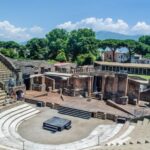
Next comes the Theater District, where culture and social life gathered. You’ll see the Large Theater, an open-air venue where crowds once attended performances like comedies, dramas, and music. With a guide, you can read the layout as a stage-and-audience system, not just a big hollow space.
If you’re visiting with kids, this cultural stop is often a win because it’s easy to imagine what entertainment looked like in Roman times. More than one family-focused review called the tour a highlight, largely because the guide kept things engaging and not overly academic.
Forum Baths and the Roman wellness habit
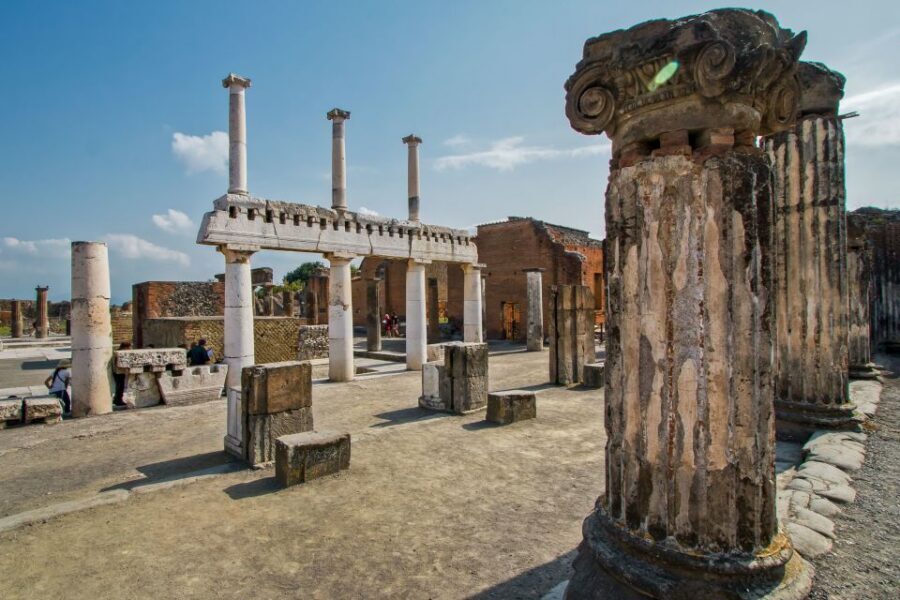
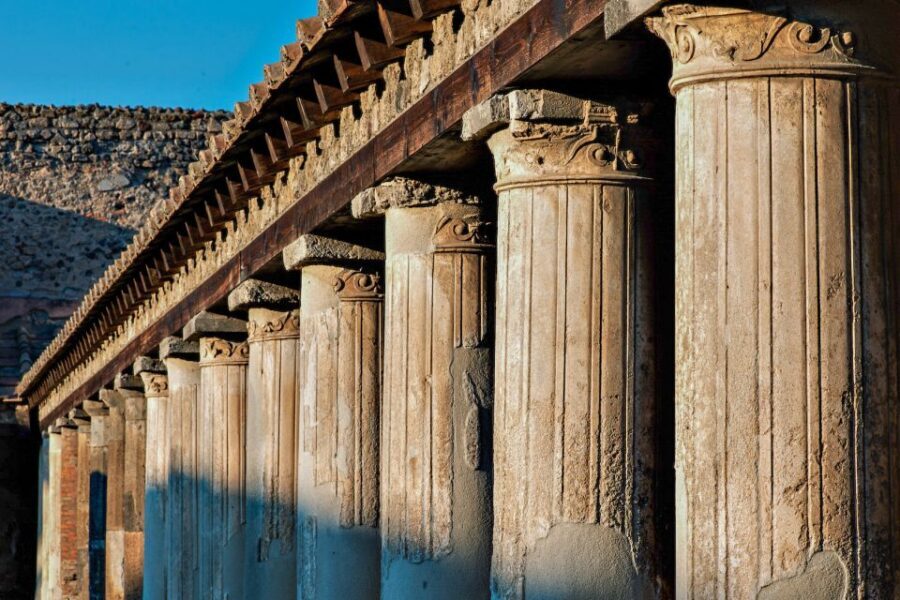
The Forum Baths are one of the best stops for understanding Roman daily routines. These aren’t just “old buildings.” Baths show how people spent time, cleaned themselves, relaxed, and socialized—often with the same energy you’d find in a modern community space.
On a hot day, baths also provide a small break from the most exposed stretches of the route, though you’ll still be walking in sun for parts of it. The tour’s structure keeps moving, so you get the context without getting stuck in one area too long.

Thermopolium and Pistrinum: how Romans grabbed food on the go
A Pompeii tour that includes food stops feels more real because it captures a common habit: eating quickly and locally. Here, you’ll encounter a Thermopolium, an ancient street food shop—essentially a place to get hot food near where you already were walking.
The tour also includes a stop connected to Pistrinum, a bakery. You’ll see millstones, ovens, and counters used to serve hot meals to locals. This is the kind of detail that usually gets overlooked when people visit on their own. With narration, you understand that Pompeii wasn’t only villas and temples—it was also busy with everyday labor and food supply.
One practical note: you’ll likely be walking and stopping in quick succession at multiple locations. Wear comfortable shoes. That sounds basic, but Pompeii’s uneven surfaces and long outdoor stretches make it a real factor in enjoyment.
The Lupanare and the question of what you might skip
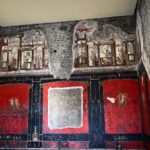
One of the most discussed stops is the Lupanare, Pompeii’s ancient brothel, described with vivid frescoes and compact stone rooms. It’s historically significant and emotionally provocative, and it can be one of the tour’s most memorable moments—especially if your guide explains how it fit into the urban economy and daily life.
That said, time and queues can affect whether you see everything. In at least one small-group experience, the guide chose to avoid the lengthy queues at the Lupanare to keep the tour flowing and fully use the time with the group. So keep expectations flexible: the tour plan includes the stop, but Pompeii logistics are real.
If you’d rather not take that chance, consider pairing this guided visit with extra free time later. The main point of this tour is the core route and a strong interpretive guide; it’s not guaranteed to be every single building in peak detail.
The House of the Faun and the Alexander Mosaic moment
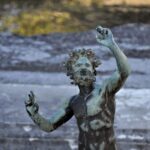
The House of the Faun is the grand finale-style stop that gives Pompeii its “wow” factor. This is a Roman villa known for its mosaics, including the striking Alexander Mosaic. Your guide’s commentary matters here because the art becomes more than decoration—it’s storytelling and status.
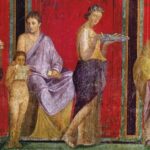
Mosaics like this are a clue to wealth, influence, and cultural taste. When you learn what the scene represents and how elite households displayed identity through art, the stop becomes a high point rather than a quick glance.
This house also works as a pacing reset. After markets, baths, and street food, the villa brings you into the private side of Pompeii: wealth, lifestyle, and the difference between public space and home life.
Macellum of Pompeii: the market where daily life added up
The Macellum—Pompeii’s food market—puts you back into the energy of everyday trade. Think of it as a place where you’d see activity, movement, and bargaining rather than ceremonies and performances.
With a guided route, the Macellum stop connects back to the food theme: street food at the Thermopolium, bakery production at the Pistrinum, and then a broader market setting where people handled goods and meals. That pattern makes the city feel less random.
I also like the emotional effect of ending at “real life” before the tour closes with the heavier reminders of what happened to Pompeii’s people.
Plaster casts: the human scale of 79 AD
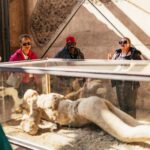
One of the most powerful moments in this tour is seeing the plaster casts of Pompeii’s victims—men, women, and children frozen in their final moments. The tour frames these as human reminders, not just museum pieces.
This is the kind of stop that can hit harder because it’s intimate. Even if you’ve seen photos before, seeing the casts in context changes how you process the site. If you’re traveling with children, consider whether they’re ready for this kind of historical reality. The tour does not allow unaccompanied minors, so you’ll be right there, able to guide the conversation.
How long is enough for Pompeii: the 2–2.5 hour pace
The tour length—about 2 to 2.5 hours—is a sweet spot if you want the essentials and don’t want to sprint. Reviews often praised this timing as perfect, with guides using the time to keep the group engaged rather than rushing through every stone.
Still, Pompeii is enormous. If you’re the type who wants to wander, you’ll need more time than a short guided route. A practical approach is to treat this tour as your “skeleton”—then, later in the day, use your new mental map to explore on your own.
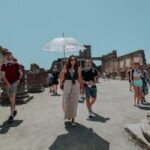
Also, plan for weather. Pompeii is hot and exposed in many stretches. One helpful tip from experience: bring an umbrella for shade if you’re visiting in summer or on a bright day, even if the tour schedule doesn’t mention it.
What you’ll pay $43 for: value that’s more than the ticket
At $43 per person, this isn’t a bargain tour. But it’s also not just a plain walking ticket. The value comes from three concrete pieces:
- a licensed local guide with live commentary
- priority access to reduce waiting at the entrance
- audio headsets for groups of 8+ so you can actually hear explanations while walking
In other words, you’re paying for time savings and interpretation. For Pompeii, those are the two things that make the biggest difference in how much you understand and how much you enjoy.
If you’re comfortable navigating on your own and you already know the site well, you might feel less urgency. But if Pompeii is your one big stop, a guided route like this is often the smartest way to avoid leaving without the key connections.
Quick check: is this Pompeii tour a good fit for you?
This tour works best if:
- you want a structured route through the most meaningful areas
- you’d rather spend your energy learning than reading faded guidebooks on the move
- you’re okay with a walking pace and a time-limited visit
- you like the idea of seeing both civic Pompeii and elite Pompeii (Forum and House of the Faun)
It may not be ideal if:
- you need a wheelchair-friendly route (it’s not suitable for wheelchair users)
- you want a slow, do-everything at your own pace experience
- you’re traveling with minors who would be unaccompanied (unaccompanied minors aren’t allowed)
A small-group or private format can also be a plus for people who want more room for questions. Some experiences noted that smaller groups felt more tailored and helped you understand more as you go.
Should you book this guided skip-the-line Pompeii tour?
Yes—if you want Pompeii to feel legible. This is the type of tour where the guide’s narration is the difference between scattered ruins and an ordered story. Priority access also helps you protect your limited time, especially if you’re visiting during peak hours.
I’d book it particularly if you’re planning only one Pompeii visit and want the “greatest hits” plus a few deeper slices of daily life—street food, public baths, elite art in the House of the Faun, and the human reminder of the plaster casts. If you’re the kind of traveler who can easily get lost without a plan, this route is a big help.
FAQ
How long is the Pompeii guided tour?
The tour lasts about 2 to 2.5 hours.
Does this ticket include skip-the-line entry?
Yes. It includes priority access to the Pompeii Archaeological Site.
Where do we meet for the tour?
The meeting point may vary depending on the option booked, and it’s described as right at the entrance area for a fast-track start. One listed start point is Porta Marina, Pompeii, and another option references Pompei Parking Zeus.
What’s included in the price?
Included are a local expert guide with live commentary, audio headsets for groups of 8+ (when applicable), and priority access. Food and beverages are not included.
Is transportation to and from Pompeii included?
No. Transportation to and from Pompeii is not included.
Are audio headsets provided?
Yes, audio headsets are provided for groups of 8+ to help you hear the guide clearly.
What languages are available?
The live tour guide operates in English, Spanish, French, and German.
Is the tour suitable for wheelchair users?
No. It’s not suitable for wheelchair users.
Can unaccompanied minors join?
No. Unaccompanied minors are not allowed.
What should I bring for Pompeii?
Bring comfortable shoes and sunscreen. The site can be hot and exposed.
Is priority entrance always guaranteed on the first Sunday?
Priority entrance may not be available on the first Sunday of each month and depends on crowd levels at the Pompeii ruins ticket office.