REVIEW · POMPEI CAMPANIA
Pompeii: Skip-the-Line Entrance Ticket with Audio Guide
Book on GetYourGuide →Operated by Tempio Travel Pompei Tickets · Bookable on GetYourGuide
Pompeii can feel like a maze, not a museum. This ticket helps you get in fast, then pairs you with an audio guide and map so you can steer your own day.
I like that you are not stuck in one rigid tour flow. You can pause for frescoes, backtrack when something catches your eye, and move between major spots like the Roman amphitheater and public gym without waiting on anyone else.
One possible drawback: the site is huge and hot, and even with skip-the-line access you may still face some crowding near key entry points. Also, a couple of practical details can matter, like bringing headphones since the headset is not included.
In This Review
- Key things to know before you go
- Skip-the-line entrance: how it changes your day at Pompeii
- Meeting point at Circumvesuviana: where you exchange your voucher
- What you actually get: audio guide, map, and the self-paced format
- Pompeii’s highlights you can cover without rushing
- Roman amphitheater and the small theater
- Public gym and everyday training culture
- Homes, banquets, and where Romans lived daily
- Frescoes frozen in time (and why they hit hard)
- Moving casts: the people (and pets) in the story
- Using the audio guide so it actually helps
- Timing your visit: crowds, heat, and the best way to pace yourself
- Price and value: is $39.97 worth it?
- Who this Pompeii ticket is best for
- Should you book this Pompeii skip-the-line audio ticket?
- FAQ
- How long is this Pompeii experience?
- What’s included in the ticket?
- Do I need to bring headphones?
- Where do I exchange my voucher?
- Are large bags allowed?
- What languages is the audio guide available in?
- Is there any special pricing for kids or young adults?
Key things to know before you go

- Skip-the-line entry helps you waste less time at the ticket office window.
- Audio guide + map are built for self-paced wandering in a place that can feel confusing.
- Main Pompeii stops you can cover include the amphitheater, small theater, and public gym.
- No headset, bring headphones so your audio actually works.
- Light on bags: luggage or large bags are not allowed.
- Watch the heat: shade is limited and you’ll want water and sunscreen.
Skip-the-line entrance: how it changes your day at Pompeii

Pompeii draws big crowds, and lines can eat up your best daylight. This ticket is designed to keep you moving by avoiding the long wait at the main ticket area, which is especially helpful if you’re arriving around the busy morning window.
In real life, you might still see people funneling toward entrances and the earliest highlight areas. But you are far less likely to spend your trip standing still before you even reach the ruins.
The other win is mental. When I’m visiting a place with thousands of details, I want the option to start exploring right away, not negotiate paperwork first.
If you're still narrowing it down, here are other tours in Pompei Campania we've reviewed.



Meeting point at Circumvesuviana: where you exchange your voucher

You exchange your voucher at the activity provider’s office on the first floor of the Circumvesuviana train station (Via Villa dei Misteri, 1, 80045 Pompei NA, Italia). If you’re using public transport, that’s a big convenience because you’re tying your ticket pickup to the route that gets you there.
The payoff is speed. The exchange point is set close enough to the Pompeii entrance area that you can turn a transit stop into a start-of-visit moment, rather than making it a separate mission. One review specifically said the exchange counter is a minute walk away from the entrance area above the train station.
There’s also a note about parking: you may have a chance at free parking at Osteria Nonna Cherubina (Via Andolfi 46) if it’s open and available. If you drive, plan to be flexible and arrive early in case spots are limited.
What you actually get: audio guide, map, and the self-paced format

Your ticket includes skip-the-line entry, an audio guide, and a map. That trio is the core idea: you are not trapped in a scripted route, but you also aren’t flying blind in a city-sized archaeological site.
Audio guides work best when the guide helps you connect what you’re seeing to why it matters. In this case, the audio commentary is meant to explain Pompeii’s history and everyday life, then point you toward key spaces so you don’t wander randomly for hours.
A few practical things to know from traveler experiences:
- One person found the system straightforward and even received a mobile phone audio guide plus a map, emphasizing that the map is a must because Pompeii is huge.
- Another visitor said it wasn’t totally clear where to get the audio guide at first, so if you don’t spot it right away, ask at the pickup office and keep moving.
- One review mentioned being asked to hand over a passport for the audio device. That may not be your experience, but it’s worth keeping in mind if you’re traveling with a passport you’d rather not leave as a deposit.
Also, the audio is listed as available in German, Italian, French, English, and Spanish. If you’re planning to tour with someone who prefers a specific language, you’ll want to confirm the language options at pickup.
Pompeii’s highlights you can cover without rushing

This ticket is built for a customizable self-guided route. You choose your pace, but the plan points you toward Pompeii’s most famous—and most moving—areas.
Roman amphitheater and the small theater
Start your day by targeting big public spaces. The Roman amphitheater and small theater are a great way to get oriented because they reveal how Pompeians organized public life. Even if you only spend a short time at each, you’ll get a quick sense of the city’s rhythm: entertainment and crowds, then back into neighborhood life.
If you like “read the room” sightseeing, theaters and amphitheaters are your friends. They make the ruins feel less like rocks and more like a functioning stage.





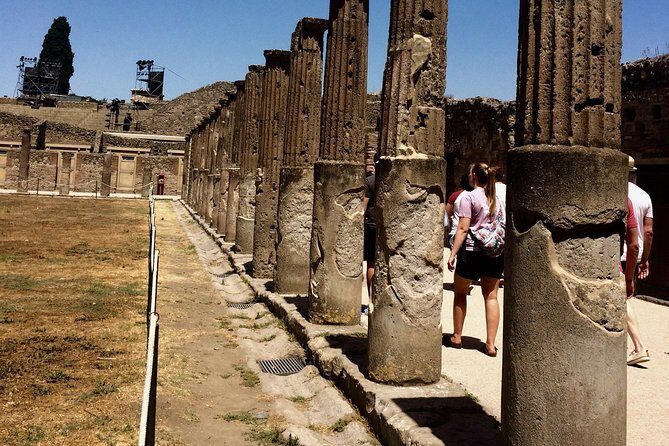
Public gym and everyday training culture
Next, look for the public gym area. Pompeii isn’t only tragedies and frescoes—there’s a social world here. A gym points you toward daily habits: exercise, meeting friends, and hanging out as part of routine, not special occasions.
This is also a good spot to slow down. The audio commentary is most useful when you’re standing still enough to actually connect the description to stonework.
Homes, banquets, and where Romans lived daily
The core emotional pull of Pompeii is domestic life—how people ate, hosted, worked, and relaxed. With this ticket, you can focus on the places where Romans lived daily life and held banquets.
That matters because it changes how you interpret the site. Instead of viewing Pompeii as a single catastrophe, you start to see a whole city full of normal conversations and everyday rituals.
Frescoes frozen in time (and why they hit hard)
One of the biggest highlights is the frescoes—centuries-old paintings that survived long enough to reach us. The audio guide helps you understand what you’re looking at, but your eyes do the real work.
I recommend giving frescoes a little extra time. Don’t rush past them like they’re background decoration. They’re often the most “human scale” part of the ruins.
Moving casts: the people (and pets) in the story
The experience also includes references to moving casts of citizens and their pets on an exclusive self-guided tour. Even when you’ve seen photos before, seeing how those casts are presented can make Pompeii feel immediate and personal.
If you’re the kind of visitor who needs context before emotions hit, the audio guide is there to help you place what you’re seeing into the larger story.
Using the audio guide so it actually helps
Audio guides are only valuable if they guide your attention. Here’s how I’d use this one so you don’t waste time fiddling with your phone or wandering back and forth.
First, walk with the audio just enough to pick a direction. Use it early to learn the layout and what you should seek first—amphitheater, theater, gym, and then the domestic areas. Once you’ve got your bearings, turn it on as needed rather than listening constantly. You’ll enjoy it more when it’s connected to a specific viewpoint.
Second, pair audio with the map immediately. Pompeii’s grid isn’t how modern cities work, and the site can feel like a maze. A map prevents the classic mistake: walking for 30 minutes, then realizing you’re not moving through the route you thought you were.
One small equipment tip: the reviews suggested having an aux cable earphone handy when the audio guide is delivered via a mobile phone. You’re not required to do this based on the basic ticket description, but it’s a smart “don’t get stuck at the last second” move.
Timing your visit: crowds, heat, and the best way to pace yourself
Pompeii rewards early starts, and the crowd pattern tends to build through the morning. One review mentioned getting there around 9am to avoid crowds and heat, which is a solid plan if your schedule allows.
But even with smart timing, heat is real. More than one person flagged limited shade and recommended packing water and sunscreen. So plan your day like you’re touring outdoors in summer, not like you’re moving through indoor galleries.
A practical pacing strategy:
- Spend your first hour on the big public areas (amphitheater/theater).
- Take a longer break when you head into domestic zones, since you’ll want time with frescoes and casts.
- Save at least a small chunk of time for wandering. Pompeii has unexpected surprises, and self-guided time is where that flexibility shines.
Also note the site rules: no luggage or large bags. If you’re coming by train, keep your day bag light so you don’t deal with restrictions mid-walk.
Price and value: is $39.97 worth it?
At $39.97 per person, the value depends on what you’re optimizing for. If you care about time and want to avoid the ticket-office bottleneck, the skip-the-line component is doing real work for you. That can be the difference between a full sightseeing day and a rushed one.
The audio guide and map add more value than they might seem. Pompeii is big, and getting lost wastes energy and daylight. When your tour includes the tools to navigate and understand what you’re seeing, the experience becomes efficient without feeling like a conveyor belt.
I also like that the tour is flexible: it’s a 1-day activity and starting times vary based on availability. You can align Pompeii with your overall Naples/Sorrento rhythm instead of forcing the ruins into a single rigid schedule.
One thing to watch: the ticket does not include food or drinks. Since shade is limited, plan to carry what you need. The mention of only one café being available also suggests you shouldn’t assume easy resupply once you’re deep in the site.
Who this Pompeii ticket is best for
This ticket is a great fit if you want:
- Self-paced freedom with structure (audio + map).
- A faster entry option, especially if your time is tight.
- To learn as you go, without committing to a long live guide tour.
It may be less ideal if you strongly prefer a live narrative delivered by a person, every minute, with zero pauses. While audio helps, it’s still not the same as having someone respond to your questions in real time.
That said, there are hints that additional guided options can be offered on top of the audio setup. One review described paying an extra €10 each for a guided tour that lasted just over two hours and praised guides named Alfonso and Alfonso-Marie, plus Astrid for an entertaining Italian-language tour. If that sort of add-on appears for you, it could be an easy way to boost context early and then shift into relaxed self-guided time.
Should you book this Pompeii skip-the-line audio ticket?

If you’re planning Pompeii as part of a busy trip and you want to trade line time for ruin time, I’d book it. The combination of skip-the-line entry plus an audio guide and map is exactly how you make a huge, complex site feel manageable.
I would book this especially if:
- you want independence but still want history explained while you walk,
- you’re visiting in hot weather and need a plan that lets you pause often,
- you’d rather spend your energy looking at frescoes and street-life scenes than figuring out how to get oriented.
Don’t book it if you know you’ll hate audio systems, or if you’re the type who gets frustrated when you have to figure out pickup details. In that case, you might prefer a fully guided group tour instead of a DIY-with-a-guide approach.
FAQ
How long is this Pompeii experience?
The activity is listed as 1 day. Starting times depend on availability when you book.
What’s included in the ticket?
Your ticket includes skip-the-line entry, an audio guide, and a map.
Do I need to bring headphones?
Yes. Headsets are not included, and you’re advised to bring headphones.
Where do I exchange my voucher?
You exchange your voucher at the activity provider’s office on the first floor of Circumvesuviana train station (Via Villa dei Misteri, 1, 80045 Pompei NA, Italia). The activity ends back at the meeting point.
Are large bags allowed?
No. Luggage or large bags are not allowed.
What languages is the audio guide available in?
The audio guide is available in French, German, Italian, English, and Spanish.
Is there any special pricing for kids or young adults?
Children aged 0 to 17 years go for free. People aged 18 to 24 from the European community with an identification document pay €2.