REVIEW · POMPEI CAMPANIA
Pompeii: 3D Walking Tour with Entry Ticket
Book on GetYourGuide →Operated by AR Tour srl · Bookable on GetYourGuide
Roman ruins look different with the right tech. This Pompeii tour pairs AR glasses with an entry ticket and a guided audio track so you can watch key buildings and spaces from 79 A.D. appear in their pre-eruption form right over the stones you’re standing on. I also like the pacing: 2 hours is long enough to make the site feel connected, but short enough to stay sharp even when Pompeii is hot and crowded. The main consideration is simple—Pompeii is outdoors and you’ll be on your feet, so comfortable shoes and water matter.
You get a real guided setup. A tour assistant meets you at Porta Marina Inferiore and helps you fit and use the AR equipment, then walks with your small group of up to 20 people. If you’re visiting with kids, it’s a nice option too, since the AR format tends to hold attention better than a traditional lecture—just note that children under 8 can enter with a standard ticket but can’t use the 3D technology.
Last thing: the meeting point is very specific, so don’t wing it. Plan to arrive a little early and you’ll start the tour smoothly; if you’re late, the group waits up to 5 minutes out of respect for everyone else.
In This Review
- Key things I’d circle on your planning list
- Pompeii before the eruption: how the AR glasses change everything
- Where you meet at Porta Marina Inferiore (and why arriving early helps)
- What 2 hours covers: temples, houses, squares, theaters, and key buildings
- Start with orientation, then move into the reconstructed city
- Temples and public-facing architecture
- Houses and everyday life
- Squares and social spaces
- Theaters and performance spaces
- A key limitation: you won’t cover suburban villas
- The guide experience: why the assistant makes or breaks the tour
- Family-friendly Pompeii, with age limits you should plan around
- Practical value: what your $61 is really buying
- Before you go: what to pack for Pompeii heat and long stone walks
- Logistics that affect your day: rain or shine, then explore on your own
- Limits and rules to know so nothing surprises you
- So, should you book the Pompeii 3D walking tour?
- FAQ
- How long is the Pompeii 3D walking tour?
- Where do we meet the tour assistant?
- What’s included in the price?
- Is transportation included?
- Can I stay in Pompeii after the tour ends?
- Can children under 8 use the 3D technology?
- Are the AR glasses wearable if I already wear eyeglasses?
- What languages is the audio available in?
Key things I’d circle on your planning list
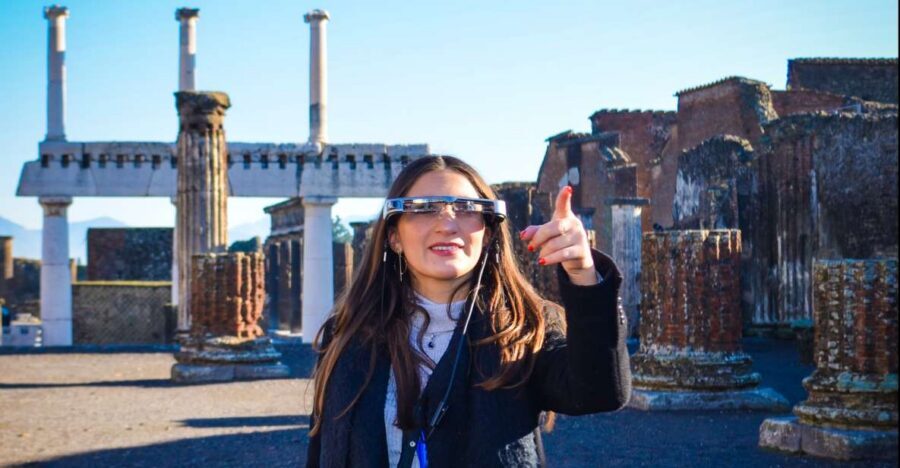
- AR glasses show reconstructions beside today’s ruins, including temples, houses, squares, theaters, and major buildings
- Entry ticket included, so you skip the extra step and get straight to the walking portion
- Small groups (up to 20 people) keep the pace friendly and the equipment handling manageable
- Multilingual audio is built in (Italian, French, Spanish, German, English, Portuguese)
- Designed by archaeologists and experts, so the overlays aim to reflect life in Pompeii before 79 A.D.
Pompeii before the eruption: how the AR glasses change everything
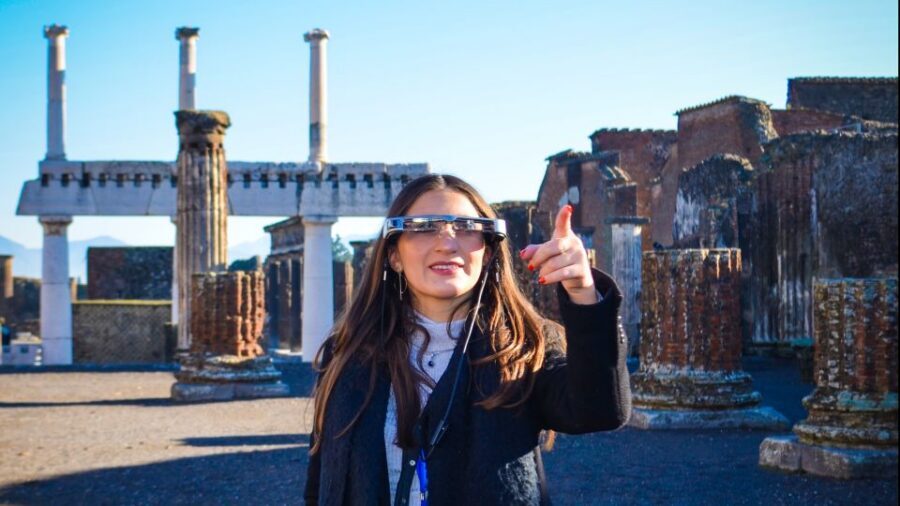
Pompeii is powerful even with no technology at all. You stand in a place that froze in time, and the ruins do most of the work. What this tour adds is the missing layer: the built-in idea of what those places looked like before the eruption.
With the AR glasses, you don’t just hear stories. You visually get an overlap between present-day ruins and pre-eruption reconstructions. The effect is practical, not gimmicky. When a roofline, facade, or interior space appears over what’s now collapsed stone, it becomes easier to understand the building’s purpose and how people actually moved through it.
The tour is built around 79 A.D., the year of the eruption that covered Pompeii in ash and preserved so much. Seeing the timeline in the same view you’re standing in makes that history feel less abstract. You’re not only learning facts; you’re building a mental map of how the city functioned.
One more detail worth noting: the tour assistant also helps you learn how to use the AR glasses early on. That matters because AR only works well if you can quickly get comfortable with the equipment and the timing.
If you're still narrowing it down, here are other tours in Pompei Campania we've reviewed.



Where you meet at Porta Marina Inferiore (and why arriving early helps)
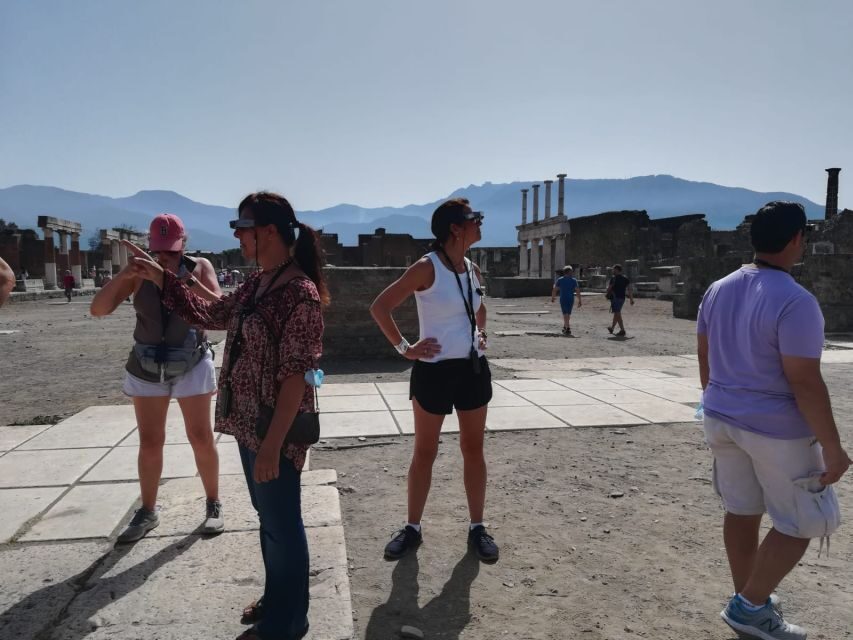
Your tour assistant meets you at Porta Marina Inferiore, in Piazza Esedra, outside the Vittoria Coffee Shop. That location is specific enough that it’s worth treating it like an appointment, not a wandering start.
Pompeii can throw off your timing. Narrow paths, the crowds at popular entrances, and the heat can slow down a normal walk from where you think you are. You’ll feel this tour is smoother if you arrive a bit early, get your bearings, and let the team take care of the equipment portion without rushing.
Also remember this small-group format: once everyone lines up and the tour starts, you’re moving as a group. If you’re running late, the tour waits for a maximum of 5 minutes, then begins out of respect for other participants.
What 2 hours covers: temples, houses, squares, theaters, and key buildings
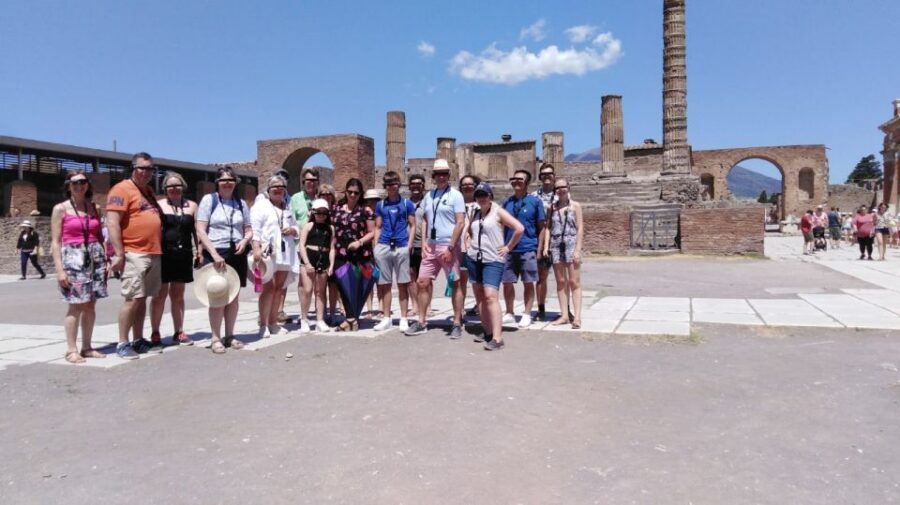
This is not a long marathon through every corner of Pompeii. It’s a focused walking route designed to show the biggest ideas of daily Roman life—and the major architectural spaces that shaped it. Expect roughly two hours of guided AR-enabled strolling, with your assistant keeping you on track.
Here’s what the experience emphasizes, in the same spirit as what the overlays are built to show:
Start with orientation, then move into the reconstructed city
You begin by meeting your assistant and learning how the AR glasses work with the audio track. Once you’re set, you move from spot to spot where the glasses trigger reconstructions. That means the story doesn’t feel random. Each stop is meant to clarify how Pompeii worked before it became ruins.
Temples and public-facing architecture
Pompeii’s temples and ceremonial spaces help explain the city’s rhythm—how religious life and civic pride showed up in stone. With AR, you get visual hints that are hard to infer from ruins alone: what scale might have been like, how entrances framed movement, and how dramatic spaces would have felt in daily life.
A practical benefit here: if you’re someone who wonders why people built certain things, AR turns that curiosity into something you can see.





Houses and everyday life
The overlays extend from grand structures into residential spaces. Homes in Pompeii are some of the most meaningful remnants because they show daily routines—how rooms related, where light and airflow would have mattered, and how family and visitors might have encountered one another.
This is often where AR pays off most. Ruins can be confusing in a maze-like way; reconstruction gives you context without requiring you to be an architectural expert.
Squares and social spaces
Public squares and street-level spaces show how the city moved at a human scale. When these areas are reconstructed on top of the current layout, you get a sense of where people gathered, how sightlines worked, and why certain buildings sat where they did.
Even if you’re not a history buff, this part can help you feel the city as a living place rather than a museum grid.
Theaters and performance spaces
Theater ruins can look simple until you understand what they were built to do. AR helps you connect form to function—how seating might have been arranged, how the stage area would have framed audiences, and why the building mattered in entertainment and community life.
If you’ve ever visited a ruin and wished you could rewind it to a fully functioning day, this is the closest you’ll get in a short time.
A key limitation: you won’t cover suburban villas
The tour does not include suburban villas, including Villa dei Misteri. That’s important if suburban villas are a top priority for you. This experience focuses on the urban Pompeii spaces where the reconstructions and story are designed to guide you through the city’s core life.
The guide experience: why the assistant makes or breaks the tour
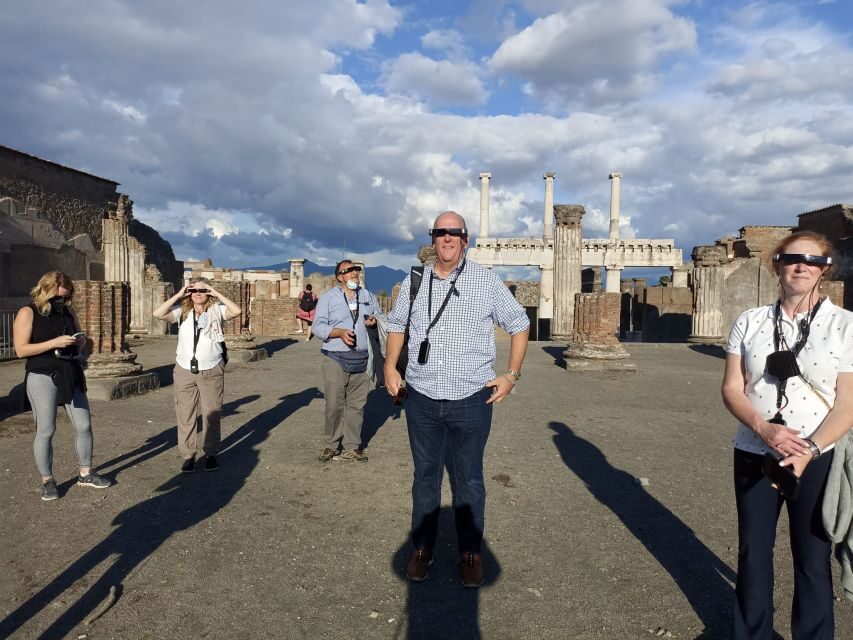
Technology helps, but the human element keeps it from becoming a headset app. What stands out in the way this tour is run is the role of the tour assistant: they set you up, keep your group moving, and answer questions as you go.
You may see names like Sabrina, Sam, Sara, Luigi, and Daniela show up in praise for doing exactly that—keeping the material clear, the pace manageable, and the vibe respectful. A tour assistant who’s good at equipment help and timing matters here because the tour includes both AR glasses and audio, and you want those to work together without frustration.
It’s also a good sign that guides are praised for patience, including when someone in the group needs extra time. That doesn’t mean the tour is slow. It means the team pays attention to real people, not just the schedule.
Family-friendly Pompeii, with age limits you should plan around
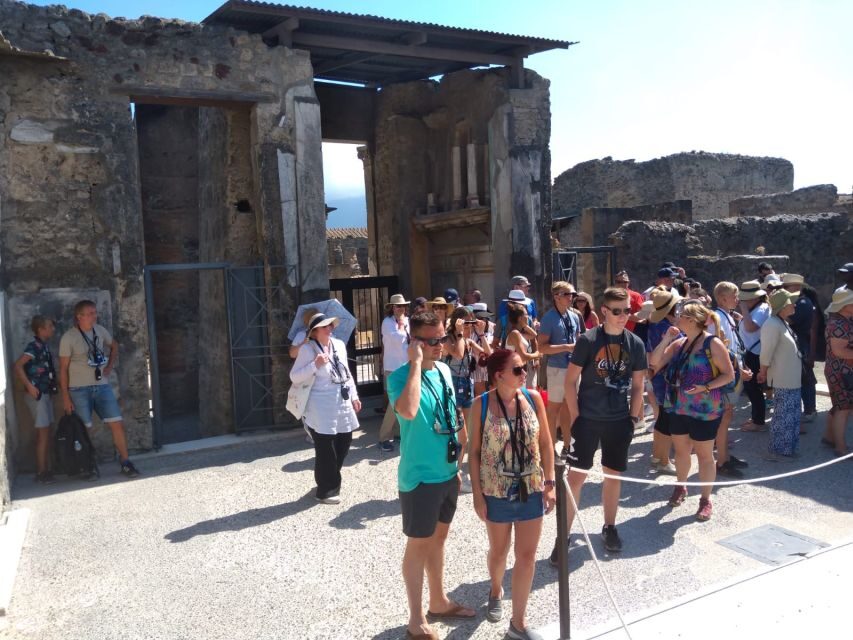
This is one of those Pompeii options that doesn’t rely solely on long standing and silent looking. It’s built for small group movement and AR-driven storytelling, which often helps kids stay engaged.
Here’s what you should know about age rules:
- Children under 8 can access the archaeological park with a standard ticket, but they cannot use the 3D technology.
- The 3D/AR experience itself is not suitable for children under 8.
So if you’re traveling with younger kids, you may need to decide whether you want them to participate as observers or whether you’ll wait for another Pompeii plan that’s better matched to their age.
For kids who are old enough to use the technology, the format can feel more like a guided exploration game than a lecture. Even if your family isn’t into ancient history, AR reconstructions can make the site easier to follow.
Practical value: what your $61 is really buying
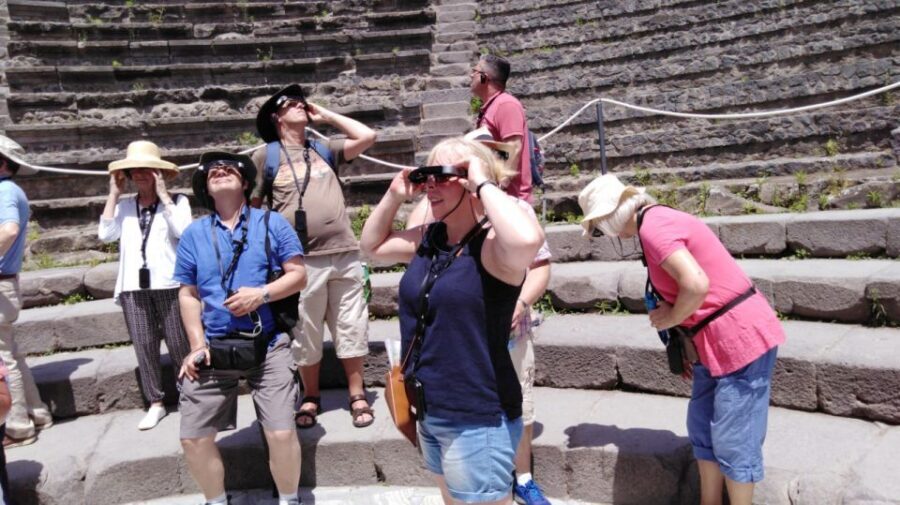
At $61 per person, you’re paying for more than an entry ticket. The price bundles:
- Entry ticket to Pompeii
- Augmented reality glasses
- An augmented reality assistant (your tour assistant)
- Audio available in 6 languages
- A guided walking tour
That’s the value equation. If you’re the kind of visitor who will actually use audio and visuals and want structure, this is a good deal for a short visit. You’re also choosing a format designed to connect buildings and stories, not just see them one by one.
If you’d rather do Pompeii at your own pace with a printed guide, or if you’re not interested in AR at all, the bundled format might feel like extra cost. The tour is best when you want guidance and a visual layer.
Also consider timing. The tour lasts 2 hours, and Pompeii can sap energy faster than you expect. A guided, time-bounded plan often helps you avoid the situation where you’re standing in the park for half a day with no clear route.
Before you go: what to pack for Pompeii heat and long stone walks
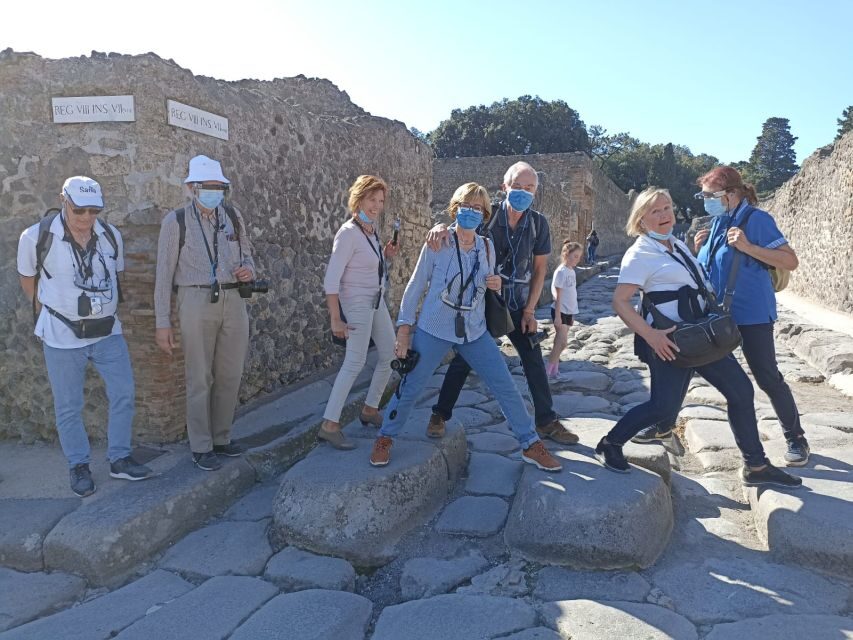
Pompeii is outdoors and can get brutally hot. Bring what keeps you walking comfortably for two hours:
- Comfortable shoes
- Sunglasses and sun hat
- Comfortable clothes, weather-appropriate
- Water
Even though the tour involves tech, the core activity is still walking. AR glasses are worn on your head, so you want steady comfort and good footing. Also, consider that the equipment and stops mean you’ll be focusing on what you see, not constantly moving off-route.
Luggage is also a factor. Luggage or large bags are not allowed, so pack light.
Logistics that affect your day: rain or shine, then explore on your own
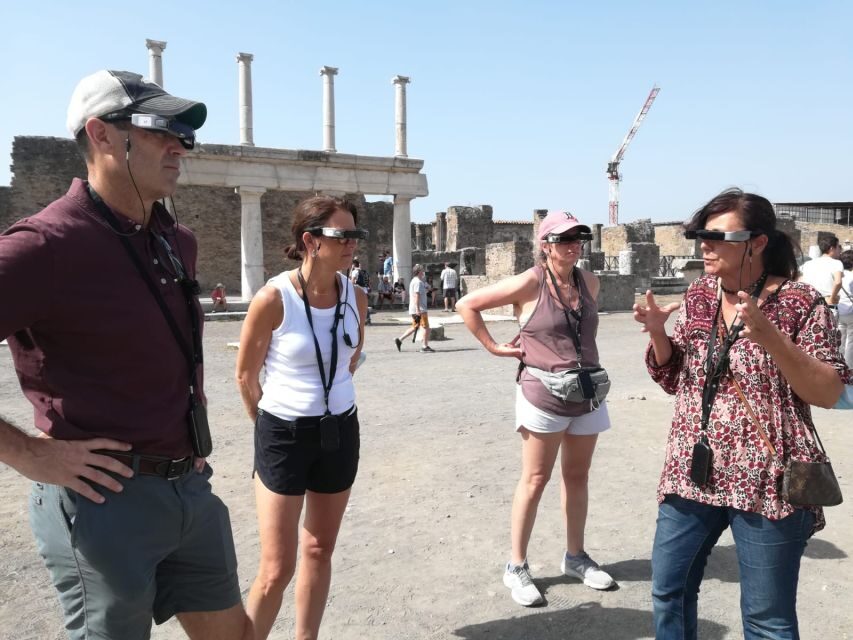
This tour runs rain or shine. Pompeii doesn’t shut down because the sky changes its mind, and neither does the experience. If rain is in the forecast, wear weather-appropriate clothing and keep your plan flexible.
When the tour ends and the AR glasses are returned, you can stay in the archaeological park and explore independently. That’s a big plus. You get the guided AR route for the overview, then you can linger at the places that clicked for you and revisit sections at your own pace.
Limits and rules to know so nothing surprises you

A few clear boundaries can save you stress on the day:
- No luggage or large bags
- Children under 8 can’t use the 3D technology
- The tour waits up to 5 minutes for late arrivals
- AR glasses can be worn even if you already wear eyeglasses
- The tour includes the core urban areas shown through the AR reconstructions, but it does not include suburban villas like Villa dei Misteri
Also note the guide/instructor languages: Italian and English. Audio is available in six languages, including Italian, French, Spanish, German, English, and Portuguese.
So, should you book the Pompeii 3D walking tour?
Book it if you want Pompeii to feel readable. The AR overlays help you connect ruins to what they were used for, especially in public spaces, homes, and performance areas. The small group size and the presence of an assistant also make the experience easier to manage than a self-guided plan when crowds and complexity hit.
Skip or reconsider if you’re traveling light on time and don’t want tech. If you only need a quick, independent look or you don’t plan to use audio and visual reconstructions, the bundled value might not match your style. Also, if your group includes children under 8, double-check how you’ll handle the 3D tech restriction.
If you’re trying to make the most of Pompeii in about two hours, this is one of the more practical ways to turn stone fragments into a city you can picture.
FAQ
How long is the Pompeii 3D walking tour?
The tour lasts 2 hours.
Where do we meet the tour assistant?
Meet at Porta Marina Inferiore, Piazza Esedra, outside the Vittoria Coffee Shop.
What’s included in the price?
The package includes the entry ticket, augmented reality assistant, augmented reality glasses, audio available in 6 languages, and a walking tour.
Is transportation included?
Transportation is not included.
Can I stay in Pompeii after the tour ends?
Yes. After the tour is over and the AR glasses are returned, you can explore the archaeological park independently.
Can children under 8 use the 3D technology?
Children under 8 can access the park with a standard ticket, but they cannot use the 3D technology.
Are the AR glasses wearable if I already wear eyeglasses?
Yes. AR glasses can be worn by participants who already wear eyeglasses.
What languages is the audio available in?
Audio is available in Italian, French, Spanish, German, English, and Portuguese.