REVIEW · POMPEII ARCHAEOLOGICAL SITE
Pompeii: Skip-the-Line Ticket and Virtual Museum
Book on GetYourGuide →Operated by TOURISTATION · Bookable on GetYourGuide
Pompeii feels real the second you arrive. This one-day combo pairs skip-the-line entry to the ruins with a Virtual Museum intro and 3D reconstructions, so you’re not just walking stones. You’ll see the Forum, baths, streets, and amphitheater—and then understand what you’re looking at before the site gets huge in front of you.
What I like most is the way the Virtual Museum helps you get oriented fast, including a French-language presentation at the start that makes the ancient city easier to picture. I also like that you’re free to explore the archaeological site at your own pace over a large area (more than 50 hectares), with a city map to keep you moving in a sensible order.
One consideration: this is not a guided tour, and at least one visitor felt the Virtual Museum presentation was outdated. So if you want lots of live interpretation and deep answers on the spot, you may find you want more explanation while you walk.
In This Review
- Key things to know before you go
- Skip-the-line Pompeii: What it changes for your day
- The Virtual Museum start: Your mental map before the stones
- Pompeii on your schedule: Forum to neighborhoods
- The central Forum
- Streets, aqueduct remnants, and street fountains
- Public baths, private houses, and businesses
- Amphitheater and theater: Where crowds once roared
- The multimedia eruption finale: Why the ending matters
- Value and price: Is $60 a smart deal?
- Practicalities that keep your day smooth
- What to bring
- What not to bring
- Pets and dogs
- Meeting point
- How long it takes
- Who this Pompeii ticket fits best
- Should you book this skip-the-line Pompeii + Virtual Museum?
- FAQ
- How long is the experience?
- Does this include skip-the-line entry to Pompeii?
- Is a ticket to the Virtual Museum included?
- Is there a guided tour or an audio guide included?
- Does the ticket include Villa dei Misteri?
- Where is the meeting point?
- What do I need to bring?
- Are pets allowed?
- What items are not allowed on-site?
- Is this experience refundable?
Key things to know before you go
- Skip-the-line entry into Pompeii saves time when the crowds are thick
- Reserved Virtual Museum ticket gives you a structured start before the ruins
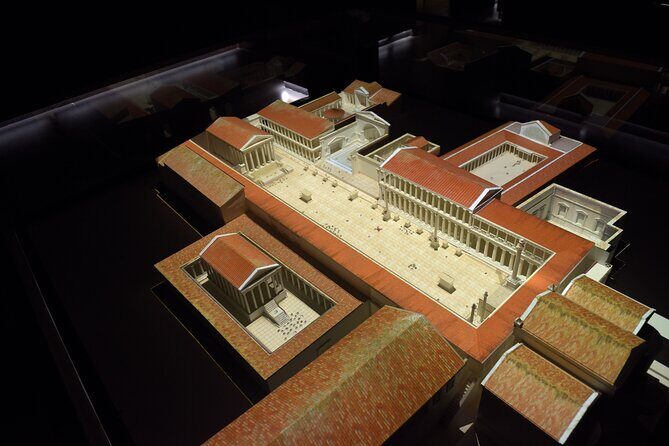
- Animated 3D reconstructions help you recognize buildings like the Forum, baths, and amphitheater
- Self-paced walking with a map means you can slow down or zoom ahead
- No admission to Villa dei Misteri means you’re focusing on the main city experience
- ID required and you can’t bring luggage or large bags into the site
Skip-the-line Pompeii: What it changes for your day
Pompeii is famous for a reason, but it’s also famous for lines. Paying for skip-the-line entry matters because it protects your time. When you’re spending a day at Pompeii, you want those hours on the ground, not stuck in a queue doing your best impression of a marble column.
This ticket gives you access to Pompeii’s archaeological site with the expectation you’ll wander. That freedom is a big part of the value. Pompeii covers a huge footprint, and even if you don’t see everything, the best experience is often moving through spaces in the right order: public areas first, then neighborhoods, then the entertainment sites. The skip-the-line part gives you a cleaner start so you can set your own rhythm rather than being dragged along by crowd timing.
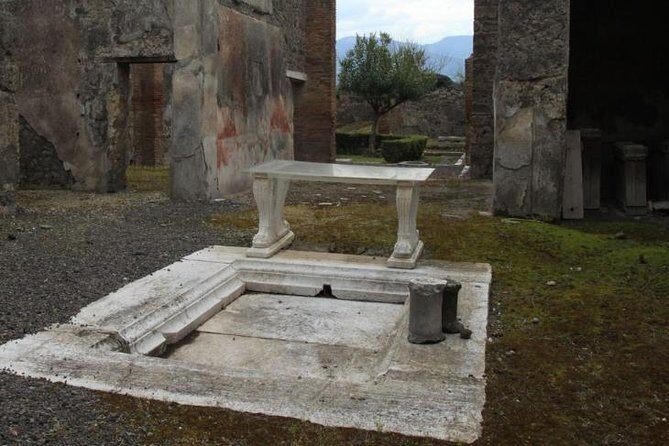
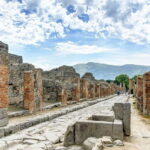
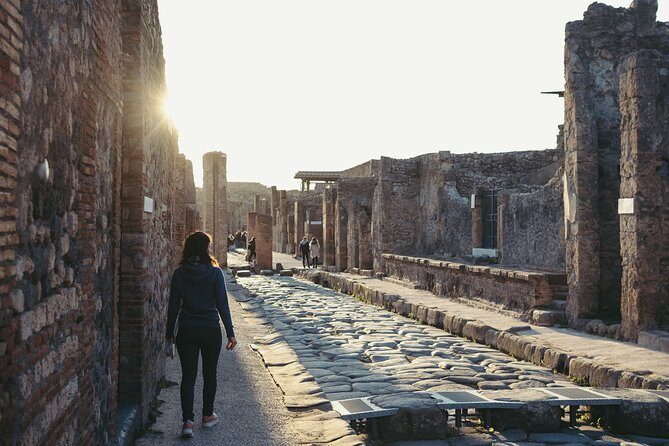
You’ll be walking through streets and structures that were frozen by the eruption of Vesuvius in 79 AD. The city is still readable. You’ll see remnants of columns and doorways, and you’ll be able to recognize where life happened—shops near the streets, public spaces in the center, and larger venues where crowds gathered.
The biggest practical win here is pacing. If you’re the kind of traveler who likes to stop, look, and connect dots, skip-the-line helps you do that without feeling punished by the clock.
If you're still narrowing it down, here are other tours in Pompeii Archaeological Site we've reviewed.


The Virtual Museum start: Your mental map before the stones
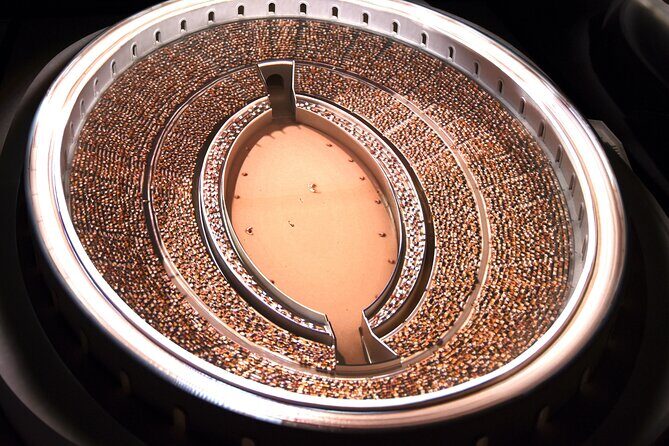
The Virtual Museum part of this package is designed as a kind of warm-up. It’s not just extra entertainment—it’s meant to change how you see what’s ahead. The idea is simple: you watch animated reconstructions of key places, then you go walk the real ruins with a stronger sense of what they once looked like.
You can expect animated reconstructions of major buildings such as:
- the Forum
- the baths
- the Amphitheater
- and a 3D experience focused on important buildings and houses
You’re also guided into the story of daily life. The Virtual Museum experience is presented as if you’re seeing Pompeii through a citizen’s eyes, which is exactly what you want when you arrive at a place that looks like scattered walls until someone helps you read the layout.
One review specifically called out that the Virtual Museum was shown in French at the very beginning of the excursion, and that this helped them visualize Pompeii in its original time period. That’s a clear clue that the presentation is most useful when it matches your language comfort level.
Possible drawback: since at least one booking criticized the Virtual Museum presentation as outdated, don’t treat it as the main reason for the trip. Think of it as a helpful primer. Your real payoff is the on-site ruins and your own walking time.
Pompeii on your schedule: Forum to neighborhoods
Once you’re at Pompeii, you’ll explore at your own pace with a city map. That matters here because Pompeii isn’t a single monument. It’s a network of spaces: public squares, streets, water systems, bath complexes, homes, and workplaces. If you’re forced into a strict route, you can miss the moments when the site clicks.
A few of the highlights you’ll be looking for:
The central Forum
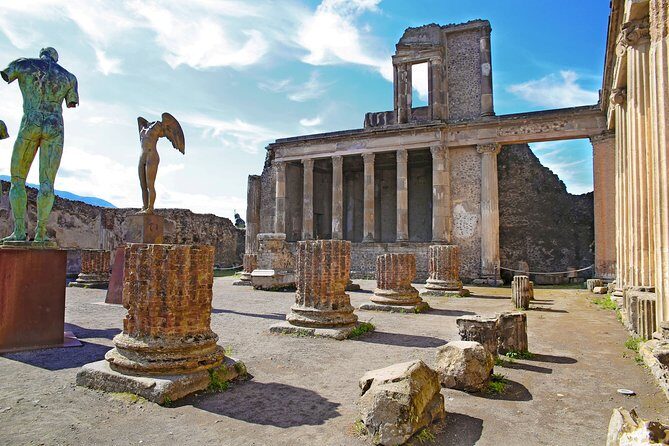
The Forum is where Pompeii feels most like a Roman city. You’ll walk around the central space and admire the surroundings with Mount Vesuvius in the background. The payoff is not only the view—it’s the understanding of scale. When you stand where leaders and crowds gathered, the city starts to look like it had a pulse.
You’ll also see remnants of columns and doorways. They look small until you remember these openings weren’t just decoration; they framed movement, entrances, and street-level activity.
Streets, aqueduct remnants, and street fountains
Pompeii’s street life is one of the reasons it survives so well. You’ll wander the streets and uncover remnants connected to the city’s water and daily routines, including:
- the aqueduct
- street fountains
These details help you imagine ordinary mornings and afternoons, not just dramatic tragedy.


Public baths, private houses, and businesses
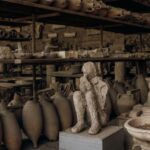
You’ll also move through areas connected to different parts of society. The public baths show communal life. Private houses and businesses show how people actually worked, cooked, hosted guests, and earned money. Pompeii is one of those rare sites where the evidence spans social classes, because the built environment includes both everyday spaces and large civic buildings.
Even better, you’ll encounter statues and remnants of artworks. This is where you start to understand that Pompeii wasn’t “ruins with a story.” It was a living city full of choices—what you wore, where you went, and what you valued.
Amphitheater and theater: Where crowds once roared
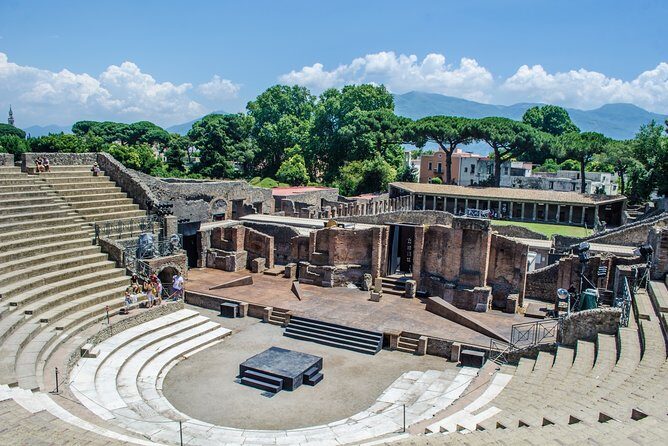
The entertainment side of Pompeii hits fast. You’ll see the Amphitheater and the dramatic theater (the listing uses this phrase for the theater experience). These venues are the places where you’d expect noise, excitement, and spectacle—and the ruins still communicate that energy.
From the Virtual Museum component, you’ll have seen reconstructions of the amphitheater. That means when you arrive on-site, you’re more likely to notice structure and sightlines instead of just admiring stone seating.
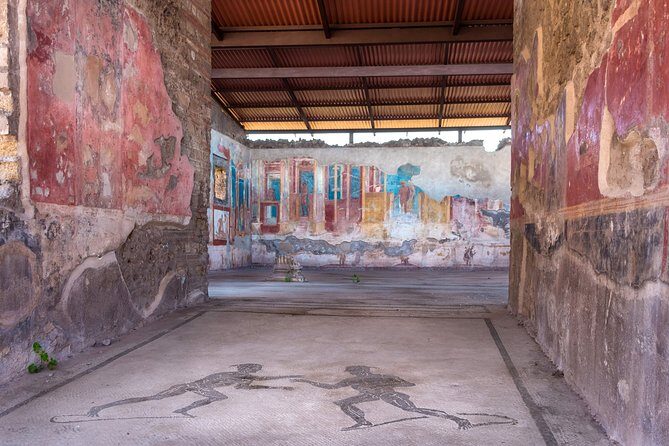
You’ll also see what remains of colorful frescoes in houses and business areas. Frescoes are a reminder that Pompeii wasn’t gray and quiet. Even where the paint is damaged, the idea of color survives in fragments—and that can make the ruins feel less like a museum exhibit and more like the walls are still trying to tell you something.
One practical tip for this portion: give yourself time. Entertainment buildings are big. If you rush, you’ll miss the emotional shock that happens when you realize this is where people once gathered for plays and events, right before catastrophe changed everything.
The multimedia eruption finale: Why the ending matters
The tour doesn’t stop with wandering. You complete the experience with a multimedia video experience focused on the eruption and the destruction it caused.
You’re meant to revisit life before and during the eruption of Vesuvius in 79 AD. Then the finale provides a reconstruction of the terrible eruption spectacle. That ending is powerful because it reframes what you saw earlier.
On-site, the ruins can feel like a time capsule. The video part forces the logic of what happened: the city didn’t simply “freeze.” It stopped. The story becomes clear, and suddenly you understand why certain details remain visible where they do.
In practical terms, the multimedia ending also helps you wrap up your day with one last mental image, instead of leaving Pompeii with scattered impressions. Even if the reconstructions aren’t perfect, the arc is strong: city life, then rupture.
Value and price: Is $60 a smart deal?
At $60 per person for a day, the value hinges on what you’re trying to get from Pompeii.
Here’s the honest math of what’s included:
- Skip-the-line ticket for Pompeii archaeological site
- Reserved ticket for the Virtual Museum
- City map
- Wi-Fi
What you’re not getting (which affects value):
- no guided tour
- no audio guide
- no Villa dei Misteri entrance
If you’re visiting Pompeii for the ruins and want to avoid line-waiting, the skip-the-line portion is a big chunk of the price justification. The Virtual Museum reservation adds structure, especially if you want a pre-walk orientation rather than wandering with only your instincts.
This package is best value for travelers who:
- like self-paced walking
- want to save time at the entrance
- can use a multimedia primer to make the ruins easier to read
It’s less value for travelers who:
- want a full guided interpretation (because you won’t get that here)
- specifically planned to include Villa dei Misteri (because it’s not included)
Practicalities that keep your day smooth
A day at Pompeii works best when you plan for the basics, because there’s not much room for improvising once you’re moving through the ruins.
What to bring
Bring a passport or ID card. You’ll need ID for all participants.
What not to bring
Keep luggage out. No luggage or large bags, and no smoking. Also no alcohol and drugs.
Pets and dogs
Pets aren’t allowed, but small dogs are permitted inside the archaeological area under conditions: they must be kept on a leash and carried when inside the buildings. If you’re traveling with a dog, plan around those restrictions.
Meeting point
Report to the Office IBT Center/Touristation next to Chalet Donna Lucia. Getting there smoothly matters because you’re combining a museum-style start with on-site walking.
How long it takes
The duration is 1 day, with starting times you should check. Without a guided script, you’ll want to pace yourself realistically. Pompeii can swallow time, especially if you stop often.
Who this Pompeii ticket fits best
This is a strong choice if you want Pompeii to be a day you control, not a day where you’re herded.
It fits especially well for:
- Couples and solo travelers who like self-guided exploration
- Travelers who want a jump-start explanation from the Virtual Museum before seeing the real Forum and amphitheater
- People who prefer multimedia support rather than standing in a line listening to a guide talk the whole time
It may not be the best fit if you:
- want a guided tour with lots of live commentary
- are aiming to include Villa dei Misteri
- need a fully updated, highly dynamic multimedia presentation as the main experience (one visitor flagged that the Virtual Museum can feel obsolete)
Should you book this skip-the-line Pompeii + Virtual Museum?
Book it if you want an efficient, well-rounded day that pairs time-saving entry with a primer that makes the ruins easier to understand. The skip-the-line part alone helps protect your day, and the reserved Virtual Museum ticket gives you context so you don’t wander Pompeii like you’re looking at random walls.
Skip it (or pair it with something else) if you’re the type who needs a live guide for interpretation, or if Villa dei Misteri is a must for your Pompeii checklist. Also, if you’re very sensitive to presentation quality, know that the Virtual Museum has had mixed feedback.
FAQ
How long is the experience?
It’s listed as 1 day. Starting times depend on availability.
Does this include skip-the-line entry to Pompeii?
Yes. You get a skip-the-line ticket for the Pompeii archaeological site.
Is a ticket to the Virtual Museum included?
Yes. You receive a reserved ticket for the Virtual Museum.
Is there a guided tour or an audio guide included?
No. A guided tour and an audio guide are not included.
Does the ticket include Villa dei Misteri?
No. Entrance to Villa dei Misteri is not included.
Where is the meeting point?
Meet at the Office IBT Center/Touristation next to Chalet Donna Lucia.
What do I need to bring?
Bring your passport or ID card. ID is required for all participants.
Are pets allowed?
Pets are not allowed, but small dogs are permitted inside the archaeological area if they are on a leash and carried when inside buildings.
What items are not allowed on-site?
You can’t bring luggage or large bags, and smoking is not allowed. Alcohol and drugs are also not allowed.
Is this experience refundable?
No. The activity is non-refundable.