REVIEW · POMPEII
Pompeii: Guided Tour with Priority Entrance
Book on Viator →Operated by IAMME IA! - Gray Line Amalfi Coast · Bookable on Viator
Skip the line and walk back in time. This 2.5-hour guided Pompeii tour uses priority entrance plus headset audio so you can actually hear the story while you move through the busiest ruins. You’ll cover the big public sites like the Civil Forum and Temple of Jupiter, then keep going to places that show everyday life—baths, the Lupanar, and major house and theater stops.
My favorite part is the headset setup in the open-air crush. It helps you focus on what the guide is saying instead of craning your neck. I also love how the route strings together the city’s “who did what” spaces—politics and justice in the Forum, then trade areas, then daily living spots—so Pompeii feels like a functioning town, not just a pile of walls.
One thing to plan for: this is a walking route on uneven surfaces, and Pompeii can roast you in summer. Even with priority entry, you still want to arrive on time and keep your expectations realistic about heat and crowd flow.
In This Review
- Key Points I’d Book For
- Priority Entry at Pompeii: What You Really Gain
- Meeting at Camping Zeus: Start Smart, Stay Together
- The Archaeological Park Stop: First Steps Inside the UNESCO City
- Civil Forum and Temple of Jupiter: Pompeii’s Power Center
- Macellum and Business Spaces: Markets, Religion, and Imperial Control
- Via dell’Abbondanza: The Main Street Where Noise Would Have Lived
- Stabian Baths (Terme Stabiane): Hot, Cold, and Split by Gender
- Lupanar: The Brothel Stop That People Either Love or Skip
- House of the Faun and the Alexander Mosaic: Elite Art You Can’t Unsee
- Large Theater: Why Entertainment Belongs in the Pompeii Story
- Headsets, Pace, and Group Size: A Huge Site, One Plan
- Value for $59.13: When This Tour Feels Like a Good Deal
- Who This Pompeii Priority Tour Fits Best
- Should You Book This Pompeii Priority Tour?
- FAQ
- How long is the Pompeii guided tour with priority entrance?
- Is priority admission included so I can skip the line?
- Does the tour include tickets to the main sites?
- Will I be able to hear the guide clearly?
- Where do we meet, and where does the tour end?
- What happens if the weather is bad?
Key Points I’d Book For
- Priority admission so you spend less time waiting at the entrance
- Headsets to keep the guide’s commentary clear in a noisy, outdoor site
- Forum-to-everyday-life route covering justice, markets, baths, and entertainment
- House of the Faun highlight with the Alexander Mosaic stop you’ll want to see
- Small group cap (up to 25) helps you stay oriented and not feel swallowed by the masses
Priority Entry at Pompeii: What You Really Gain
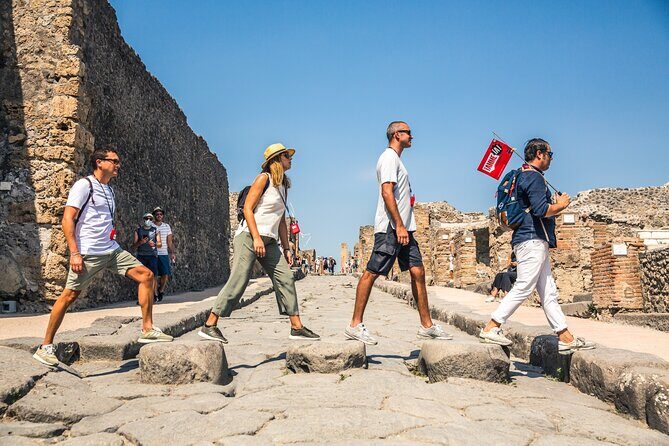
Pompeii is huge, and it’s not set up like a museum where everything is easy to reach in a straight line. The big value of a guided tour with skip-the-line admission is simple: you start sightseeing sooner, and you don’t lose your energy to entrance queues.
But priority isn’t just about saving time at the gate. It changes the whole vibe of the visit. If you get into the ruins earlier, you’re more likely to beat the most intense crowd bursts around the Forum and the most photogenic corners. That matters because the site is open-air. When the heat and the crowds peak, it gets hard to think, let alone listen.
This tour is built around a tight, sensible circuit. You’ll hit the core civic landmarks first—then fan out into baths, a famous brothel, a major elite house, and an open-air theater. In 2 hours 30 minutes, you’re not trying to cover everything. You’re trying to see the right things and understand how they connect.
Other skip-the-line Pompeii tours in Pompeii


Meeting at Camping Zeus: Start Smart, Stay Together
The tour meets at Camping Zeus (the Zeus Car Park meeting point), at Via Villa dei Misteri, 3, 80045 Pompei. The activity ends back at the same meeting point, which makes it easy to plan the rest of your day without needing extra navigation tricks.
What you should do: build in buffer time to reach the meeting point. One of the downside themes that shows up in the tour experience is delays—like starting late or technical issues with audio equipment. If anything goes sideways, arriving early is what protects your schedule. Also, the site involves uneven ground, so keeping your bag light helps. Think sunscreen, water, and comfortable walking shoes.
The group size is capped at 25. That’s small enough to feel like a real group rather than a traveling parade. Still, Pompeii is crowded, so you’ll want to follow the guide closely. It’s the difference between feeling “guided” and feeling like you’re constantly playing catch-up.
The Archaeological Park Stop: First Steps Inside the UNESCO City
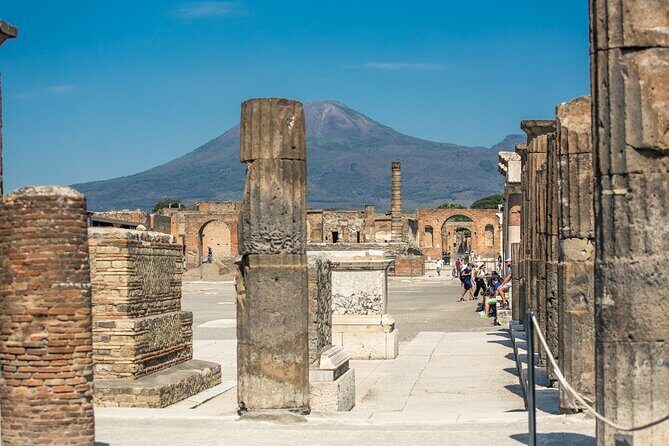
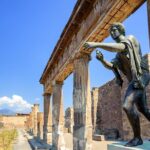
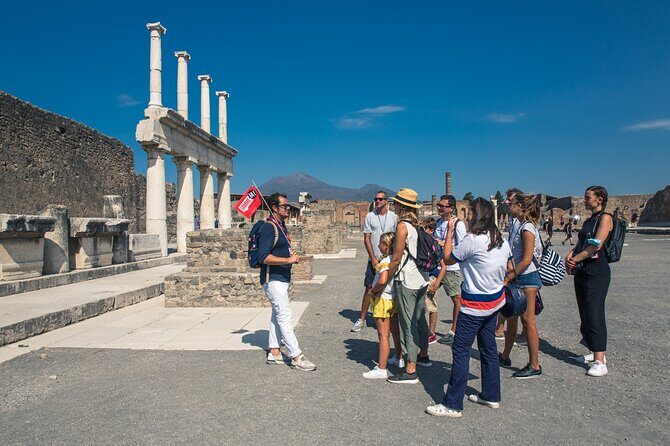
Your first major stop is the Archaeological Park of Pompeii with admission included, and with the key benefit: priority access. Once inside, the tour quickly gets you into the rhythm of the ruins—standing where ancient people lived their daily routines, while your guide explains what you’re actually looking at.
Here’s what I like about tours that begin with this approach: they help you stop treating Pompeii like scenery. Instead, you learn what the buildings were for—public life, religion, commerce, and leisure. That context is what turns random stones into a city you can visualize.
You’ll also be using the tour’s audio system. Headsets are provided to help you hear the guide clearly—especially for groups larger than 10 passengers. In Pompeii, wind and noise are real. Having audio support means you can stay focused on the guide’s explanation instead of constantly turning to find them.
Civil Forum and Temple of Jupiter: Pompeii’s Power Center
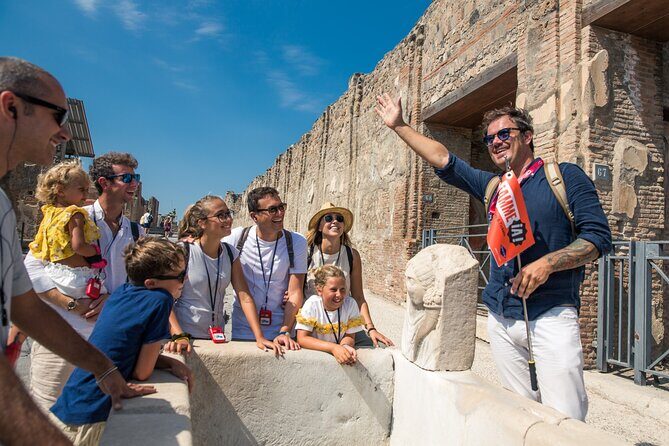
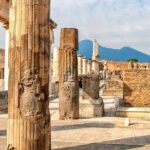
If you want Pompeii to click fast, the Civil Forum is where it starts. This is the core of daily life in the city—where people came for administration and justice, business management, and trade. It was also a citizen worship focal point, so you see civic and religious life braided together.
When your guide points out what kinds of buildings ring the Forum, you start noticing patterns: entrances, elevations, how public space was designed for crowds, and how authority was displayed in stone. Even if you only grasp a few key details, your understanding improves every few minutes.
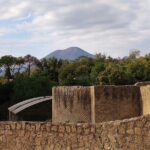
Then you move to the Temple of Jupiter, which dominates the north side of the Forum. The guide’s explanation links two big visuals: the temple’s role in civic-religious identity and Vesuvius rising behind it. That backdrop makes the story harder to forget.
You’ll also hear the temple went through major change when the colony was founded in 80 BC. It was radically renovated and became a real Capitolium. The temple housed cult statues of Jupiter, Juno, and Minerva, placed on a raised base so they could be seen across the Forum square—meaning the architecture was meant to stage power.
Practical note: this is one of the areas where crowds can stack up. If your headset audio is working smoothly, you’ll be able to take in the explanation even when you’re standing with limited elbow room.
Macellum and Business Spaces: Markets, Religion, and Imperial Control
Next up is the Macellum, Pompeii’s market area. This stop is great for understanding how everyday economics mixed with religion and even politics. The structure includes a tuff quadriporticus (a kind of surrounding arcade) and a hall used for worship on the eastern side aligned with the entrance.
What’s interesting here is the mix of “shopping” and “state messaging.” You’ll see details about marble statue elements—copies of two marble figures described as a female and an armed male—plus a fragment likely linked to an emperor such as Titus or Vespasian. The guide ties these details to the imperial cult, which is basically how Roman power made itself felt inside local life.
The Macellum also includes spaces connected to meetings of a sacred board, and even a masonry counter suggested for fish sales. That’s the kind of detail that makes Pompeii feel believable: people weren’t just worshiping and governing. They were buying food, meeting, and negotiating daily needs.
If you’re someone who likes practical “how did daily life work” explanations, this section is usually a highlight.
Other guided tours in Pompeii



Via dell’Abbondanza: The Main Street Where Noise Would Have Lived
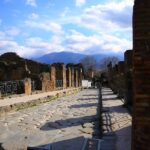
Pompeii’s most famous main street stop is Via dell’Abbondanza. It was the ancient main street (a decumanus maximus), running east–west from the Forum toward Porta Sarno.
Your guide will paint the picture of what this corridor was like in real life: crowded, noisy, with shops and workshops (officinae), cafes, snack-bars, and restaurants for food and drink. The street layout plus the building fronts helps you imagine foot traffic and daily movement. You start seeing the ruins as a network, not isolated “points of interest.”
This stop is also useful for setting expectations: Pompeii was built for flow—people moved through spaces that were designed to handle trade and gatherings. When you understand that, you stop being distracted by what’s missing and start focusing on what’s still legible.
Stabian Baths (Terme Stabiane): Hot, Cold, and Split by Gender
Behind the Temple of Jupiter you’ll reach the Stabian Baths, known as the Terme Stabiane. Dating is part of the story here: they go back to just after Pompeii’s early development around 80 BC, in the era following the founding of the colony of veterans.
The guide explains that the baths had separate entrances for women and men. That detail matters because it shows how public life still followed strict social rules.
Inside the men’s section, you’ll hear about spaces like the apodyterium (dressing room), the tepidarium (medium-temperature bath), the frigidarium (cold bath), and the calidarium (hot bath). Think of it like a sequence you move through, not one room.
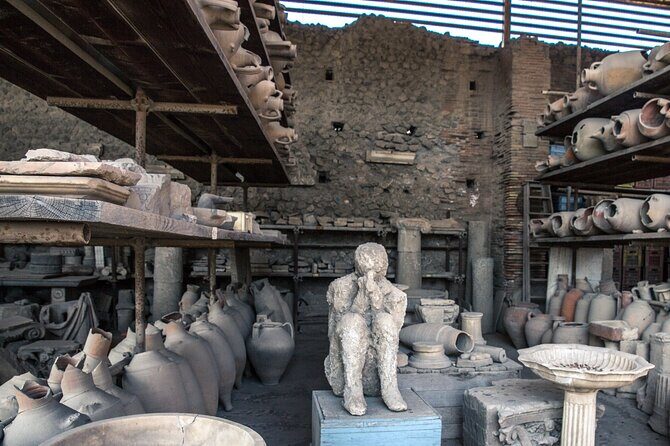
Like many Pompeii buildings, the baths were heavily damaged during the earthquake of 62 AD. That’s one of the recurring themes of Pompeii: disasters didn’t just destroy structures; they interrupted routines and froze daily life midstream. You’ll see it in the way walls and openings look broken and uneven.
A small timing note: this stop is brief (about 10 minutes with admission free). If you love baths and Roman wellness culture, keep an eye on the clock so you don’t miss the key explanation and go back on your own later if time allows.
Lupanar: The Brothel Stop That People Either Love or Skip
Next is the Lupanar, Pompeii’s famous brothel, also known as the Lupanare Grande. This stop is short, but it’s packed with details that make Pompeii feel unfiltered.
The guide’s explanation includes the wall paintings and what they likely communicated. You’ll also learn the meaning of the word Lupanar—literally brothel—and how the sex trade operated in Roman city life.
The provided details get very specific: the prostitutes were mostly described as Greek and Oriental slaves, and payment ranged from two to eight asses. For comparison, a glass of wine was one as. That kind of pricing detail is jarring, but it helps you understand how the economy of sex worked in a way that wasn’t hidden behind myth.
Practical consideration: if this subject doesn’t interest you, the tour time is limited here. Some people may choose to linger less and move on quickly. The good news is the tour keeps moving through the city’s other major highlights.
House of the Faun and the Alexander Mosaic: Elite Art You Can’t Unsee
Then the tour brings you into the House of the Faun, one of the grand Roman villas. The headline is the mosaics, especially the Alexander Mosaic, described as a striking masterpiece of ancient art and storytelling.
Even if mosaics aren’t your “thing,” this is still one of those Pompeii moments that helps you understand who owned these houses and what they wanted to show off. Roman elite homes were cultural billboards. They weren’t only about comfort; they were about status and identity.
If you like art, storytelling, or just the sheer workmanship of ancient work, plan to slow down here. This is one stop where time spent listening pays off because the guide can connect what you’re seeing to larger Roman tastes.
Large Theater: Why Entertainment Belongs in the Pompeii Story
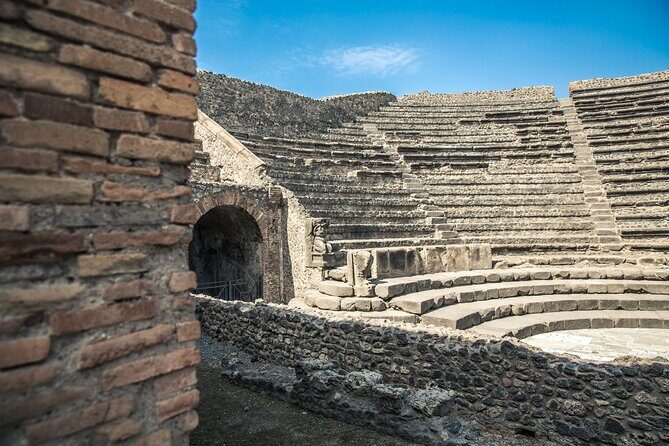
After the house stop, you’ll head to the Large Theater, an open-air venue where crowds once gathered for performances—comedies, dramas, and musical events.
This is a good “balance” stop. After you’ve learned about civic life, trade, baths, and the Lupanar, theater reminds you there was leisure too. A city doesn’t just run on politics and commerce. It needs community gathering, entertainment, and spectacle.
You’ll probably also notice the theater’s design helps manage crowds and acoustics. Even without technical details, the space tells you how Romans staged public life.
Headsets, Pace, and Group Size: A Huge Site, One Plan
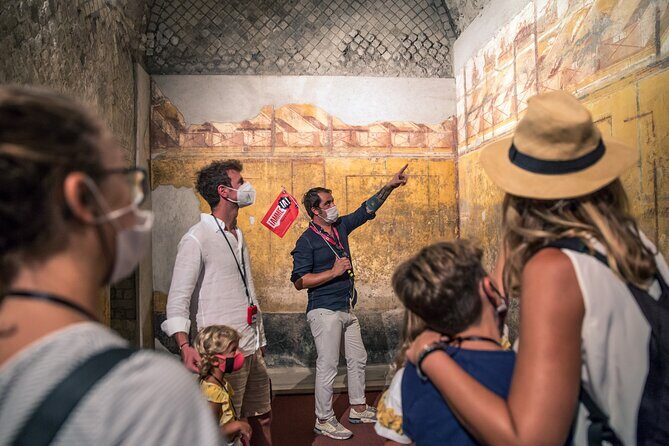
This tour uses headsets to help groups hear the guide clearly in Pompeii. In practice, this is where the tour quality is felt. If the audio works, you can keep your attention on the guide’s narration instead of constantly searching for them.
Most of the experience data is positive here—people praise easy group finding and working headsets. There’s also a clear caution from one unhappy experience: audio issues can happen, and starting late can snowball into longer waits than expected. That’s why I suggest two simple rules:
- Arrive early so you’re not rushed into your first decision point
- Keep your schedule flexible enough to handle a delay without ruining the rest of your day
Pace is another factor. One theme that shows up is that Pompeii has too much to see in only 2 hours 30 minutes. The guide can only cover key highlights. That’s not a failure—it’s the tradeoff for priority entry and a focused route.
Value for $59.13: When This Tour Feels Like a Good Deal
At $59.13 per person, you’re paying for three things bundled together: a licensed guide, priority entrance, and guided navigation through major highlights.
If you were to visit Pompeii on your own, you’d need to do your homework to connect the Forum buildings, the market spaces, the baths, and the entertainment venues. That context doesn’t come automatically. A guide gives you the map in your head while you walk the ruins.
You’re also getting admission support included as part of the route. Different stops have different ticket notes—for example, some are included, and others are listed as free with admission. The overall structure means you’re not constantly checking what’s included and what isn’t once you’re inside.
Is it the cheapest way to see Pompeii? Probably not. Is it a practical way to see the right highlights without wasting half your day on logistics and crowd confusion? That’s the value proposition that makes sense, especially if you have a limited time window.
Who This Pompeii Priority Tour Fits Best
This tour is a strong match if:
- You want a guided route that focuses on the city’s most important public sites and standout ruins
- You’d rather spend your limited time learning than plotting an efficient route on the spot
- You like hearing how architecture connects to daily life, not just reading plaques
- You can do a couple of hours of walking on uneven surfaces in warm weather
It may be less ideal if:
- You need total freedom to wander slowly at every stop
- You’re traveling with kids who need constant pacing control (the tour is designed for staying as a group)
- You’re extremely sensitive to heat and want frequent long breaks
If you get a guide like Giulia, you might hear a lot of enthusiasm and clear answers to questions. If your guide is Vincenzo or Vicente, you may find the tone friendly and the explanations organized. Names like Claudio, Max, and Vivianna also show up as standout examples of guide style from the experience data. You can’t choose a guide in advance based on this information, but you can feel confident that guides are a central part of why people enjoy this tour.
Should You Book This Pompeii Priority Tour?
Book it if you want a structured first trip to Pompeii. Priority entrance helps you start strong, the headsets make the narration usable in a busy outdoor site, and the itinerary hits the Forum core plus everyday-life anchors like baths, the Lupanar, the House of the Faun, and the theater.
Skip this style of tour and consider going at your own pace if you:
- want to move slowly and repeatedly re-visit details
- need frequent stops that break group flow
- plan to spend most of your time on areas not covered in a tight highlight circuit
My practical take: if it’s your first time at Pompeii and you only have a half-day, this is a smart way to get oriented and leave with the city’s story in your head—not just photos on your phone.
FAQ
How long is the Pompeii guided tour with priority entrance?
It runs about 2 hours 30 minutes.
Is priority admission included so I can skip the line?
Yes. Skip-the-line admission fees to the Pompeii ruins are included.
Does the tour include tickets to the main sites?
Admission is included for the archaeological park and listed stops, with specific note that the Stabian Baths admission is free and the Lupanar admission is included.
Will I be able to hear the guide clearly?
Yes. Headsets are provided in Pompeii to help you hear the guide clearly for groups bigger than 10 passengers, and the tour is offered in English.
Where do we meet, and where does the tour end?
You meet at the Zeus Car Park meeting point at Camping Zeus (Via Villa dei Misteri, 3, 80045 Pompei NA, Italy). The tour ends back at the meeting point.
What happens if the weather is bad?
This experience requires good weather. If it’s canceled due to poor weather, you’ll be offered a different date or a full refund.