REVIEW · POMPEII
Guided Private Tour in Pompeii
Book on Viator →Operated by Capri Top Tours · Bookable on Viator
Pompeii feels human again on this walk. This private tour takes you through daily Roman life with an archaeologist leading the way, and the storytelling sticks long after you leave the stones. I love that it’s built around real routines—streets, markets, baths, religion—so you don’t just “see ruins,” you understand how people lived.
Second, I like the practical flow: you start at Piazza Esedra, use a smart entrance to help you avoid the worst queue, and then keep moving without wasting time. One possible drawback: it’s only about 2.5 hours, so the stops are tight—and a couple viewpoints (like a Teatro Grande panoramic angle) may not be accessible at the moment.
If you want Pompeii to feel tailored, this is a good bet because it’s private for your group (up to 5) and uses a mobile ticket. Just budget for the Pompeii park entrance separately, since that’s not included in the tour price.
In This Review
- Key things to know before you go
- Entering Pompeii like a local: the Piazza Esedra start
- How the 2.5-hour private format actually feels on the ground
- Stop by stop: streets, forum energy, and what daily life looked like
- Pompeii Archaeological Park entrance and the port view
- Teatro Grande: entertainment in two sizes
- Tempio di Iside and a nearby house tied to the excavation story
- Termopolio di Vetuzio Placido: Pompeii’s fast-food wall
- Stabian Baths (Terme Stabiane): how Romans stayed clean and safe
- The two big “wow” stops: brothel history and luxury house life
- Piccolo Lupanare: the red-light district on foot
- Casa del Fauno: villa luxury, frescoes, and a glass of wine
- Temples and political power: why the forum felt like the center of everything
- Basilica: Pompeii’s parliament energy
- Temple of Apollo and religious rhythm
- Temple of Jupiter Capitolino: public speech in the forum area
- Food market and street realism: where you feel Pompeii’s texture
- Macellum: market life with frescoes and body casts
- Tempio di Venere: scenery highlight with sanctuary context
- Price and ticket math: is $326.72 per group good value?
- What you’ll get beyond ruins: Roman food, baths, and the “daily life” lens
- Practical tips so your Pompeii visit stays comfortable
- Should you book this Pompeii private tour?
- FAQ
- What is included in the guided Pompeii tour?
- How much are the Pompeii Archaeological Park tickets?
- How many people are in the private group?
- How long does the tour last?
- Where do we meet for the tour?
- Do you use a mobile ticket?
- Is free cancellation available?
Key things to know before you go
- An authorized archaeologist guides the pacing so you get context for what you’re seeing, not just names.
- Small private group (up to 5) makes it easier to ask questions and keep the tour at your speed.
- A smart Pompeii entrance via Piazza Esedra helps you get inside and start seeing the port area faster.
- Food and bath experiences are built in—this is more than a photo stop circuit.
- You hit a lot of Pompeii types: temples, political buildings, markets, entertainment, and a luxury house.
Entering Pompeii like a local: the Piazza Esedra start
The meeting point is Ristorante Suisse, Piazza Esedra 10/13. Starting here matters because it sets you up to enter Pompeii through Porta Marina Inferiore—the tour’s chosen way to help you avoid long lines and also get a quick visual handle on the old port area.
The tour runs during the daytime window (the listed hours are 9:00 AM to 3:00 PM, Monday through Sunday). That’s useful because Pompeii can get hot and crowded later, and you’ll still cover a lot in a short, focused session.
You’ll also use a mobile ticket, which is one less thing to juggle once you’re near the entrance gates. For families and first-timers, this reduces friction: you can focus on the ground in front of you, not your phone and paperwork.
Other private Pompeii tours we've reviewed in Pompeii

How the 2.5-hour private format actually feels on the ground
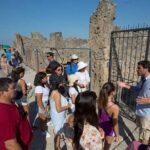
This tour is designed for people who want highlights, but with real explanation. With a group limited to up to five, you’re not competing with strangers for the guide’s attention, and you’re more likely to get answers that match your interests.
The trade-off is time. Pompeii is huge, and even a “highlights” tour will feel like a sprint. Still, the route is structured so you move through major categories—civic life, religion, food, entertainment, and domestic spaces—so the time doesn’t feel random.
And based on the way the guide works, expect a steady pace with room for the kind of questions that keep you engaged—especially when the guide connects everyday life to what you’re standing in.
Stop by stop: streets, forum energy, and what daily life looked like
Pompeii Archaeological Park entrance and the port view
You begin at Pompeii Archaeological Park, entering at the Piazza Esedra → Porta Marina Inferiore point. The big win here is timing and orientation: you get inside with less waiting, and you start with a sense of where ships and trade would have mattered.
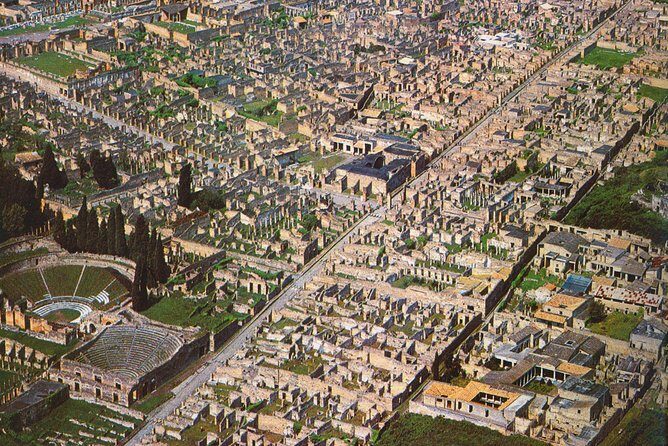
Think of this as your quick “map lesson.” Once you have the layout in your head, everything later—baths, markets, temples—makes more sense.
Teatro Grande: entertainment in two sizes
From there, you head to the Teatro Grande area. The tour includes time for the Big Theater and Little Theater from a panoramic view, though the listing notes that this panoramic access may not be available at the moment.
Even with that limitation, the theaters are one of Pompeii’s best reminders that Romans weren’t only political and religious. They built venues for spectacle, and that entertainment thread shows up again and again in how the city is laid out.
If you care about performance spaces, arriving with that question—What did people do here?—will help you read the site faster.
Other guided tours in Pompeii


Tempio di Iside and a nearby house tied to the excavation story
Next is the Tempio di Iside (Temple of Isis). You’ll also visit a house right in front of the temple, described as connected to the story of how Pompeii was found.
This combo is useful because temples are often photographed as standalone monuments. The reality is more human: neighborhoods and domestic spaces lived side by side with religion, and that blending helps you understand how worship fit into daily routines.
Termopolio di Vetuzio Placido: Pompeii’s fast-food wall
Then you reach the Termopolio di Vetuzio Placido, one of Pompeii’s best-known examples of “fast food.” This is where you stop thinking in abstract and start imagining lunch: quick meals, social talk, and painted surfaces that advertised what you could buy.
The walls are famous for artwork. Even if your Italian isn’t perfect, you’ll leave with a clear sense of how a termopolio worked as a daytime hub.
Stabian Baths (Terme Stabiane): how Romans stayed clean and safe
At Stabian Baths, you get one of the most practical pieces of the whole experience: public spa life. The tour includes time to experience a Roman-style bathing ritual, so you’re not just looking at rooms—you’re trying to picture the steps and routines.
The baths are also a great “social architecture” lesson. Romans weren’t just cleaning; they were gathering, talking, and using the public space safely as part of everyday life.
The main consideration here is comfort. Pompeii is uneven and you’ll be moving through ancient stone corridors and platforms, so wear shoes you trust.
The two big “wow” stops: brothel history and luxury house life
Piccolo Lupanare: the red-light district on foot
Next is the Piccolo Lupanare, described as a red-light district and including a visit to the brothel. This isn’t added for shock value; it’s here because sex work and nightlife were part of the city’s economic and social ecosystem.
Look at it like a history problem: How did space work? Where did customers wait? How did the business advertise itself?
If you’re sensitive to adult themes, this stop may feel awkward—plan for that. But if you want the full Pompeii picture, you can’t skip it.
Casa del Fauno: villa luxury, frescoes, and a glass of wine
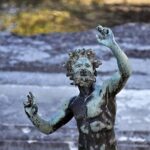
Then you hit the Casa del Fauno, one of the best examples of Pompeii luxury. You’ll spend time with the garden of a Roman villa and admire frescoes, with a glass of wine included as you reflect on what this house signals about wealth and daily comfort.
This is the moment when Pompeii stops feeling like a single city and starts feeling like a whole social ladder. The contrast between bath walls, street-level food spots, and a luxury villa house is exactly the point.
It’s also a good reminder that “Roman daily life” wasn’t only public. Many of the most important moments happened at home: eating, showing status, hosting, and collecting art.
Temples and political power: why the forum felt like the center of everything
Basilica: Pompeii’s parliament energy
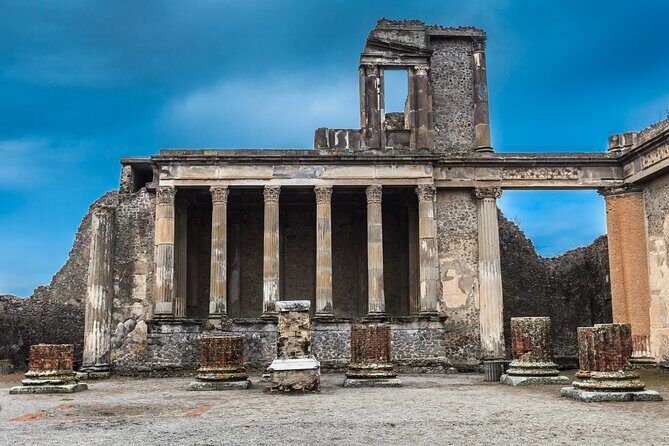
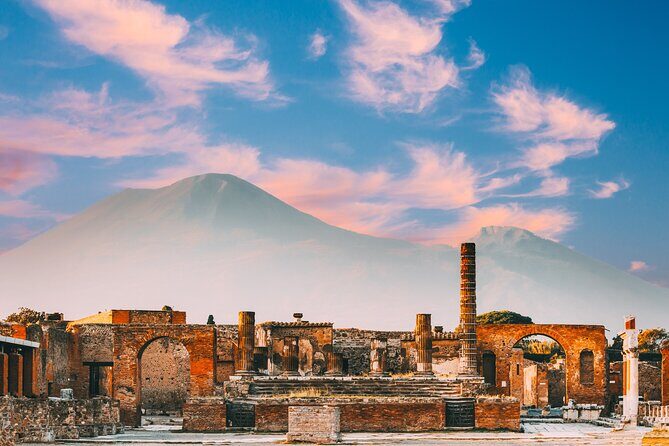
You’ll pass by Pompei La Basilica, described as the Roman political space with high-style marble decoration. This kind of building matters because it tells you how power looked: formal, expensive, and designed to impress.
Standing there with a guide changes the experience. Instead of seeing columns and marble, you start connecting it to speeches, decisions, and public business.
Temple of Apollo and religious rhythm
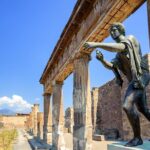
Next is the Temple of Apollo, in its sanctuary setting. Temples like this are easier to understand once you’ve already walked through civic buildings, because religion and politics were linked in everyday life.
It’s not only about belief. It’s about routines—how public space kept a city organized.
Temple of Jupiter Capitolino: public speech in the forum area
Then comes the Tempio di Giove Capitolino (Jupiter’s sanctuary). The tour frames it as connected to public speech in the forum, which helps you treat it like a working part of civic life rather than a scenic stop.
Food market and street realism: where you feel Pompeii’s texture
Macellum: market life with frescoes and body casts
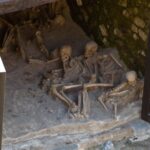
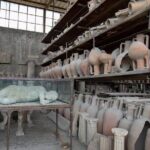
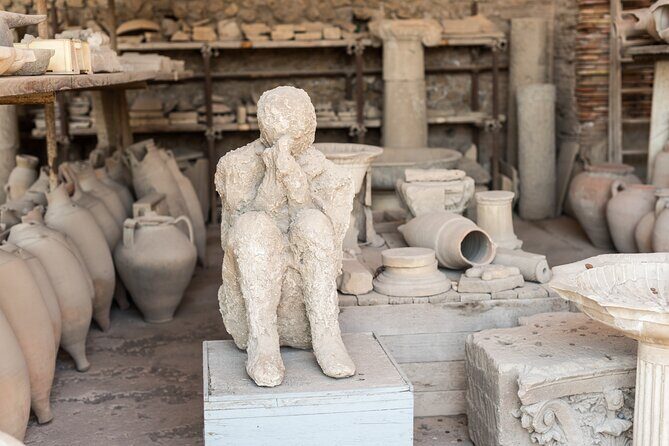
At the Macellum, the food market, you get time to see the frescoes and also what are described as body casts. This is emotionally heavier than other stops, so it helps to go in with the mindset that you’re learning from tragedy, not hunting for spectacle.
The market is a strong anchor point for the whole tour. If you want to understand daily life fast, markets explain it: trade, food variety, and the rhythm of shopping.
Tempio di Venere: scenery highlight with sanctuary context
You also visit Tempio di Venere (Venus’ sanctuary), framed as a scenery highlight. This gives you a breather between heavier moments and helps balance the route with something more visually and emotionally “lighter.”
In a short tour, that pacing choice matters. Otherwise, Pompeii can feel like back-to-back intensity.
Price and ticket math: is $326.72 per group good value?
The tour price is $326.72 per group for up to five people, lasting about 2 hours 30 minutes. That sounds like a lot until you do the math—and then it starts looking like a smart deal for the right group.
Here’s the key catch: the Pompeii Archaeological Park entrance ticket is not included. It’s listed as 18 euros per person (free under 18). So your total cost depends on headcount, and the “value” improves when you fill the group.
What you’re paying for is the archaeologist-led route plus the guided pacing through major Pompeii categories. In practical terms, you’re buying time saved, context delivered, and the kind of stop-by-stop interpretation that makes Pompeii feel coherent rather than random.
If you’re traveling solo or as a couple, ask yourself whether you’d rather spend your time doing a self-guided walk and reading on your phone—or pay for a guide who already knows the connections and can point out what matters fast.
What you’ll get beyond ruins: Roman food, baths, and the “daily life” lens
The best part of this tour is how it leans into the everyday. You’ll have moments linked to eating (including a local bakery taste with freshly baked bread and Roman-style snacks) and moments tied to hygiene and routine (Roman-style bathing ritual at the baths).
Then you move into domestic life with the villa experience—garden time, frescoes, and that glass of wine. That blend is why the tour works for many first-timers: you don’t only chase the famous monuments.
Even the food stops aren’t just for pictures. They teach the city’s social wiring: where people met, what they ate, and how public life flowed through street-level spaces.
Practical tips so your Pompeii visit stays comfortable
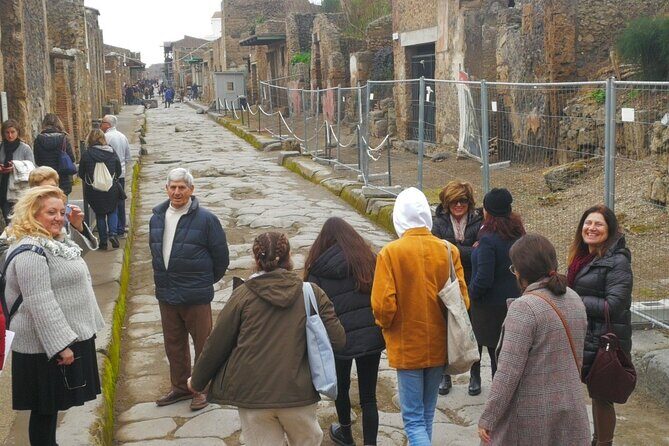
Wear solid shoes with grip. Pompeii floors can be uneven, and you’ll be walking between multiple sites in a short window. Bring a bottle of water, and consider sun protection if you’re going during the busiest midday stretch.
Also, keep expectations realistic. You’re not doing Pompeii end to end. You’re doing the kind of route that gives you the clearest “first impression” of the city’s major systems—public, private, religious, and commercial.
If any viewpoint access is limited on the day (like the Teatro Grande panoramic angle noted in the description), don’t fight it. A good guide adjusts and keeps the story moving so you still leave with the key ideas.
Should you book this Pompeii private tour?
Book it if you want Pompeii to feel like a living city: streets with routines, food with context, baths with meaning, and buildings explained in plain language. The private group size (up to five) is a real advantage here, especially if you like asking questions or you don’t want to rush.
Consider skipping or adjusting expectations if you only want the absolute top monuments at maximum time per stop. This route is fast, and it’s designed to cover categories rather than linger.
One more reason I’d lean toward booking: the guide behind this experience is repeatedly described as exceptionally prepared and story-driven, with the kind of humor and pacing that makes Pompeii easier to process. If you’re the type who learns best by seeing something and hearing how it worked, this tour is built for you.
FAQ
What is included in the guided Pompeii tour?
The tour includes an authorized archaeologist guide service for about 2 hours 30 minutes, a private tour, and admission tickets included for the listed stops during the tour (the Pompeii park entrance ticket fee is not included).
How much are the Pompeii Archaeological Park tickets?
The Pompeii Archaeological Park entrance fee is 18 euros per person, with free entry under 18. This ticket fee is not included in the tour price.
How many people are in the private group?
This is a private tour/activity for your group only, with a maximum of up to 5 people per group.
How long does the tour last?
The duration is listed as about 2 hours 30 minutes.
Where do we meet for the tour?
Meet at Ristorante Suisse, Piazza Esedra 10/13, 80045 Pompei NA, Italy. The tour ends back at the meeting point.
Do you use a mobile ticket?
Yes. The experience includes a mobile ticket.
Is free cancellation available?
Yes. You can cancel for a full refund if you cancel at least 24 hours before the experience start time.