REVIEW · SORRENTO
Pompeii & Amalfi Coast Private Tour: Archaeologist-led, Flexible
Book on Viator →Operated by Fabrizio Belleni - Leisure Italy Private Guide · Bookable on Viator
One day, two wow-factors, and zero rushing. This private, archaeologist-led tour lets you walk Pompeii with clear, human explanations and then switch to the Amalfi Coast with flexible town stops and scenic coastal driving. What I like most is the focus on how Romans lived day to day inside Pompeii, not just big monuments, and the fact that the Amalfi portion can be tailored so your group gets the right mix of views, viewpoints, and time to wander. One thing to consider: you’re packing a lot into an 8 to 9 hour day, so if your group moves slowly, plan on shorter stops and more breaks.
You’ll start with pickup and private transport from Sorrento (or Naples, Positano, Pompeii). Then you’ll pair a guided Pompeii walk with the Amalfi roads and cliff towns that most people picture when they think of Campania. The guide’s name is Fabrizio Belleni, and he’s the kind of person who builds the day around your interests, your pace, and even practical needs like timing in hot months.
In This Review
- Key Points to Know Before You Go
- Pompeii First: What Makes the Archaeologist Approach Worth It
- Pompeii in a Walk: Forum, Baths, Markets, and the Places People Lived
- Antiquarium di Pompei: The Air-Conditioned Stop That Makes the Ruins Click
- Porta Marina to the Forum: How the Route Builds Momentum
- SS145 and Sorrento: The Coast Drive That Sets the Tone
- Amalfi Drive (SS163): The Hairpin Section That People Remember
- Positano, Amalfi, and Ravello: Three Different Moods on One Coast
- Beyond the Classics: Vietri, Minori, Maiori, and Erchie Options
- Price and Logistics: Is $540.66 Per Person Good Value?
- Who This Private Pompeii + Amalfi Tour Fits Best
- Should You Book This Tour?
- FAQ
- Is this a private tour or shared?
- Where does pickup happen?
- How long is the tour?
- What language is the tour offered in?
- Is Pompeii admission included?
- Do I need to buy tickets for Pompeii?
- Does the tour include lunch?
- Is bottled water and WiFi included?
- Is there any skip-the-line benefit?
- Can I cancel and get a full refund?
Key Points to Know Before You Go
- Archaeologist-led Pompeii with emphasis on streets, private homes, and daily life, not just the headline sights
- Flexible Amalfi Coast route that adapts to what your group wants to prioritize
- Hotel-area pickup and private transport with WiFi onboard and bottled water
- Skip-the-line depends on your ticket option for Pompeii admission
- Family-friendly pacing reported by multi-generation groups, with adjustments for walkers and kids
Pompeii First: What Makes the Archaeologist Approach Worth It
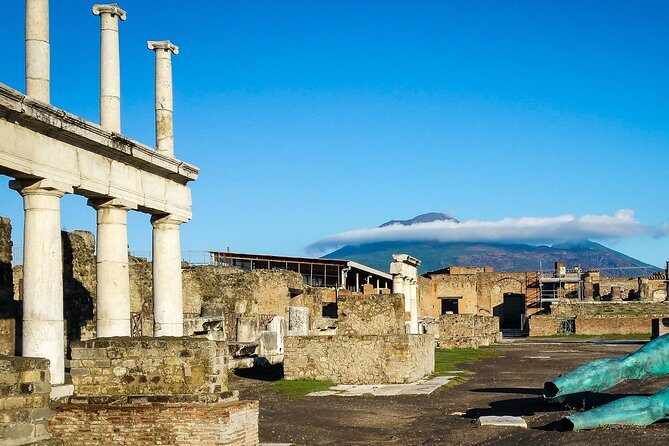
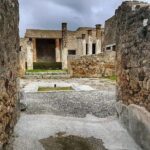
Pompeii is one of those places that can feel either overwhelming or magical, depending on how you visit. The big win here is that the guide teaches you to read the ruins, so you don’t just walk through stone blocks and street corners. The day is built around the idea that Pompeii is what Mt. Vesuvius left behind when it buried the city under about 20 feet of volcanic debris. Because that cover was soft and protective, many parts stayed remarkably intact. That matters, because you can actually understand layout and daily routines instead of just spotting famous highlights.
I also like the way the Pompeii time is framed: you’re not only hitting the Forum and major public structures. You’re also moving through the streets and shops, and getting into the scale of private homes and residential spaces. That shift is the difference between seeing Pompeii as a museum and seeing it as a living town.
One practical takeaway: you’ll cover a lot of ground, so wear real walking shoes. The tour is marked as not recommended for people with walking issues, which is fair. You’ll want mobility for the uneven surfaces and the busy Pompeii paths.
If you're still narrowing it down, here are other tours in Sorrento we've reviewed.


Pompeii in a Walk: Forum, Baths, Markets, and the Places People Lived
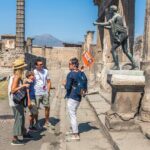
The Pompeii portion starts at the Archaeological Park. From there, the route makes sense for first-timers and repeat-visitors alike: you’re guided through key public buildings, then pulled toward spaces that show daily routines.
Basilica (civic power, not worship)
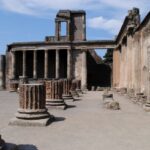
The Basilica Pompeiana is a standout because it’s a courthouse and commercial exchange. Think of it as the city’s courtroom and business hub, where magistrates presided from a raised podium. You can still picture the scale: the remains of the 28 giant columns that once supported the roof, and the long sense of authority inside.
Forum (the Roman “square” that controlled life)
The Forum is where politics, religion, and trade mixed into one huge pedestrian plaza. You walk across original travertine paving stones, and the view toward Mt. Vesuvius helps you feel the setting. A detail I’d pay attention to during your walk: the mensa ponderaria, the stone table used to check weights and measures. It’s the kind of small clue that makes the city feel real.
Macellum (covered market with food culture)
Right by the Forum area, the Macellum shows official food market life. Look for the arrangement: tabernae (shops) around a central circular pavilion (tholos). Frescoes of market goods and the mensa ponderaria connect commerce to everyday eating. There are also plaster casts linked to the eruption victims, which can be emotionally heavy but also adds a human level you don’t get from distance alone.
Forum Baths (the full Roman bathing circuit)
If you want a stop that makes Romans feel close, the Forum Baths often does it. You can trace the apodyterium (changing room), then the frigidarium, tepidarium, and calidarium. Pay attention to the engineering: vaulted ceilings, bronze braziers, and the hypocaust system that circulated hot air like an ancient sauna.
Casa dei Vettii (luxury you can actually walk through)
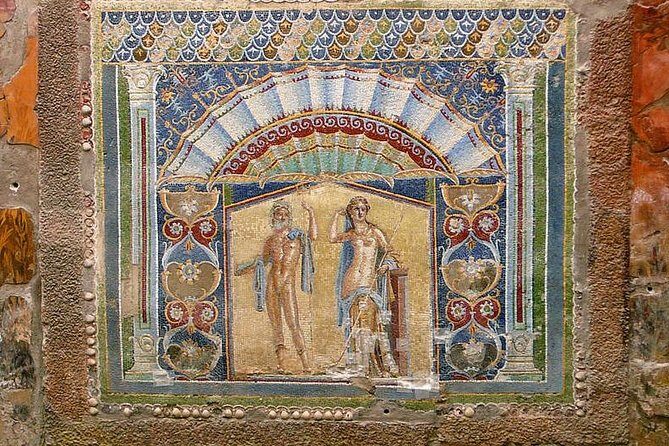
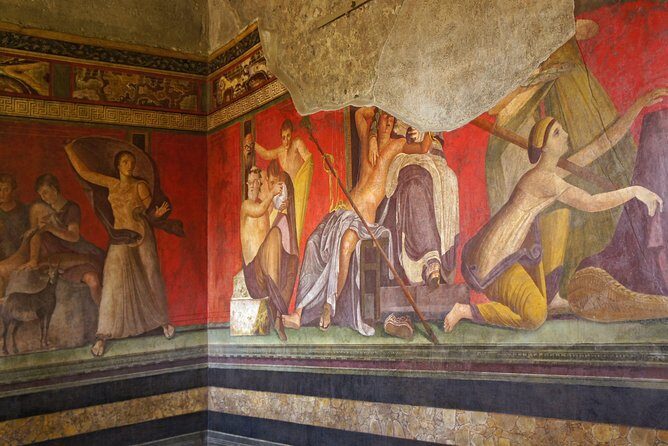
This house is famous for bright, preserved frescoes and a restored feel after recent work. The peristyle garden is a key moment: you see how elite private life looked right before the eruption. The Room of the Cupids and the Priapus entrance image are the sort of spots people remember later, because they feel like Roman personality, not just decoration.
Thermopolium (Pompeii’s fast-food counter)
This is one of the most fun categories of stops because it’s about “takeout” culture. The Thermopolium of Regio V has a preserved L-shaped counter with bold animal frescoes that likely acted like a visual menu. The terracotta jars (dolia) are another highlight because they preserve the remains of the diet archaeologists found, including seafood and land snails. It’s oddly satisfying to see how food, art, and daily survival all show up in one place.
Insula dei Casti Amanti (active excavation views)
This block has a modern touch: elevated walkways where you can look down into ongoing excavation. The famous fresco about a gentle kiss during a banquet is part of the story, but so are the charcoal sketches of gladiators that point to Roman childhood and interests. You also see an ancient bakery space and remains of victims, so it’s both research-forward and emotionally intense.
Teatro Grande (social hierarchy you can feel)
The Teatro Grande is impressive not only for being old, but for being specific. You can explore horseshoe-shaped seating and how marble seats were for the elite, while other tiers served the common people. Also, the acoustics are legendary in the sense that even a whisper in the center could carry to the top rows across thousands of seats. When you’re done inside, the backdrop of the hills and Vesuvius makes the visit feel cinematic.
For a tour day like this, your guide’s pacing matters. Fabrizio’s approach is described as tailored to your requests, which is exactly what you want when Pompeii is big and sometimes crowded with other tour groups.
Antiquarium di Pompei: The Air-Conditioned Stop That Makes the Ruins Click
After the outdoor walk, you’ll include time at the Antiquarium di Pompei. This modern museum is not just a break. It acts like a bridge between scattered stones and the emotional weight of the end of Pompeii.
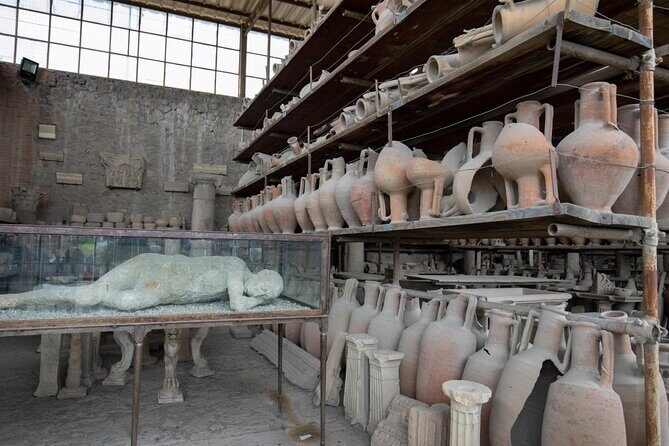
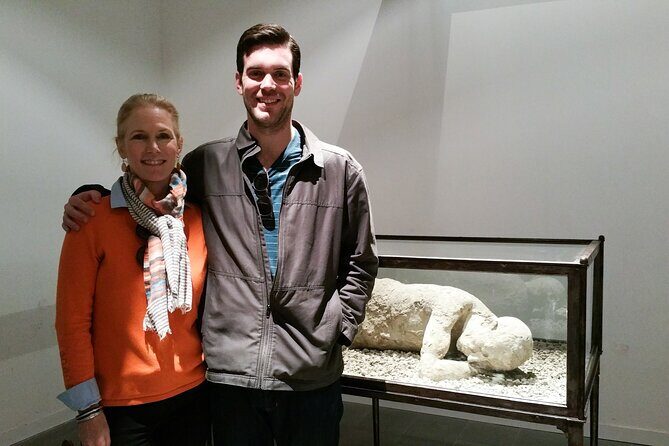
You’ll see treasures that help explain status and daily life: silver hoards, small objects tied to amulets (including items sometimes described as sorcerer’s kits), and fresco fragments that once decorated villas. The most powerful portion is the display of plaster casts of victims and animals caught in the eruption. It can hit hard, but it’s also one of the clearest ways to connect the story to real humans.
If you’re sensitive to heat, this stop also gives you a more comfortable indoor environment before you continue on to the coast.
Porta Marina to the Forum: How the Route Builds Momentum
A smart Pompeii plan avoids starting in a random place and then spending energy backtracking. This itinerary begins with Porta Marina e cinta muraria, which is more than a gateway. It’s a dramatic entry with a dual-arched passage and a steep basalt-paved ramp. As you step out, the city opens up toward big landmarks like the Temple of Apollo, the Basilica, and the Forum.
Starting with that entrance matters for two reasons. First, you get orientation fast. Second, you’re pulled forward by the architecture into the main spine of Pompeii. It’s an efficient way to start, especially if you’re trying to see as much as possible without spending your day lost in stone alleys.
The route also connects you quickly to nearby museum and bath contexts, which helps you keep the day flowing instead of feeling jumpy.
SS145 and Sorrento: The Coast Drive That Sets the Tone
Once Pompeii is done, you switch from ancient city streets to bright Mediterranean views. The scenic drive along SS145, the Sorrentina road, is one of the best “reset” moments. It winds along cliffs connecting the Bay of Naples to the Sorrento Peninsula, with tunnels, bridges, and sweeping curves that keep the scenery changing.
As you ride, you get classic framing: the turquoise water, Mount Vesuvius across the bay, and towns like Vico Equense and Meta clinging to the limestone bluffs. Lemon groves and watchtowers line parts of the route, so it doesn’t feel like a single long highway moment. It feels like a series of picture opportunities stitched together by roads that hug the coastline.
Then you arrive in Sorrento for a walking break. The vibe here is “pretty and practical” rather than overly staged. You can wander through the centro storico, check out Piazza Tasso, and then use the Villa Comunale viewpoints if your group wants sea air and skyline photos. If your day includes lunch or snack time, Sorrento is a good place to find something easy before continuing down the coast.



Amalfi Drive (SS163): The Hairpin Section That People Remember

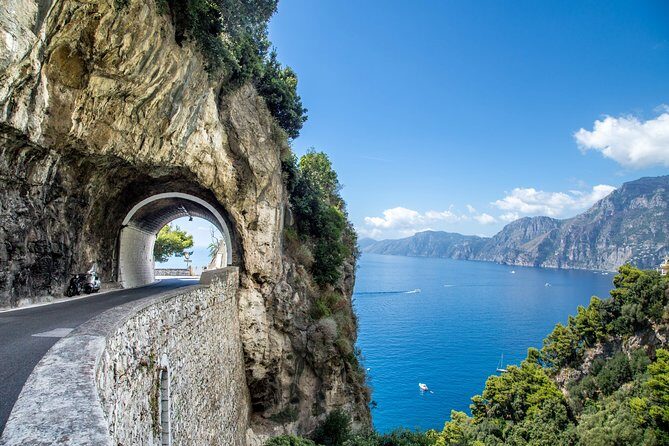
If you’re the type who likes scenery with a little adrenaline, the Amalfi Drive SS163 is a highlight. The road hugs the cliffs, carved into rock, with tight bends and big drops to the sea below.
This is the part where the tour shifts from history to pure sensory travel: turquoise water far down, terraced lemon groves, and the villages perched above the coast. It’s also a realistic choice for a private day because you can control stop lengths. You can do picture stops without relying on public transport schedules.
One more practical note: in hotter months, timing matters. In at least one case, Fabrizio recommended adjusting your Pompeii timing by waiting until afternoon because the breeze typically picks up later. That kind of real-world advice is what makes the day feel customized, not generic.
Positano, Amalfi, and Ravello: Three Different Moods on One Coast
This is where the itinerary shines for variety. You don’t just see one kind of place.
Positano: the vertical village
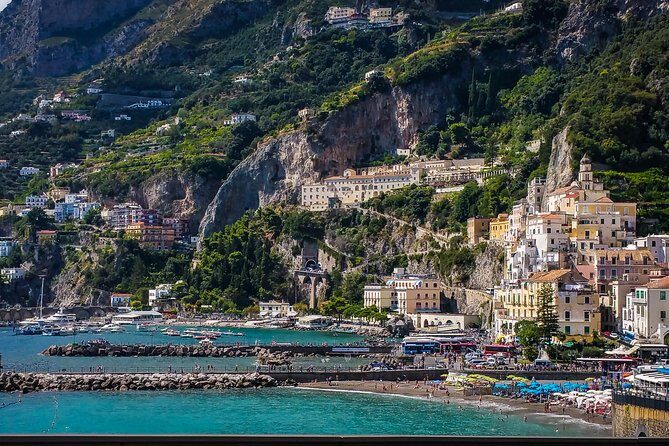
Positano is the “vertical city,” with pastel houses tumbling down toward the sea. You’ll walk narrow alleys lined with bougainvillea, and it’s worth aiming your time around the Church of Santa Maria Assunta with its iconic tiled dome. If your group wants a beach break, Spiaggia Grande is the classic shoreline stop.
Amalfi: maritime power meets town life
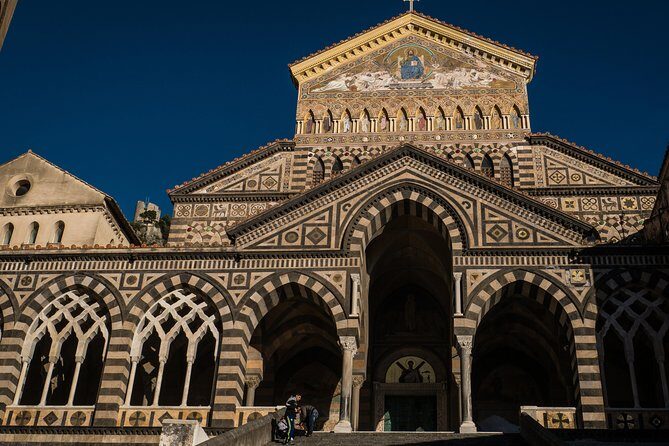
Amalfi is the historic heart of the coast, with the Duomo di Sant’Andrea as the anchor. The cathedral’s striped Arab-Norman facade, its 11th-century bronze door from Constantinople, and the long staircase up to the main space are memorable in a very concrete way. If you like exploring small lanes, Amalfi’s vicoletti and tunnels provide that maze feeling without needing a map obsession. You can also browse the Paper Museum area if your group wants a crafts-and-culture moment.
Ravello: quiet heights and garden views
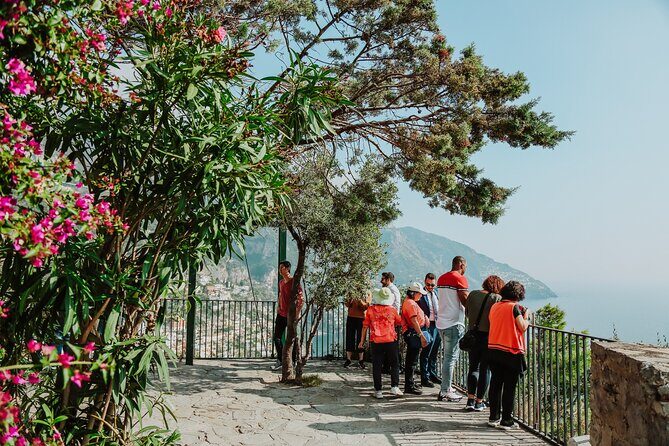
Ravello is a calmer, higher-altitude stop. It’s known as the City of Music, and it delivers big panoramas without the crush feel of some lower coastal spots. Villa Rufolo and Villa Cimbrone are the main garden choices, plus a chance to see Ravello’s quieter streets and architecture.
Villa Cimbrone and the Terrace of Infinity
Villa Cimbrone Gardens is famous for the Terrace of Infinity, a belvedere viewpoint lined with classical busts. The key travel value here is timing and tempo. Your private guide can help you experience it without feeling like you’re standing in a tourist line for long stretches. It’s also one of the rare moments where the scenery feels like the coast itself is the main attraction.
Beyond the Classics: Vietri, Minori, Maiori, and Erchie Options
A big advantage of this private tour is that your Amalfi list doesn’t have to be only the biggest names. The tour includes several additional towns that can work well depending on your tastes.
Vietri sul Mare (ceramics and a colorful stop)
Vietri is the gateway town and Italy’s ceramics center, with bright yellows and blues on shopfronts and streets. The Church of San Giovanni Battista has a majolica-tiled dome that’s hard to ignore, and you can pair that with the seaside area at Marina di Vietri.
Minori (food focus)
Minori gets described as a City of Taste, and it’s easy to see why if your group likes pastries and local flavors. It’s also linked to Villa Romana Marittima, where mosaics and frescoes remain visible, plus Santa Trofimena as an important church stop.
Maiori (sand, promenade, and walking routes)
Maiori is better suited if you want a wider, less steep layout and a longer sandy beach. It’s also known for the Collegiate Church of Santa Maria a Mare with its majolica-tiled dome. If your group likes short hikes, the Path of the Lemons is mentioned as a great way to experience terraced citrus groves.
Erchie (small, calm, and beachy)
Erchie is positioned as a quieter choice with an easy payoff: a pebbled beach with crystal-clear water and a slower pace. The description also highlights access by boat for nearby coves, plus the idea of a simple seafood lunch in a small trattoria setting.
Price and Logistics: Is $540.66 Per Person Good Value?
At $540.66 per person, this isn’t a budget tour. You’re paying for a private format: a Pompeii walking tour with an official guide, private transportation with pickup and drop-off, plus WiFi onboard and bottled water.
Here’s how I’d think about the value. If you’ve ever tried to combine Pompeii guide time with coast logistics using separate taxis and last-minute bookings, the cost and stress add up quickly. This tour bundles transport and guide time into one plan, and that matters when Pompeii is time-intensive and the Amalfi Coast requires driving between viewpoints.
One crucial detail: Pompeii admission fees are not included unless you choose the ticket-included option. The listed admission price is €19 per person (free for kids). So your real total can land higher depending on which option you select. Still, the skip-the-line benefit (when ticket-included is selected) can be genuinely helpful on high-traffic days.
Who This Private Pompeii + Amalfi Tour Fits Best
This is ideal for:
- Families and multi-generation groups who want a guide to slow things down when needed (and speed up when everyone’s ready)
- People who want Pompeii explained like a place where real people ate, shopped, bathed, and worked
- Anyone who cares about planning and pacing, especially if you’re on a cruise day or have time limits in port
It may not be ideal if:
- Your group has mobility challenges. Pompeii isn’t recommended for walking issues, and you’ll be on foot in a big outdoor site.
- You want a “mostly lounge” day. This itinerary is packed with stops, even if they’re flexible.
Also, if you’re traveling with kids, this tour design can work well. The guide is described as engaging for children, using educational games and keeping younger minds busy while still teaching Roman life.
Should You Book This Tour?
If you want Pompeii to feel understandable and human, I’d say yes. The combination of archaeologist-led explanations, a structured walk through major and everyday spaces, and then a coast drive that slows down into towns is a strong way to use one day in Campania. You also get real personalization: Fabrizio can tailor the itinerary to your preferences, and that flexibility is backed up by examples like adjusting timing for heat and finding a specific gluten-free lunch option near the Pompeii entrance.
If your group has limited walking ability, or if you dread a full day of transportation and stairs, you should reconsider. But for most active travelers who want a smarter day than “board bus, see highlights,” this private approach is exactly the right kind of effort.
FAQ
Is this a private tour or shared?
It’s private, meaning only your group participates.
Where does pickup happen?
You can be picked up in Naples or Sorrento or Positano or Pompeii. Meeting at the port/airport/railways in Naples is also listed as no problem. Pickup in Amalfi or Ravello is possible for an additional charge.
How long is the tour?
It runs about 8 to 9 hours.
What language is the tour offered in?
The tour is offered in English.
Is Pompeii admission included?
Pompeii admission fees are not included unless you select the ticket-included option when booking.
Do I need to buy tickets for Pompeii?
Yes, if you don’t select the ticket-included option. The listed Pompeii admission price is €19 per person and free for kids.
Does the tour include lunch?
Lunch is not included. The guide can suggest choices based on what you want.
Is bottled water and WiFi included?
Yes. Bottled water and WiFi on board are included.
Is there any skip-the-line benefit?
Admission fee skip-the-line entry is included only if you select the ticket-included option upon booking.
Can I cancel and get a full refund?
Yes. You can cancel up to 24 hours in advance for a full refund.