REVIEW · POMPEII
Private Pompeii and Vesuvius with Wine Tasting and Full Tickets
Book on Viator →Operated by Leisure Italy · Bookable on Viator
Pompeii feels close when it is private. This day is built around your own guide pace plus private transport, so you spend less time in the crush and more time seeing what matters, from Pompeii’s streets to the walk up Vesuvius.
I love that the tour is set up for real learning in a smart order, with optional Pompeii for Kids activities for ages 6 to 11. The other big win is the vineyard stop: you get wine tasting with lunch on the volcano slopes, not just a quick pour and a goodbye.
One consideration: the day mixes guided walking and outdoor sun, and Vesuvius includes a gravel-and-ash climb, so you’ll want moderate fitness and good shoes.
In This Review
- Key things that make this tour worth your time
- Private transport, full tickets, and a schedule that doesn’t fight you
- Pompeii the smart way: guided highlights without getting lost
- Archaeological Park: the core Pompeii experience (and the kid-friendly option)
- Porta Marina e cinta muraria: the gate that explains movement and control
- Temple of Apollo: religion in the open courtyard
- The Forum area: the civic heart in a view you can actually read
- Macellum: the food market that shows the daily heartbeat
- Terme del Foro: the bath complex that explains social life
- Pompeii’s elite houses and working neighborhoods: Vettii and Casti Amanti
- Casa dei Vettii: elite taste on display
- Insula dei Casti Amanti: daily life caught mid-moment
- Roman drama and the Antiquarium: putting emotion into the ruins
- Teatro Grande: performances with a view
- Antiquarium di Pompei: the setup room before you process the town
- Vineyard lunch with wine: Cantina del Vesuvio on the volcano slopes
- Vesuvius National Park: gravel climb, volcanologist talk, and crater views
- Price and value: what $701.99 gets you (and what you’re really buying)
- Who should book this private Pompeii and Vesuvius day
- Should you book it?
- FAQ
- How long is the Pompeii and Vesuvius private tour?
- Is this tour private or shared with other people?
- Does the price include Pompeii and Vesuvius tickets?
- Is pickup included, and where can it start?
- What language is the tour conducted in?
- What’s included in the wine tasting and lunch?
- Is there a kid-friendly option for Pompeii?
- Can I cancel for a full refund?
Key things that make this tour worth your time
- Private driver + pickup from Naples, Sorrento, Pompeii, and more, with only your group aboard
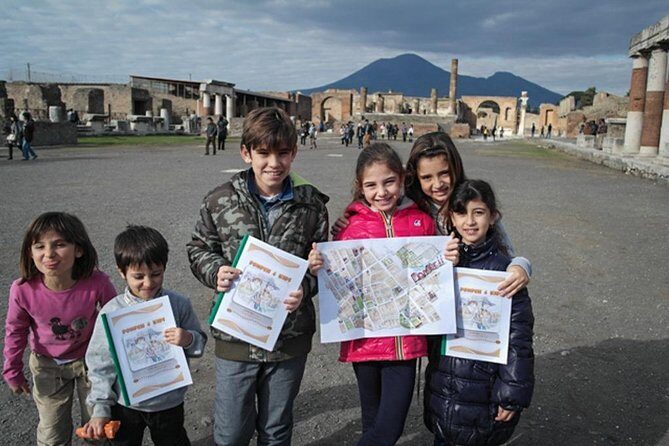
- Pompeii for Kids option with an interactive tour book and games for ages 6–11
- Full-ticket handling for Pompeii and Vesuvius, so your guide can focus on the sites
- Cantina del Vesuvio vineyard lunch with a set menu plus 5 wine tastings
- Vesuvius National Park crater views with an on-site volcanologist talk
Private transport, full tickets, and a schedule that doesn’t fight you
This tour runs like a private day should: you’re not sharing transport or timing with a big bus crowd. You’ll get pickup in places like Naples, Sorrento, Pompeii, train stations, airports, and even cruise terminals/ports (you pick your exact spot when booking). That matters because Pompeii and Vesuvius get traffic-heavy, and a tight schedule usually turns into a stress festival unless someone else handles the driving.
You’ll also get mobile tickets and guidance in English, which helps if you want the story explained clearly as you move between areas. The format is family-friendly and flexible—your guide focuses on highlights and can steer you to what you care about most, rather than forcing a one-size-fits-all checklist.
Other private Pompeii tours we've reviewed in Pompeii


Pompeii the smart way: guided highlights without getting lost
Pompeii is one of those places where it’s easy to wander—and miss the meaning. This tour keeps you oriented by guiding you through the Archaeological Park and selecting highlights rather than sending you off alone. If you’re on a first visit, I like this approach because it gives you names, layout, and purpose fast, so the ruins start to feel like a real town instead of scattered walls.
Archaeological Park: the core Pompeii experience (and the kid-friendly option)
You start at the Archaeological Park of Pompeii, with a private guide taking you through major highlights. Admission is included here, so you’re not stopping to sort tickets mid-walk.
There’s also a specific Pompeii for Kids visit option recommended for kids aged 6 to 11. It uses activities and games (plus an interactive tour book) designed to keep younger visitors engaged while still teaching them what they’re seeing. If you have kids in that age range, this is the difference between a “ruins tour” and something they’ll actually remember.
A practical note: even when the stops are “short,” the surfaces are archaeological stone, and you’ll be walking. That means comfortable shoes and a water plan are not optional.
Porta Marina e cinta muraria: the gate that explains movement and control
One quick stop that helps the whole day click is Porta Marina e cinta muraria. This gate was a key entry point near the port area and connects to Pompeii’s defensive walls. Seeing the ramp and fortifications helps you understand how a city controlled access—merchants, sailors, and visitors would have gone through places like this.
Even with only a few minutes here, the payoff is big: the gate gives you a “town entry” lens, so later you can picture streets as routes, not random gaps.
Temple of Apollo: religion in the open courtyard
Next comes the Temple of Apollo, dedicated to Apollo, tied to the sun, music, and prophecy. It sits in a large open courtyard near the Forum area. This is one of those stops where a guide can make ruins feel purposeful, because the temple’s setting tells you how public worship worked—offers, guidance, and religious rhythm woven into everyday city life.
If you like religious architecture, this stop is a good anchor. If you don’t, it still helps because it frames how Pompeii organized civic space around belief.
Other Mount Vesuvius tours in Pompeii



The Forum area: the civic heart in a view you can actually read
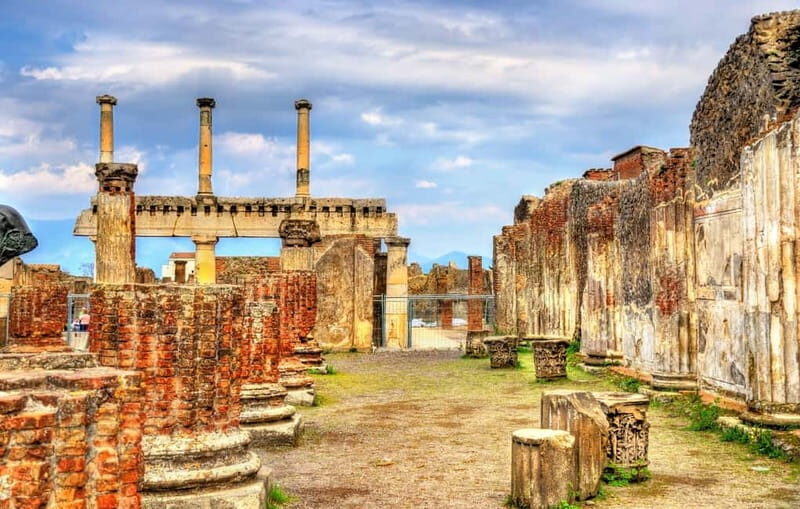
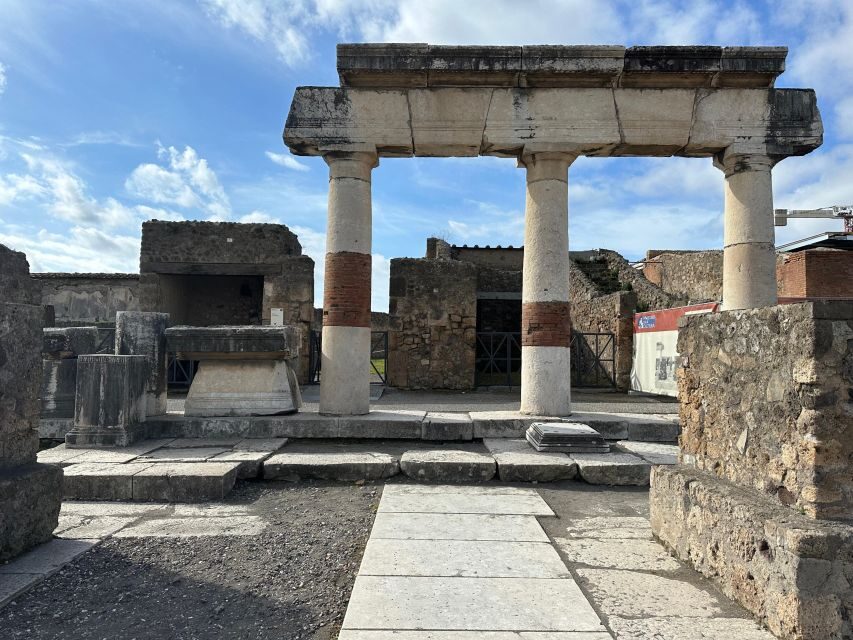
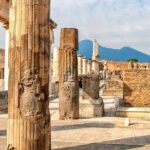
At the Forum of Pompeii, you get a perspective on politics, religion, and commerce in one monumental square. The elevated walkways and terraces give you a clearer layout than you’d get standing down in the middle of streets.
You’ll see key structures framed around the square, including the Capitolium, Basilica, and Macellum. It’s a fast stop, but it’s one of the most important stops because it explains why Pompeii felt organized—people didn’t just live in houses, they participated in a public system.
Macellum: the food market that shows the daily heartbeat
Then you hit the Macellum, Pompeii’s main food market. It was covered, with stalls selling fish, meat, fruit, and imported goods. Even a brief look helps you picture the city’s supply chain and morning bustle.
The layout—stalls, storerooms, and central organization—makes this more than “food stuff.” It’s urban planning you can see with your eyes.
Terme del Foro: the bath complex that explains social life
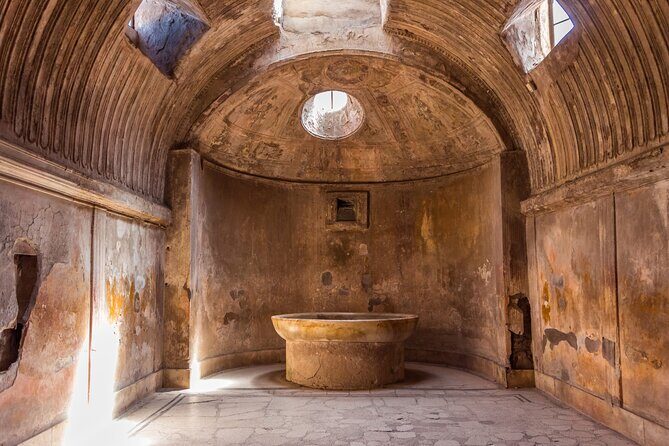
The Forum Baths (Terme del Foro) are a standout if you like social history. These baths served as a hub for hygiene, leisure, and conversation, with separate areas for men and women. You can see the warm and hot bathing halls, plus the cold plunge pool, heated by an advanced hypocaust system.
If you’re short on time in Pompeii, I still think this is a valuable stop because baths reveal daily culture better than almost any single building.
Pompeii’s elite houses and working neighborhoods: Vettii and Casti Amanti
After the main public spaces, the tour shifts toward how people lived—who had money, who worked, and how neighborhoods functioned.
Casa dei Vettii: elite taste on display
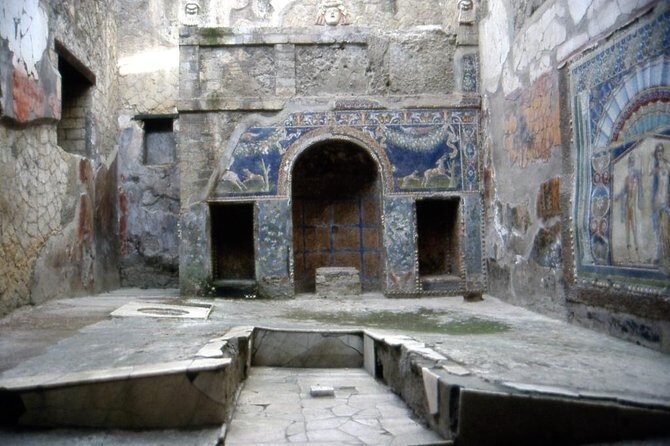
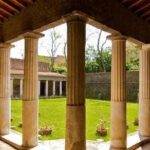
The House of the Vettii (Casa dei Vettii) is one of the finest aristocratic residences in Pompeii. You’ll see why it’s famous for richly decorated frescoes and an elegant layout organized around atria and peristyle gardens.
This stop helps you understand ambition in Roman domestic life. Frescoes weren’t just decoration; they were status signals. Even for a short visit, it’s a strong reminder that Pompeii wasn’t just streets and tragedy—it was art, design, and personal display.
Insula dei Casti Amanti: daily life caught mid-moment
The Insula dei Casti Amanti is named after a vivid fresco of lovers. What’s interesting here is the way visitors access the site via elevated ramps, giving a panoramic look into workshops, storerooms, and domestic rooms below. That’s a rare viewing angle that doesn’t require stepping onto fragile ground.
You’ll get a sense of Pompeii as a working city where trade and home life overlapped. Painted signs and half-finished renovations help you picture daily routine up to the eruption moment in AD 79.
Roman drama and the Antiquarium: putting emotion into the ruins
Two more stops round out the “what life felt like” picture.
Teatro Grande: performances with a view
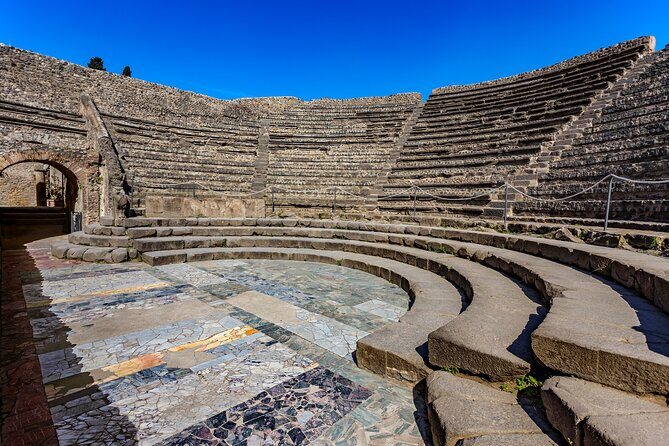
The Teatro Grande gives you a strong sense of Roman entertainment. From upper terraces and modern walkways, you can look down onto seating tiers and the stage building. The theatre’s acoustics and views toward the city and Mount Vesuvius help explain why people packed in for comedies, tragedies, and public ceremonies.
Even if you don’t care about theatre, this stop makes Pompeii feel less like a museum and more like a place where people gathered to watch, react, and celebrate.
Antiquarium di Pompei: the setup room before you process the town
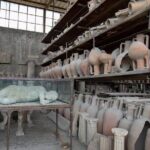
The Antiquarium di Pompei works like a mental bridge. It’s a gateway space with galleries of statues, household objects, inscriptions, jewelry, and other artifacts recovered during excavations. Because some delicate items wouldn’t survive outdoors, glass cases and organized exhibits let you study details that the open ruins can’t show.
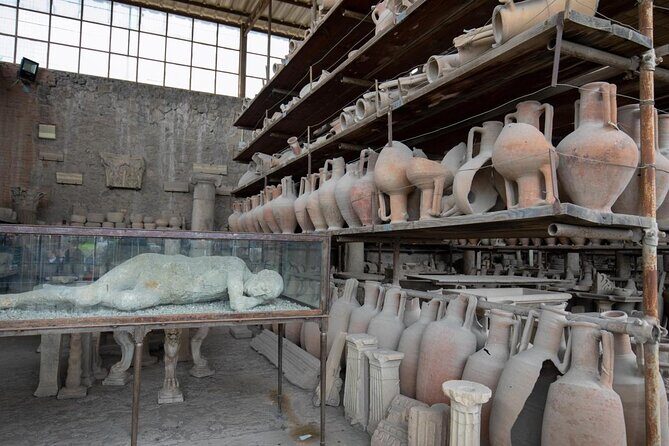
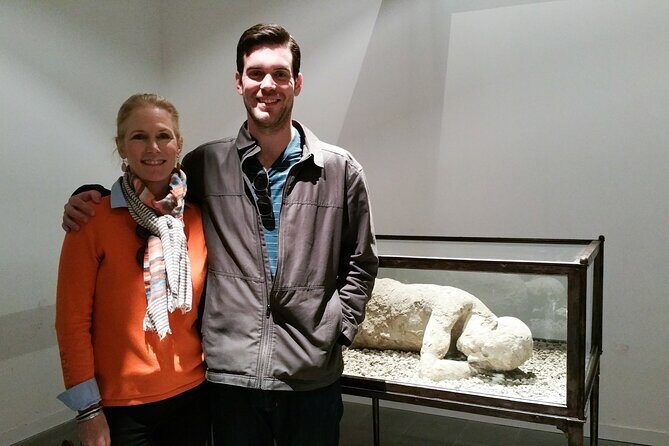
Then you reach rooms that include plaster casts of victims and dramatic eruption material. It’s emotional, but it also gives context: without this framing, the outdoor ruins can feel abstract.
Vineyard lunch with wine: Cantina del Vesuvio on the volcano slopes
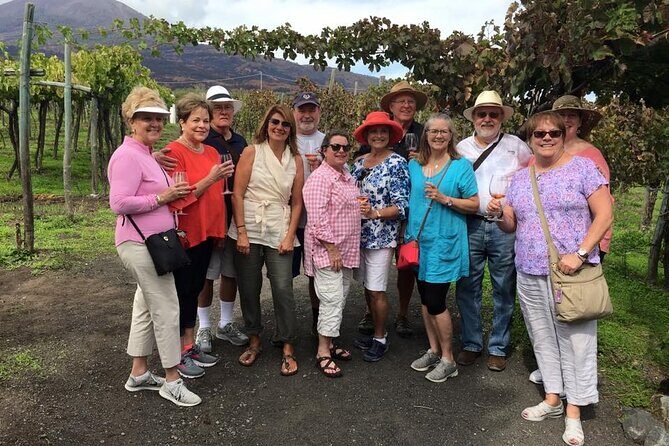
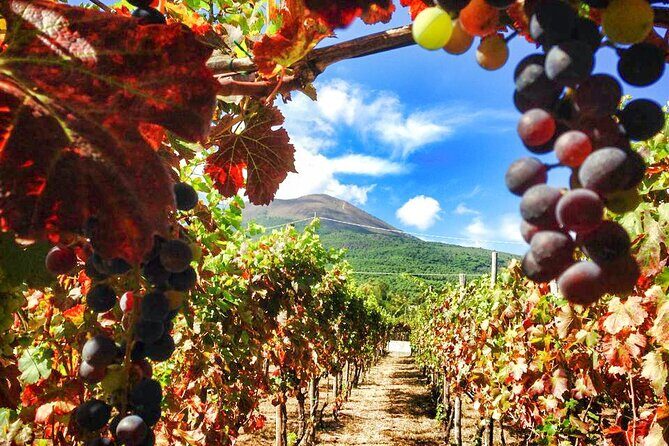
After Pompeii, you head to Cantina del Vesuvio – Famiglia Russo, perched on the slopes of Mount Vesuvius. This is where the day turns from ruins to taste.
You get time to explore the vineyard area and taste wines in a family-run setting, with volcanic terroir as part of the story. Lunch is a set menu:
- Bruschetta, provolone cheese, salame, and capocollo cured pork
- Spaghetti with cherry tomatoes del Piennolo from Mt Vesuvius
- Pastiera (wheat and ricotta cake)
On top of that, you’ll have 5 different wines served: Rosè Sparkling, White, Rosé, Red, Red Reserva, plus a sweet dessert wine option as part of the tasting set. It’s a full stop, not a five-minute side quest, and it pairs food with local agriculture in a way that fits the Vesuvius theme.
If you’re the type who likes to drink thoughtfully, this is a better setup than many tours where wine is treated as a checkbox. The time on-site is listed as 1 hour 30 minutes, which is enough to actually eat and chat.
Vesuvius National Park: gravel climb, volcanologist talk, and crater views
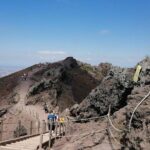
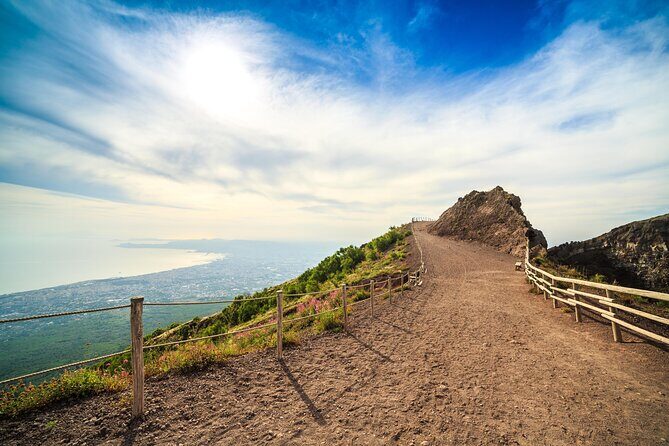
Then comes the climb. The driver handles tickets and brings you to the closest spot at the beginning of the trail, which takes about 30 minutes up on gravel and ash. This part is exposed—sun and wind are real. If it’s a hot day, plan shade breaks and water. If it’s windy, dress for it; the top can feel colder than you expect.
Once you’re up top, you can catch a live introduction by a volcanologist. It’s a short, shared talk in English that starts every few minutes and runs about 10 minutes. That timing detail is great because you don’t have to wait around for one exact start time.
You can walk halfway around the crater on your own, roughly 30 minutes. On a clear day, pictures are a highlight. When you head back down, you retrace the path to meet the driver.
There’s also a café by the parking lot for anyone who doesn’t feel like climbing. That makes the Vesuvius piece more flexible than tours that treat the climb as mandatory.
Price and value: what $701.99 gets you (and what you’re really buying)
At $701.99 per person, this isn’t a budget tour. But value isn’t only about price tags—it’s about what’s included and how much it saves you in time and hassle.
Here’s what you’re paying for in practical terms:
- Private transport with pickup from several areas, plus a driver who handles tickets for Vesuvius
- A private guide for Pompeii who selects the highlights so you don’t waste the day wandering
- Admission tickets included for Pompeii sites and the major stops listed
- Lunch and wine tasting at Cantina del Vesuvio, including a set menu and five wines
- A full day structure that ties Pompeii’s story to Vesuvius’s story
Is it a lot for one day? Yes. But you’re compressing two major destinations into one plan while also adding a vineyard meal that would cost money on its own.
One possible drawback is that “8 to 9 hours” on the move is still a long day. If you’re booking with sore knees or low tolerance for heat, you might find the pace demanding even with breaks between stops.
Who should book this private Pompeii and Vesuvius day
This tour fits best if you want:
- Pompeii with context, not just a self-guided walk
- A day that works for couples and families, especially with the Pompeii for Kids option for ages 6–11
- Wine and food in a local vineyard setting tied to the Vesuvius theme
- Private transport that reduces crowd stress
It may not be your best match if you:
- Prefer a slow, minimal-walking day with lots of free time
- Want a purely classroom-style experience with no outdoor walking
- Are sensitive to sun and wind, since the Vesuvius trail is exposed
If you want the Pompeii highlights plus the crater views in one clean package, this plan makes sense.
Should you book it?
I’d book this if you want a private day with full tickets and a guide who helps Pompeii “make sense” quickly—then you’d like a proper vineyard lunch with real tastings, not a snack-and-vanish stop. The Pompeii for Kids option is also a smart lever if your kids are in that 6–11 sweet spot.
I’d skip it (or switch to a lighter format) if you’re not up for the gravel-and-ash climb and the sun/wind factor at Vesuvius.
If you’re good with a full day and you want the story of Pompeii connected directly to the volcano, this is the kind of tour that turns a famous place into a memorable one.
FAQ
How long is the Pompeii and Vesuvius private tour?
It runs about 8 to 9 hours.
Is this tour private or shared with other people?
It’s a private tour/activity, and only your group participates.
Does the price include Pompeii and Vesuvius tickets?
Yes. Admission tickets are included for the listed Pompeii stops, and tickets for Vesuvius are handled for you.
Is pickup included, and where can it start?
Pickup is offered from Naples, Sorrento, Pompeii, and also places like train stations, airports, and cruise ports. You choose your pickup spot when booking.
What language is the tour conducted in?
The tour is offered in English.
What’s included in the wine tasting and lunch?
Lunch at Cantina del Vesuvio includes a set menu (bruschetta and cured meats starters, spaghetti with vesuvian cherry tomatoes, and pastiera dessert). You’ll also have 5 different wines served.
Is there a kid-friendly option for Pompeii?
Yes. There’s an optional Pompeii for Kids visit with activities and an interactive tour book, recommended for ages 6 to 11.
Can I cancel for a full refund?
Yes. Free cancellation is available if you cancel up to 24 hours in advance for a full refund.