REVIEW · SORRENTO
Private Pompeii Tour with Guide & Transfer included from Sorrento
Book on Viator →Operated by IAMME IA! - Gray Line Amalfi Coast · Bookable on Viator
Stepping into Pompeii feels like time travel. I like the private hotel transfer that removes the stress of getting there, and the fast-track entry that helps you start exploring sooner. The main catch: the schedule is tight, with quick stop times, and summer heat can be intense even with an early start plan.
This is built for people who want structure without feeling rushed to learn on their own. You get an official guide for the big walking portion, then you hop through key areas like the Forum, baths, and major houses with enough time to ask questions and reset your bearings as you go. Just note that hotel pickup can be tricky in some Sorrento zones, so you’ll need to confirm the exact meeting location at least 24 hours ahead.
In This Review
- Key things to know before you go
- A private Pompeii plan that starts with logistics, not stress
- Hotel pickup in Sorrento: what to expect and what to double-check
- Fast-track entry: why it’s worth paying for
- The main Pompeii walk: a 2-hour guided route that keeps the city understandable
- Foro de Pompeya and the Temple of Jupiter: Pompeii’s daily power center
- Foro de Pompeya
- Tempio di Giove Capitolino
- Macellum to Via dell’Abbondanza: markets and the main street feel
- Macellum
- Via dell’Abbondanza
- Stabian Baths: Roman bathing, with real damage visible
- Via delle Ville and the Villa of the Mysteries area: leaving the city walls
- Casa del Fauno, Teatro Grande, and the Basilica: bigger icons, quick visits
- Casa del Fauno
- Teatro Grande
- Basilica
- Timing and pace: how 4–5 hours can feel if you like to linger
- Price and value: what you’re really buying at $504.67
- Who this private Pompeii tour suits best
- Should you book this Pompeii tour from Sorrento?
- FAQ
- Is pickup from my hotel in the Sorrento area included?
- How long is the Pompeii tour?
- Is the guide available in English?
- Do I need to buy admission tickets separately?
- Do you get fast-track or priority entry into Pompeii?
- Is this a private tour or shared group tour?
- Can I cancel for a full refund?
Key things to know before you go
- Round-trip private transfer from your Sorrento hotel area means fewer buses, fewer meeting points, less waiting.
- Fast-track entry to Pompeii helps you skip the line at the ticket window.
- Official guide during the main walk keeps the site readable, not just ruins in all directions.
- Tickets for the included Pompeii stops are part of the experience price.
- Short, focused viewing blocks at several highlights make it easier to cover more ground in 4–5 hours.
- English-speaking guide plus a private setup for your group only.
A private Pompeii plan that starts with logistics, not stress
Pompeii is huge. Even when you know where you’re going, the time sink is often the same: getting in, figuring out the route, and not missing the big stuff. This tour tackles the boring part first. You’re picked up in the Sorrento area and handled with round-trip transport, so you can focus on the ruins instead of coordinating transit.
The private format matters here. It’s not a cattle-car shuffle where you’re forced to follow a pace that doesn’t fit your attention span. You can ask questions when something clicks, and you’re not stuck waiting for strangers to catch up on the next corner.
If you're still narrowing it down, here are other tours in Sorrento we've reviewed.


Hotel pickup in Sorrento: what to expect and what to double-check
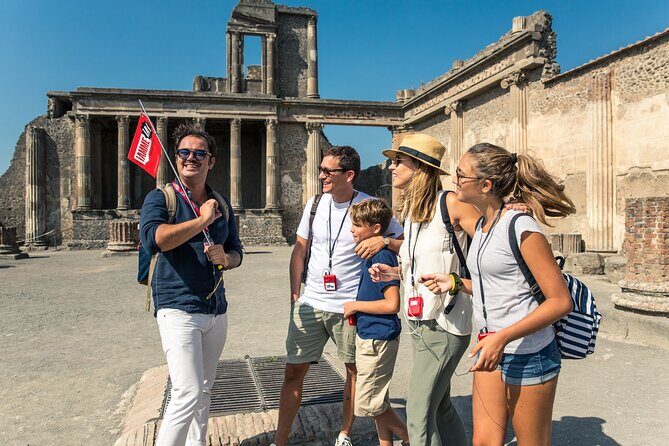
Your day begins with pickup from your hotel area in Sorrento. That’s a real quality-of-life upgrade. But there’s an important detail: not every hotel can be reached due to traffic restrictions and pedestrian-only zones. You’ll confirm the exact location with the provider at least 24 hours before departure so the driver can get as close as possible.
If your hotel is in a tighter, more historic area, plan for a short walk to the pickup point. That’s normal in Sorrento. The smart move is to share a precise address or a nearby landmark when you confirm.
Also keep in mind the tour is listed as near public transportation. That’s useful if you need a fallback meeting point that makes sense locally.
Fast-track entry: why it’s worth paying for
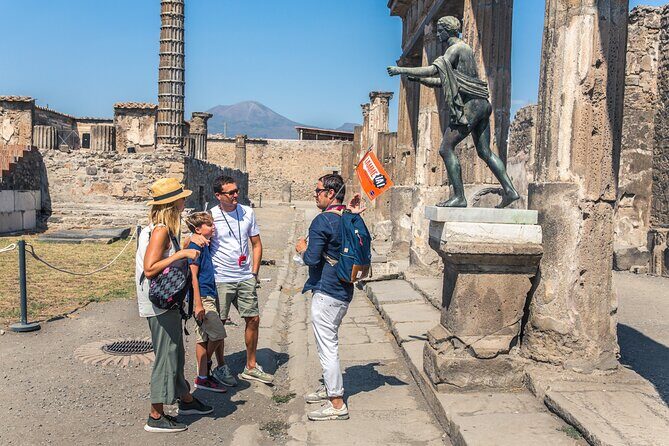
Pompeii’s ticket window can take time, especially in peak season. This tour includes priority access to the Pompeii Archaeological Site, so you can bypass the line and get moving faster.
For a 4 to 5 hour window, that difference is huge. You don’t just save minutes; you spend those minutes inside the site instead of waiting at the entrance. Your guide also has momentum, so you can start building context right away.
The main Pompeii walk: a 2-hour guided route that keeps the city understandable
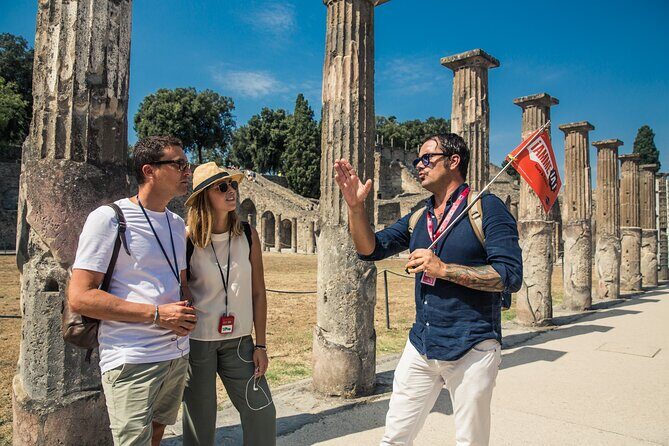
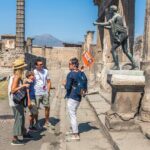
The heart of the experience is a 2-hour walking tour with an official guide. This is where Pompeii stops being a random set of streets and buildings and starts working like a real city.
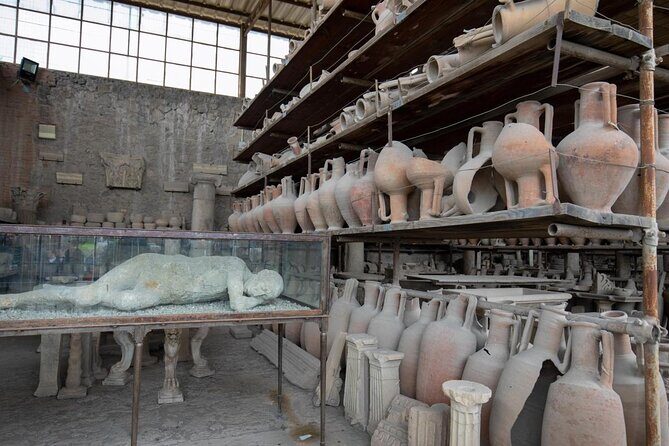
You’ll get the big story first: the eruption of Mount Vesuvius in 79 AD buried Pompeii under lapilli and lava, which helped preserve what was inside the city. That means the guides can point to actual infrastructure—thresholds, wall lines, room layouts—and explain how people lived rather than just naming structures.
Practically, the guide helps you:
- recognize what’s civic vs. residential
- understand why certain buildings line up the way they do
- connect scenery to Roman life and belief
Even if you’ve visited ruins before, Pompeii is unusually specific because so much is still in place. A good guide keeps that detail from turning into chaos.
Foro de Pompeya and the Temple of Jupiter: Pompeii’s daily power center
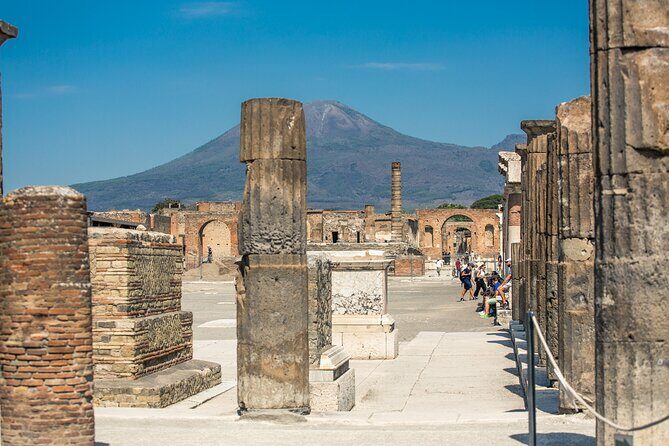
After the main walk, the route moves through the civic core.
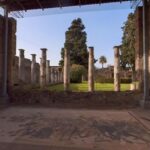

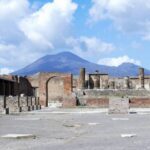
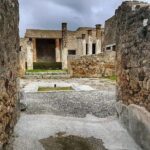
Foro de Pompeya
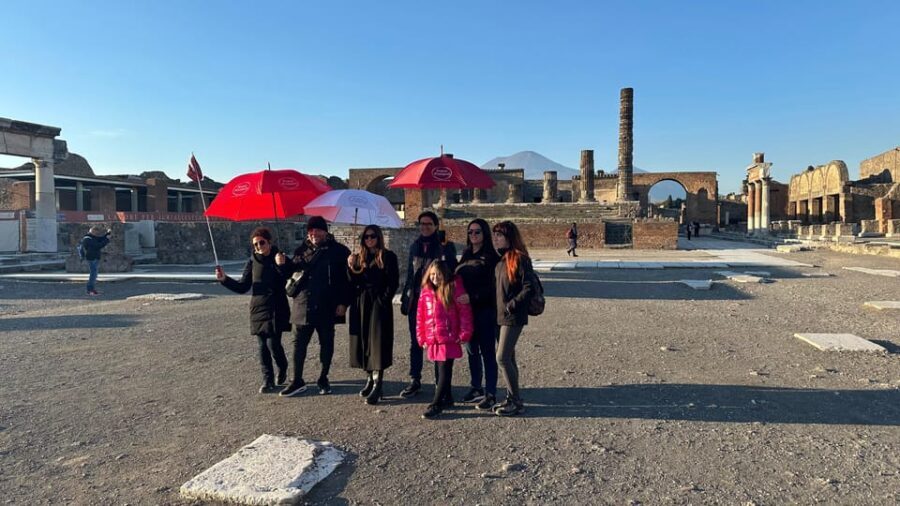
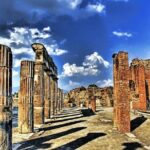
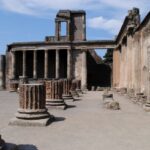
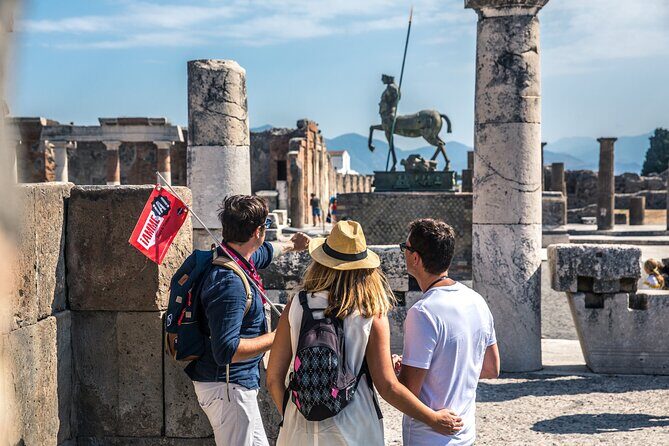
You’ll spend a short stop at the Foro de Pompeya, Pompeii’s Civil Forum—center of daily life. This is where you’d see public administration, justice, business activity, and commerce. It’s also tied to religious life through citizen worship.
Even with limited time here, the Forum is where you can quickly feel the city’s rhythm. The Forum isn’t just one building—it’s a whole idea of how public space worked in Roman towns.
Tempio di Giove Capitolino
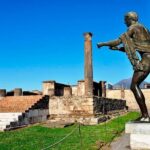
Next is the Temple of Jupiter, on the north side of the Forum, with Mount Vesuvius visually rising behind it. That sightline is not accidental. When the colony was founded (80 BC), the temple got a major renovation and became part of a Capitolium set-up associated with Jupiter, Juno, and Minerva. The arrangement was designed so those statues were visible to people moving through the Forum square.
If you want a quick “wow” moment with meaning attached, this is one of them: sacred space right next to political and commercial life.
Macellum to Via dell’Abbondanza: markets and the main street feel
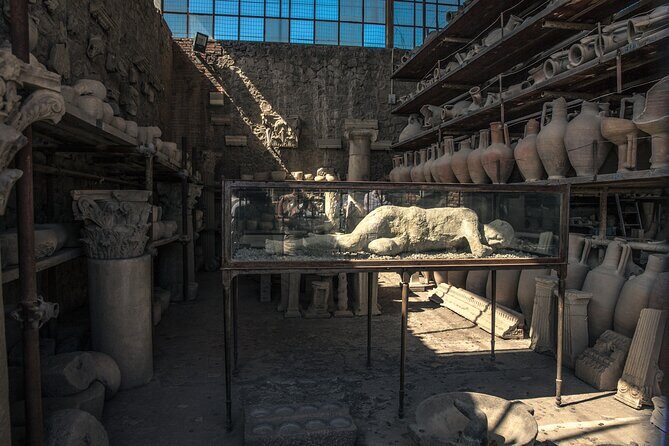
Rome loved organization, and Pompeii shows it in how food, commerce, and movement were built into daily routines.
Macellum
The Macellum was Pompeii’s market area. The structure includes an open tuff quadriporticus and an elevated worship hall. You’ll also see references to how it connected with imperial cult ideas, plus practical details that hint at what people bought—like a counter area likely used for fish sales.
Why this stop is worth the time: markets weren’t just convenience. They were social space. You can imagine conversations happening between visits, and the architecture supports that idea.
Via dell’Abbondanza
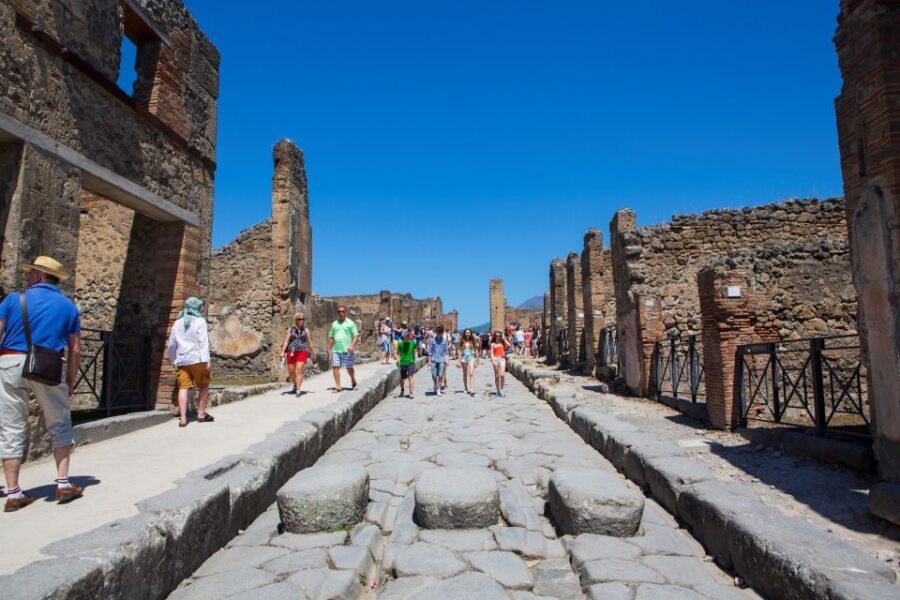
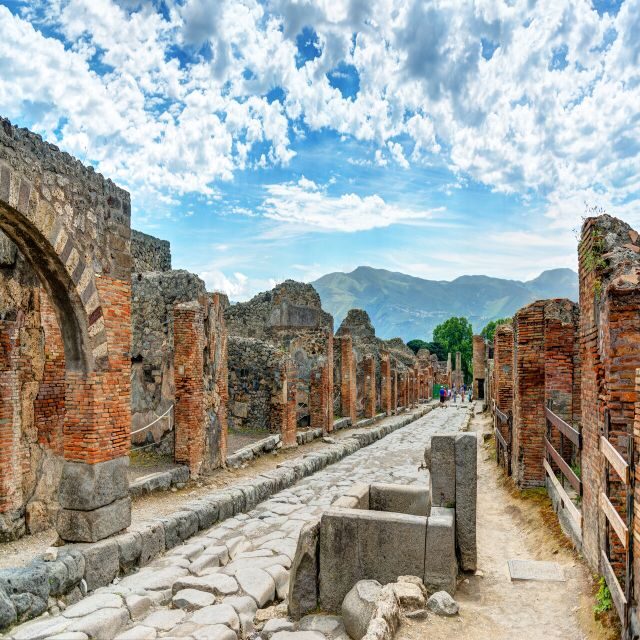
Then you head to Via dell’Abbondanza, Pompeii’s main street running east/west from the Forum to Porta Sarno. In the ancient city, this street would have been full of shops, workshops (officinae), cafés, and snack-bars.
Even if your stop time is brief, this street gives you orientation in a way no map can. Standing here helps you understand the “spine” of the city and how everything connected outward.
Stabian Baths: Roman bathing, with real damage visible
Pompeii’s baths give you a different kind of history—less about government and more about routine.
The Stabian Baths (Terme Stabiane) sit behind the Temple of Jupiter and date to just after the colony was founded by veterans. They had separate entrances for women and men. In the men’s section, you’ll see the layout moving from apodyterium (dressing room) to tepidarium (medium temperature) to frigidarium (cold baths) and calidarium (hot baths).
Then comes the earthquake clue: like other buildings, the baths were damaged during the 62 AD earthquake. You’re effectively looking at a city that was shaken and then lived in again—right up until the 79 AD eruption.
It’s a short stop, but it’s one of the best places to make Pompeii feel human.
Via delle Ville and the Villa of the Mysteries area: leaving the city walls
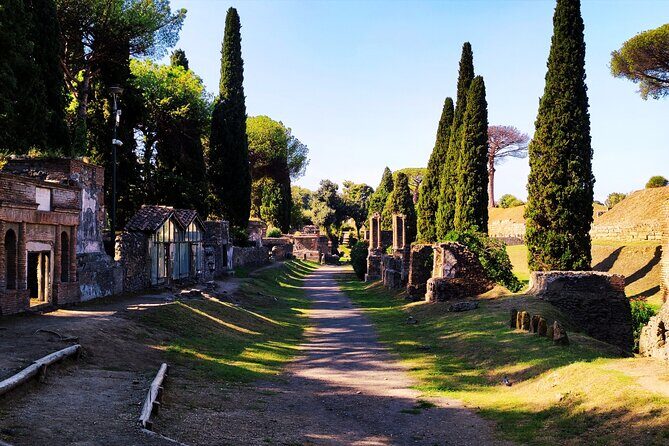
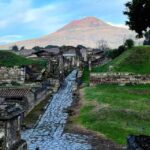
You also get time for Via delle Ville, a road outside Pompeii’s walls leading from Porto Ercolano gate into the suburbs. This route is known for a necropolis lined with impressive tombs.
And the highlight here is the nearby Villa of the Mysteries area, famous for frescoes connected with Dionysian rites. The key value is the contrast: you move from dense city life to a calmer setting where the art and ritual details can feel more atmospheric.
Because this is outside the main crowded blocks, it often helps you breathe. It also gives the day more variety than sticking to only Forum and residential ruins.
Casa del Fauno, Teatro Grande, and the Basilica: bigger icons, quick visits
The later part of the tour is all about famous names and major civic spaces. The stop times are shorter here (think quick orientation plus key points), which is fine if you want coverage in one day.
Casa del Fauno
The House of the Faun (Casa del Fauno) is one of the largest and most impressive private residences in Pompeii. Built during the 2nd century BC, it’s known for luxury and for holding major art pieces.
Even in a brief stop, this is where you can understand how class and wealth showed up in architecture—how houses were designed to impress and how art was built into daily life.
Teatro Grande
Next is Teatro Grande, the Large Theater, built on a hillside with a natural depression turned into a theater space. The seating is divided into sectors, and the theater was used for tragedies in the Greco-Roman tradition.
The theater stop helps you grasp leisure and performance culture—Pompeii wasn’t only work and worship.
Basilica
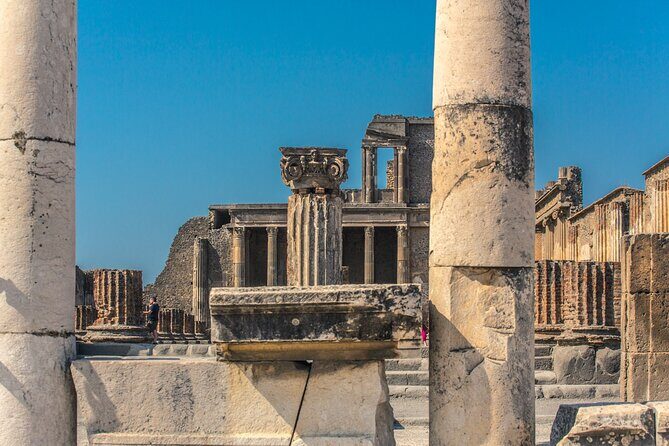
The Basilica was part of the Forum complex and was one of the most sumptuous buildings there. It covered about 1,500 square meters and served business and legal administration.
This is a good closing “civic” note because it connects justice and commerce to architecture. It also helps tie the earlier Forum stops into one bigger picture.
Timing and pace: how 4–5 hours can feel if you like to linger
This is a 4 to 5 hour experience, built around one larger guided segment and several short highlight stops. That structure is ideal if you:
- want an organized route without planning
- like hearing explanations as you walk
- still want to ask questions without falling behind the group
But if you’re the type who wants 30–40 minutes in one space with lots of wandering and quiet time, you might feel the clock. The private guide can adjust within reason, yet the design of the tour still aims for a strong “greatest hits” sweep.
My practical advice: bring your curiosity. Ask at each stop what to look for next. Then spend the last minute before you move on taking a focused photo or two—rather than trying to capture everything at once.
Price and value: what you’re really buying at $504.67
At $504.67 per person, this isn’t a budget day trip. But it’s also not just a ticket and a map. Your price includes:
- private round-trip transportation from your Sorrento hotel area
- an English-speaking private guide with live commentary
- priority entry into Pompeii
- admission tickets for the listed Pompeii stops on your route
- a true private format (your group only)
When you add up the likely costs of separate transport, separate guides, and entry tickets, the value math gets more sensible—especially if you’re traveling with someone you can share the private vehicle with, or if you’re the “I hate lines” type.
One more angle: Pompeii is one of those places where a guide can change how you remember it. Without guidance, it’s easy to leave with lots of photos and fewer connections. With guidance, you leave with a mental map of what each building meant.
If you’re visiting in summer, the tour’s planning emphasis matters too. The tour suggests sunscreen and comfortable shoes, and an early morning start is a smart tactic when heat climbs.
Who this private Pompeii tour suits best
This is a strong fit if you’re:
- visiting Pompeii for the first time and want the main structure of the city explained
- short on time and don’t want to spend hours figuring out logistics
- traveling as a couple or small group that values a private schedule
- the kind of person who learns best by walking and talking, not reading a guidebook later
It’s also a good pick if you’re not chasing every single corner of Pompeii. This is more “see the key places well” than “complete the entire park.”
Should you book this Pompeii tour from Sorrento?
I’d book it if you want a clear Pompeii route, minimal friction, and enough guide time to make sense of what you’re seeing. The private transfer removes a big pain point for Sorrento visitors, and fast-track entry helps you spend your limited hours inside the ruins.
I’d think twice if you’re very heat-sensitive, or if you know you want long stays at a few buildings rather than a structured sweep. In that case, you might prefer a longer Pompeii-only plan. For most first-timers, though, this hits the sweet spot.
FAQ
Is pickup from my hotel in the Sorrento area included?
Yes. The tour includes private transportation with an English-speaking driver from and to your hotel in the Sorrento area. Keep in mind some hotels may not be reachable due to traffic restrictions and pedestrian areas, so you’ll need to confirm the exact pickup location at least 24 hours before departure.
How long is the Pompeii tour?
The duration is approximately 4 to 5 hours.
Is the guide available in English?
Yes. The tour is offered in English.
Do I need to buy admission tickets separately?
Admission tickets are included for the listed Pompeii stops on your route, including the main Archaeological Park entry.
Do you get fast-track or priority entry into Pompeii?
Yes. Priority access is included to help bypass the line at the ticket window.
Is this a private tour or shared group tour?
It’s a private tour/activity, meaning only your group participates.
Can I cancel for a full refund?
Yes. You can cancel up to 24 hours in advance for a full refund. If you cancel less than 24 hours before the start time, the amount paid is not refunded.