REVIEW · SORRENTO
Private Pompeii & Herculaneum Tour from Sorrento
Book on Viator →Operated by IAMME IA! - Gray Line Amalfi Coast · Bookable on Viator
Pompeii and Herculaneum in one sweep sounds bold, but it works. You’ll get a private, guided day that connects the big moments of AD 79 with small details of everyday life you’d miss if you just wandered.
I love the time-saver here: hotel-area pickup, pre-booked entry, and a structured route so you don’t lose half the day finding your way. I also love how the guide work is split between Pompeii (2 hours) and Herculaneum (2 hours), so both sites feel taught, not rushed.
One consideration: this is a full day with real walking across archaeological stone and uneven paths, and drinks are not included—so plan comfort and bring what you need.
In This Review
- Key Things to Know Before You Go
- Why Do Pompeii and Herculaneum in One Day From Sorrento?
- Hotel Pickup in Sorrento and the Skip-the-Line Advantage
- Pompeii’s Forum and Main Streets: Where Roman Public Life Took Shape
- Via dell’Abbondanza, Markets, and Baths: The Daily-Life Circuit
- Pompeii’s Theater and the Lupanar: Entertainment and Social Reality
- Pompeii’s Big Private House Moments: Casa del Fauno
- Lunch Break: Use It Wisely (Food and Drinks Aren’t Included)
- Herculaneum: Why Mud and Lava Preserved a Whole Town Better
- Casa dei Cervi, Noble Homes, and the “Still There” Feeling
- House of the Skeleton and the Human Cost
- Herculaneum Central Thermae: Public Baths, Different Scale
- Partem Domus Lignea and the Wooden-Door Detail
- Salone della Barca di Ercolano: The Boat Museum Room
- Timing, Pace, and Comfort: Can You Actually Do This in One Day?
- Guides and the Value of Having Someone Point Things Out
- Price and What You’re Paying For (US$769.43 per Person)
- Who This Tour Suits Best
- Should You Book Private Pompeii & Herculaneum From Sorrento?
- FAQ
- Where does the tour start in Sorrento?
- Is pickup from my hotel included?
- How long is the tour?
- What language is the tour in?
- Are admission tickets included and do we skip the lines?
- How long is the Pompeii guided portion?
- How long is the Herculaneum guided portion?
- Is lunch included?
- What should I wear or bring?
- Can I cancel for a full refund?
Key Things to Know Before You Go
- Skip-the-line entry means you spend time looking, not queuing.
- Hotel-area pickup and drop-off keeps the day simple from Sorrento.
- Two guided blocks (Pompeii + Herculaneum) help you cover both cities without chaos.
- Pompeii highlights include the Forum, Via dell’Abbondanza, baths, and the theater—with stops timed for flow.
- Herculaneum is approached as a whole town, with houses, baths, and the famous boat museum room.
- You’ll get planned free time for lunch between sites and leisure time in Herculaneum.
Why Do Pompeii and Herculaneum in One Day From Sorrento?
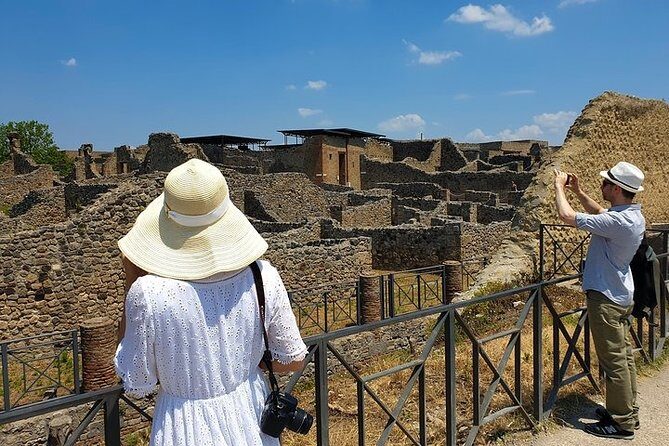
If you’re basing yourself in Sorrento, this is one of the most efficient ways to hit two of the most important UNESCO archaeological sites in Campania. You start inland at Pompeii, then shift to Herculaneum, and you’re back to Sorrento around late afternoon (about 4pm–5pm).
What makes this combo special is that it lets you compare two “same eruption, different outcome” stories side by side. Pompeii was buried in volcanic ash and pumice. Herculaneum was sealed by mud and lava flows. When you stand inside each ruin, that difference isn’t just theory—it changes what you can still see and how preserved the spaces feel.
The guided format is also a big deal. Pompeii especially is vast. Without a guide, it’s easy to bounce between dramatic spots and miss how Roman daily life fit together—public buildings, markets, baths, homes, and even the small signs of ordinary routines.
If you're still narrowing it down, here are other tours in Sorrento we've reviewed.


Hotel Pickup in Sorrento and the Skip-the-Line Advantage
The day begins with pickup from your hotel or a central meeting point in Sorrento at an agreed time. The meeting point listed is Piazza Torquato Tasso, 16, 80067 Sorrento NA, Italy, and the overall flow ends back at the same spot when you return.
Here’s why the skip-the-line tickets matter: both Pompeii and Herculaneum can be busy, and waiting in line burns the best part of your day—daylight, energy, and attention. This tour is built to reduce that waste by handling admission in advance and using your timed entry.
Transport is private and air-conditioned, which is practical if you’re visiting in hotter months. The drive gives you a buffer before you step into the ruins—no standing around, no complicated transfers, just a straight shot to the archaeological park.
Pompeii’s Forum and Main Streets: Where Roman Public Life Took Shape
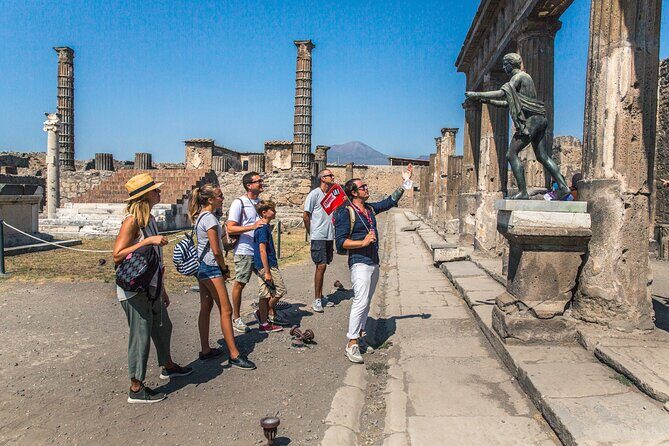
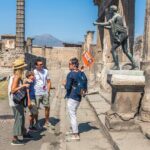
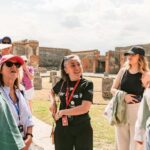
You’ll meet your private guide at the entrance to the Pompeii archaeological area and settle into a route that focuses on the site’s most meaningful “anchors.” The guided Pompeii segment is about 2 hours, and it’s paced with short stops at key structures rather than a slow shuffle through everything.
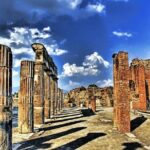
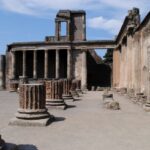
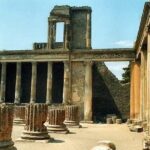
A strong starting point is the civic heart: the Foro de Pompeya (the Civil Forum). This is where power and daily activity intersected—city administration, justice, business management, trade activity, and citizen worship. When you stand in the Forum areas, it helps you understand why Pompeii wasn’t just a place of homes. It was a working city with rules, rituals, and commerce all tied to public spaces.
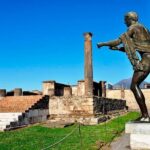
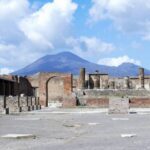
Then you move to the Tempio di Giove Capitolino on the north side of the Forum. This temple’s placement matters because it dominates the Forum view—especially with Mount Vesuvius rising in the background. The guide’s explanation makes it feel less like a lone ruin and more like part of a planned religious and political setting. The temple was renovated when the colony was founded (80 BC) and became a Capitolium with cult statues of Jupiter, Juno, and Minerva.
Via dell’Abbondanza, Markets, and Baths: The Daily-Life Circuit
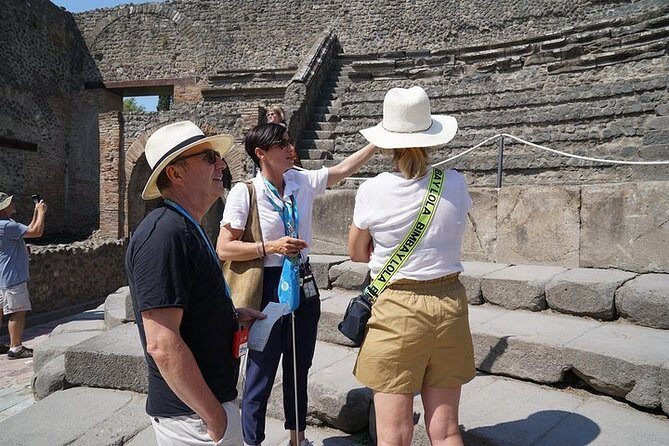
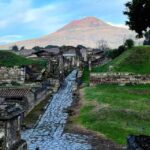
Next comes the street-level Pompeii story: shopping, work, and social life. The Via dell’Abbondanza is the main commercial artery. It runs from the Forum toward the Sarno Gate, and today you can still follow it by the surviving shopfronts and the way the raised stepping stones are arranged. It’s one of those walks where the ruins stop feeling like museum props and start feeling like street corners—places where people picked routes, read notices, bought goods, and heard news.
From there, you’ll visit the Macellum, the city’s market complex. The way the market is described gives you a clear sense of how food and commerce were organized, but also how imperial-style worship blended into everyday activity. You’ll see details tied to how the area supported meetings and ritual functions, plus a setting that suggests where certain products were sold.
Then there’s the social wellness centerpiece: the Stabian Baths (Terme Stabiane). This complex is especially worth your time because it shows Roman engineering at full strength. You’ll hear about the underfloor heating system (a hypocaust), and you’ll also see how the baths were organized for different groups. There are men’s and women’s sections, and the complex includes an open-air gymnasium (palaestra) and a large pool—so it wasn’t just a wash station. It was a place to meet, relax, and keep routine.
If you like the idea of “real life clues,” this is one of the best stops on Pompeii’s side. Baths make the city feel human because you can imagine conversations happening in spaces that still hold shape.
Pompeii’s Theater and the Lupanar: Entertainment and Social Reality
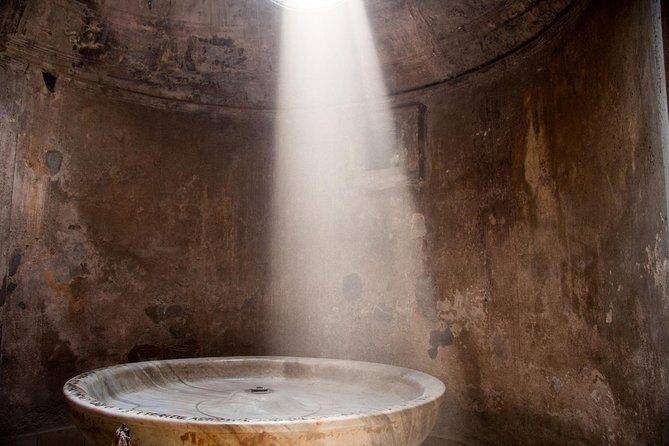
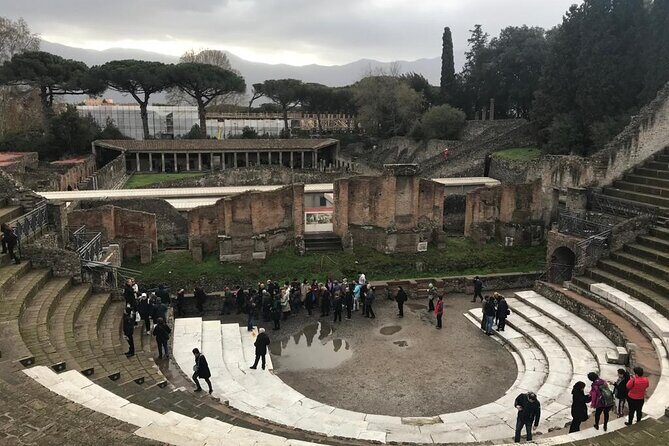
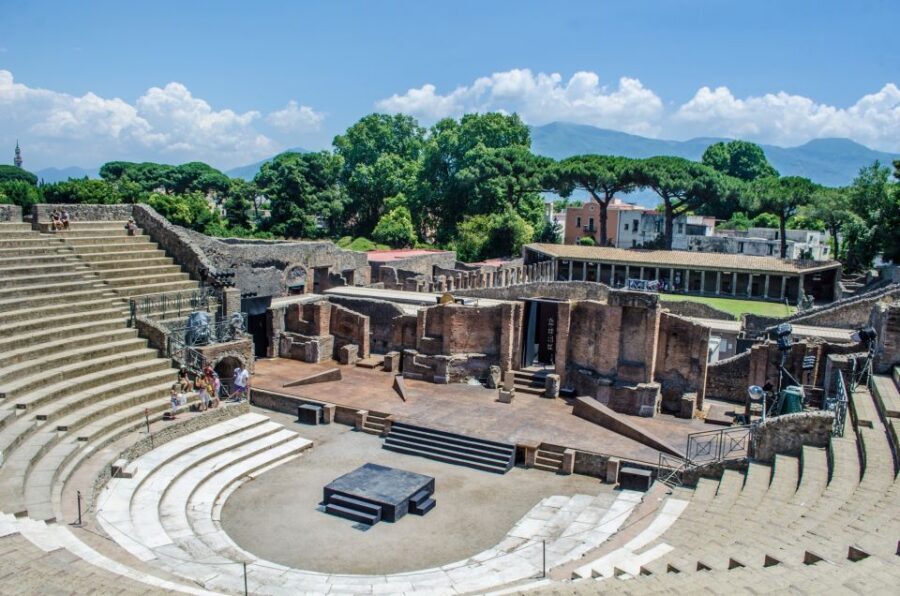
Pompeii isn’t only work and worship. It’s also entertainment, and public theater was a major outlet. At the Teatro Grande, you’ll see a horseshoe-shaped auditorium built into a hillside and designed to hold roughly 5,000 spectators. It dates to the 2nd century BC and is described as the first Greek-style stone theater in Pompeii. Watching the geometry of the seating and stage area helps you picture the scale of shows—and how art and performance were part of civic life.
Then there’s the stop people often approach with curiosity: the Lupanar, Pompeii’s most famous brothel (Lupanare Grande). You’ll be shown details about its erotic wall paintings and how services were priced in Asses. Even if you’d rather not go deep into the subject, the stop is useful because it grounds Pompeii in a fuller picture of society. Roman cities included everything from public baths to theaters to regulated commercial sex work—and this ruin preserves that reality in a way that’s hard to recreate from the big headlines alone.
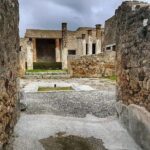
Pompeii’s Big Private House Moments: Casa del Fauno

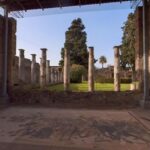
If you want a glimpse into wealth and status, the Casa del Fauno (House of the Faun) is the classic stop. It was built during the 2nd century BC and is described as one of the largest and most impressive private residences in Pompeii, known for major artworks.
This house tends to land well because it contrasts with the public spaces you’ve already seen. In the Forum and markets, you understand how the city ran. In a grand private residence, you see what elite life looked like—space, display, and the power to commission and collect.
Lunch Break: Use It Wisely (Food and Drinks Aren’t Included)
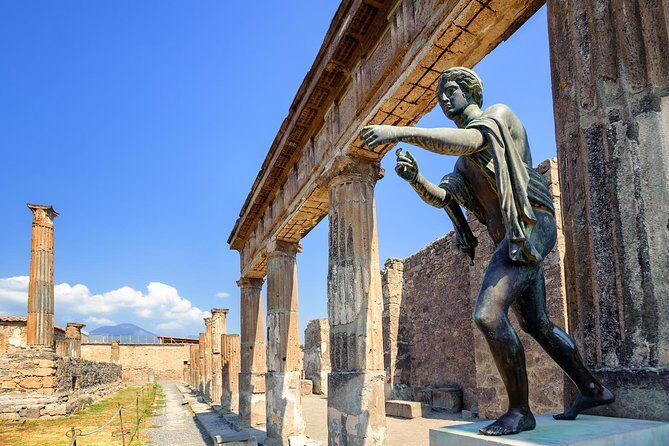
After your Pompeii tour, you’ll have free time for lunch. Lunch is own expense, and the tour doesn’t include food or drinks.
This is where a simple strategy helps: plan something quick, but don’t rush the moment you sit down. You’ll be shifting to Herculaneum afterward, and your legs will tell you whether you paced your break. Also, since drinks aren’t included, I’d bring or buy water during the day, especially if you’re visiting in summer heat.
Herculaneum: Why Mud and Lava Preserved a Whole Town Better
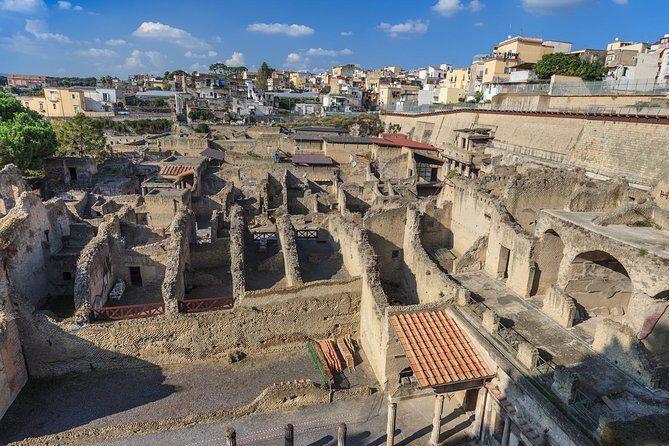
Then the day shifts. You’ll travel to Herculaneum, another city buried by the AD 79 eruption, and you’ll meet your guide at the ruins.
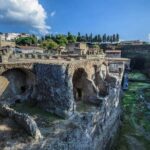
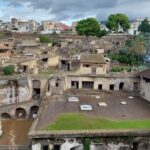
The key idea you’ll get right away is preservation. Many people find Herculaneum more intimate than Pompeii because the town was encased in mud and lava. That cover changed what survived, and it often means you can see details with a stronger sense of the original layout. Your guided Herculaneum segment is about 1 hour, followed by extra free time to explore at leisure.
This is a great place to slow down. Pompeii can feel like a sprint through famous stops. Herculaneum is more like walking through fragments of a lived-in neighborhood.
Casa dei Cervi, Noble Homes, and the “Still There” Feeling
One of the first Herculaneum highlights is the Casa dei Cervi, a prominent noble-family home. It’s described as having murals and beautiful still-life paintings, and you’ll hear how it had a seafront address before the eruption.
Herculaneum houses can hit harder than you expect because you see the shape of rooms and courtyards in a way that makes imagination easier. It’s not just a single wall fragment; it often reads like a sequence of spaces people moved through.
You’ll also visit the College of the Augustales, thought to be tied to the cult of Emperor Augustus and linked to the Collegium Augustalium (and possibly the local curia). That helps you understand the blend of civic religion and organization—the same city engine you saw in Pompeii, but expressed differently here.
House of the Skeleton and the Human Cost
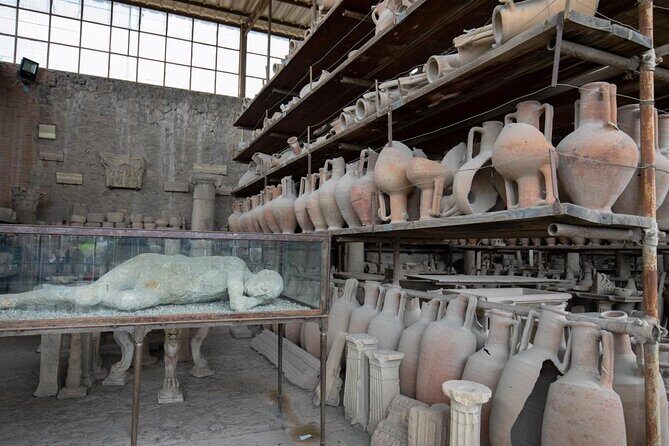
If Pompeii is about life before the eruption, Herculaneum also has a direct and sobering angle. The House of the Skeleton got its name from human remains found in a second-floor room in 1831. The tour context explains that some people sheltered inside their homes and died there from suffocation or heat gases.
This stop is heavy, but it’s also important. It turns the story from abstract catastrophe into real human choices and real outcomes—right where your feet are. If you’re sensitive to tragic history, pace yourself here. Take a breath, then keep going when you feel ready.
Herculaneum Central Thermae: Public Baths, Different Scale
Another high-value stop is the Central Thermae. Like Pompeii, Herculaneum had public baths, and the description emphasizes that private baths were limited to the most well-to-do families. The key detail is the layout: the thermal bath buildings are divided into sections reserved for women and men.
You’ll also hear about the room sequence: changing room, cold bath room, tepid bath room, and hot bath room. What’s useful for your own understanding is that you’re not just looking at a single pool. You’re seeing the whole ritual route of a Roman bath day.
Partem Domus Lignea and the Wooden-Door Detail
One of the more oddly fascinating Herculaneum moments comes from the Partem Domus lignea (Casa del Tramezzo di Legno). It’s named for a folding wooden door discovered there, used to separate the atrium from the tablinium (the owner’s studio).
Even the benches in front of the façade—where clients waited to be received—add a practical human touch. It’s a small design element, but it shows how social roles were built into architecture.
Salone della Barca di Ercolano: The Boat Museum Room
The tour ends with a memorable stop: the Salone della Barca di Ercolano. After the eruption, people fled toward the beach. The area described involves waves, sand, and lava destroying the port and beach, but one wooden boat survived and was recovered from the ancient beach.
The boat was covered with resinous material, which helped preserve it, and it was brought back to life in 1982—then placed back in the correct position so visitors can admire it.
This is a good way to finish because it connects archaeology with survival in a concrete object. It also reminds you that AD 79 left behind more than ruins—it left artifacts that carry stories of motion, escape, and ordinary coastal life.
Timing, Pace, and Comfort: Can You Actually Do This in One Day?
This day is designed to feel “full,” not frantic. You’ll start with pickup in Sorrento, then get around 2 hours guided Pompeii, a lunch break, and about 1 hour guided Herculaneum plus leisure time.
Still, plan for heat and sun. The tour suggestion is straightforward: wear sunscreen and comfortable shoes. Pompeii and Herculaneum are archaeological parks, so the ground can be uneven and your walking involves real steps between structures.
My practical advice: wear shoes you trust on stone, and don’t plan to carry a heavy daypack. If you can, keep essentials in a small bag: sun protection, a hat, and a water plan since drinks aren’t included.
Guides and the Value of Having Someone Point Things Out
A private guided tour only works if your guide makes the places click. In this case, the tour has a track record of guides who tie the ruins to real life—things like how public space functioned, why baths were built the way they were, and how Roman religion played out in everyday civic routines. Past guides on this route have included names such as Connie, Ugo, Nella, and Carmela.
Even if you’re not an archaeology fanatic, that interpretation matters. You can still see impressive walls without help. But when someone explains why the Forum worked as an administrative and trade hub—or how the Stabian Baths’ hypocaust heating system changed comfort—you start to understand the city’s logic.
That’s the core value of paying for a guide time block twice in one day: Pompeii and Herculaneum become two readable chapters, not two lists of sights.
Price and What You’re Paying For (US$769.43 per Person)
At $769.43 per person, this isn’t a budget day. But for what you get, it can be good value if you care about time and quality.
Here’s what the price covers based on the tour details:
- Private transportation with hotel-area pickup and drop-off
- 2 hours guided Pompeii plus 2 hours guided Herculaneum
- Skip-the-line admission tickets
- A structured route that hits Pompeii’s major anchors and Herculaneum’s preserved highlights
So you’re paying for three things that are hard to replicate without extra effort: reliable ground logistics from Sorrento, guided time that reduces wandering, and pre-booked entry that reduces waiting. If you can’t stand lines or you want your day to feel organized rather than improvised, this price starts making sense.
On the flip side, if you love spending your day at your own pace and you’re comfortable handling ticketing and transportation yourself, you might choose a different style of visit. This one is built for people who want the day managed.
Who This Tour Suits Best
I think this works especially well if:
- you want both Pompeii and Herculaneum without planning every transfer
- you prefer guided stops over walking randomly across huge sites
- you’re visiting with limited time in the area and want a full cultural hit in one go
- you like practical storytelling that links structures to daily routine
It may be less ideal if you want a slow, beach-day pace, because this is built for structured touring and cross-site time management.
Should You Book Private Pompeii & Herculaneum From Sorrento?
Yes, if you want a day that runs on rails. The best reason to book is the combination of skip-the-line entry + private guides + hotel-area pickup. That lets you spend your limited time inside the ruins instead of dealing with logistics.
I’d book it with confidence if you enjoy seeing the connection between big disaster history and the everyday Roman world—Forum life, market spaces, bath routines, private houses, and the preserved artifacts of Herculaneum.
But if you’re the type who wants zero structure and lots of unplanned wandering, or if your group needs very flexible timing for breaks, you might want a different approach.
FAQ
Where does the tour start in Sorrento?
The meeting point is Piazza Torquato Tasso, 16, 80067 Sorrento NA, Italy.
Is pickup from my hotel included?
Yes. Pickup is offered from your hotel or a central location in the Sorrento area, and you also get return transfer back.
How long is the tour?
It runs about 8 hours (approximately), with guided time at both archaeological sites.
What language is the tour in?
The tour is offered in English.
Are admission tickets included and do we skip the lines?
Yes. Admission tickets are included for the Pompeii and Herculaneum stops, and the tour includes skip-the-line entrance tickets for both sites.
How long is the Pompeii guided portion?
Pompeii includes about 2 hours of private guided tour time.
How long is the Herculaneum guided portion?
Herculaneum includes about 2 hours total with private guided touring, plus free time to explore at leisure.
Is lunch included?
No. After Pompeii, there is free time for lunch, but food and drinks are not included.
What should I wear or bring?
Wear sunscreen and comfortable shoes, since it can get hot in summer and you’ll be walking a lot on uneven ground. Drinks are not included, so plan accordingly.
Can I cancel for a full refund?
Yes. Free cancellation is available up to 24 hours in advance for a full refund.
If you tell me your travel dates and group size, I can also help you think through whether an 8-hour day fits your stamina and what to prioritize in Pompeii vs Herculaneum.