REVIEW · NAPLES
Herculaneum – Private Tour (skip-the-line admission included)
Book on Viator →Operated by Pompeiify · Bookable on Viator
A quiet walk through buried streets is rare. This private, skip-the-line visit turns Herculaneum’s ruins into a clear, guided story, with a calm pace that feels far less crowded than the usual big-stops circuit. I love the focus on specific houses and daily details, and I also like how the route lands on the seafront with the preserved wooden boat. A fair consideration: it’s only about 2 hours, so you’ll want to pace yourself and choose what to linger on.
The whole thing works well if you want more than photos. You get an English-speaking guide, admission included, and the tour is just your group—so questions stay easy and you don’t get herded. One other plus: if your schedule gets messy, there’s at least one recent example of the guide adapting kindly when a flight was delayed.
In This Review
- Key highlights to look for
- Herculaneum in two hours: the calm, guided way to see a lot
- Getting in fast: what skip-the-line really changes
- The house circuit: where Roman life comes into focus
- House of the Deer: symbols you can actually spot
- House of the Wooden Partition: privacy and room flow
- House of Neptune and Amphitrite: when myth meets daily rooms
- House of the Bicentenary: scale, layout, and what matters
- Roman shops, public baths, and the main street: life outside the houses
- Typical Roman shops: how commerce worked at street level
- Public baths: where routines became social
- Main street and public buildings: reading the city layout
- The seafront tragedy and the perfectly preserved boat
- What kind of group this is best for
- Price and value: what you’re actually paying for
- Weather and comfort: plan like a smart local
- Should you book this Herculaneum private tour?
- FAQ
- What’s included with the Herculaneum private tour?
- How long is the tour?
- Is this tour skip-the-line?
- Is it a private tour or shared with strangers?
- What language is the tour offered in?
- Do I need a paper ticket?
- Are service animals allowed?
- Is the meeting point near public transportation?
- What happens if the weather isn’t good?
- Is free cancellation available?
Key highlights to look for
- Skip-the-line entry so you can start seeing ruins sooner
- Private group format that keeps the experience calm and question-friendly
- Major houses like the House of the Deer and the House of Neptune and Amphitrite
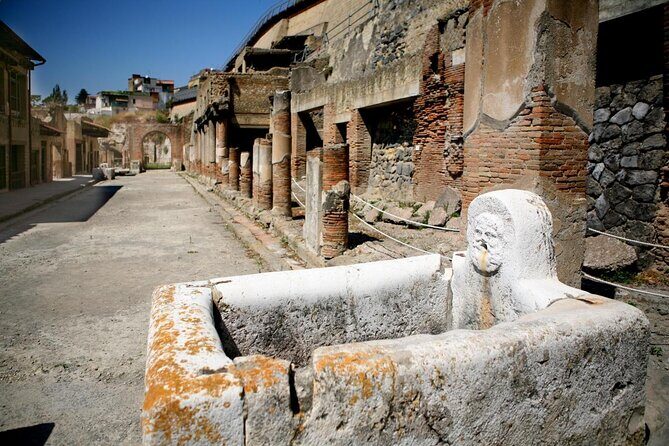
- Street-level Roman life with shops, public baths, and key city buildings
- The seafront moment with skeletons in shelter areas and a wooden boat still there
- English guide plus a mobile ticket that keeps logistics simple
Herculaneum in two hours: the calm, guided way to see a lot
Herculaneum is the kind of place that can feel like a blur if you just wander. The streets and rooms are spread out, and you can miss the connections—what you’re looking at, how people used the spaces, and why certain spots matter. A private guide solves that fast. You’re not just walking through ruins; you’re getting a guided route that ties scenes together.
This tour is built around a tight timeframe, about 2 hours. That’s both the strength and the limitation. The strength is momentum. You’ll cover major highlights without getting stuck on one area too long. The limitation is choice: if a room or corridor grabs you, you may have to save the deeper staring for later unless your guide gives you extra time.
Value-wise, the price—$162.56 per person—can look steep at first glance. But you’re paying for three things that often cost extra separately: a guide, admission included, and a private format (only your group). If you’re traveling with a few people and want the “we can stop and ask” experience, this is often where private tours make sense.
If you're still narrowing it down, here are other tours in Naples we've reviewed.

Getting in fast: what skip-the-line really changes
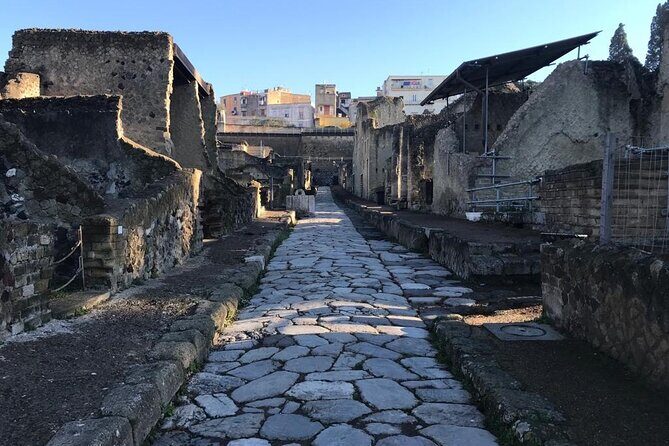
Skip-the-line matters more than it sounds in ruined sites. When you arrive during peak times, time can vanish before you even see the first wall. Here, admission is included and the tour is designed to get you through promptly. That means your guide can start shaping your visit right away—where to look, what to notice, and what to ignore.
Also, you’re not stuck waiting around with everyone else. A private tour format keeps the group moving smoothly. You still get the sense of history, but you don’t have to fight for attention at every stop.
And because you’re issued a mobile ticket, you’re less likely to waste time with paper, printing, or last-minute phone scramble. It’s a small thing, but it adds up on travel days.
The house circuit: where Roman life comes into focus
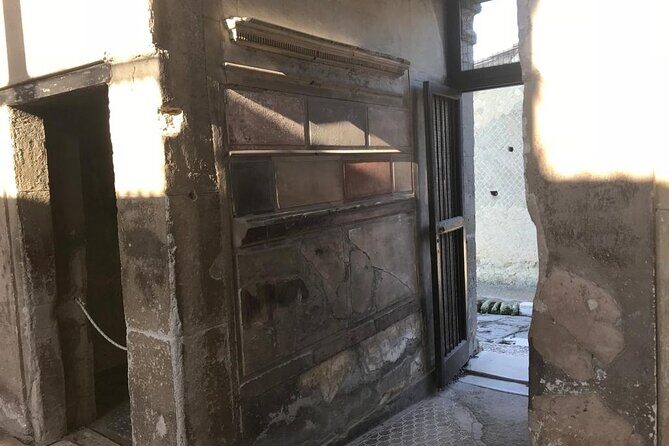
The heart of this experience is the house route. You’ll visit some of the most prominent private homes, and the way the tour presents them makes the ruins feel functional rather than random. Instead of seeing architecture, you get a sense of how rooms connected to daily living.
Here are the stops that define the tour.
House of the Deer: symbols you can actually spot
The House of the Deer is one of the big named houses you’ll see. Even if you’re not an archaeology superfan, it’s the kind of site where the guide can point you to notable details that help you read the space. The value here is that your guide steers your attention toward what makes this house recognizable.
In a place like Herculaneum, you’ll walk past many similar-looking walls and doorways. A good guide helps you avoid the “I saw it, but now what?” feeling.
House of the Wooden Partition: privacy and room flow
The House of the Wooden Partition is a smart inclusion. It hints at how residents organized space and controlled sightlines and movement. In other words, it’s not just about what’s left—it’s about how people likely lived with structure and privacy in mind.
A drawback you should consider: houses can be a bit repetitive if you’re expecting totally different themes at every stop. The fix is mindset. Treat each house like a different chapter of the same city’s home life.






House of Neptune and Amphitrite: when myth meets daily rooms
The House of Neptune and Amphitrite is another standout. The name alone suggests the house’s imagery and theme, and the guide can help you connect what you see to the Roman taste for mythology and storytelling in domestic spaces.
This is where you’ll likely start noticing that the ruins aren’t only “old.” They were built to be meaningful to the people living there. That’s the difference between a quick walk and a guided one.
House of the Bicentenary: scale, layout, and what matters
The House of the Bicentenary adds variety to the set. Large houses in Herculaneum tend to reward a slower look because there’s a layout logic behind them—entrances, room sequences, and how space gets used. With a time-boxed tour, you’ll never see every corner in depth, but you will get enough structure to understand what you’re looking at.
My advice: choose one house to be your “main” house during the tour. Let the rest be orientation and context.
Roman shops, public baths, and the main street: life outside the houses
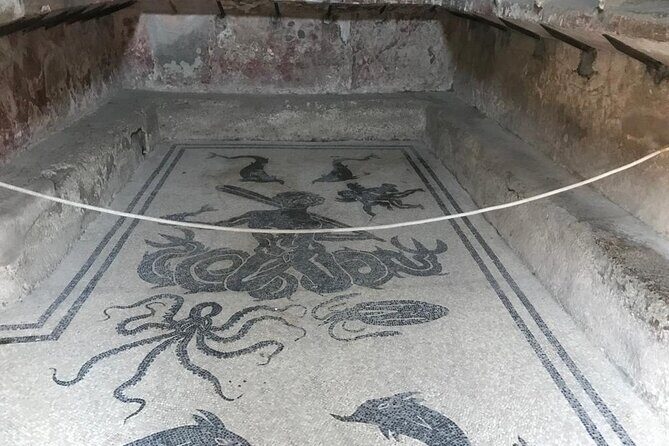
After the houses, the tour widens into the city. This is crucial. Houses alone can trick you into thinking Herculaneum was mostly private life. The route balances that by showing typical Roman shops, public baths, and the main street along with key public buildings.
Typical Roman shops: how commerce worked at street level
Seeing typical Roman shops helps you picture the city as a place of everyday transactions, not a museum display. Even with limited visible features, the guide can point out where trade likely happened and how shops would connect to the street rhythm.
If you like “human scale” travel, this part tends to land well. It makes the place feel closer to real life.
Public baths: where routines became social
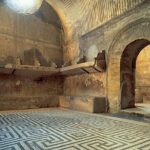
Public baths bring a different mood to the ruins. Baths are about routine and community, and the remnants you see help you imagine that daily rhythm. It’s also one of the best stops for understanding that Roman cities weren’t designed only for homes and temples; they were built for movement, meeting, and repetition.
Main street and public buildings: reading the city layout
The main street and public buildings give you the big picture. You start to understand where major life happened and how residents and visitors might have moved through the city.
This is another reason a guide adds value. Without one, it’s easy to get lost in beautiful but disconnected fragments. With guidance, those fragments become a simple map of city life.
The seafront tragedy and the perfectly preserved boat
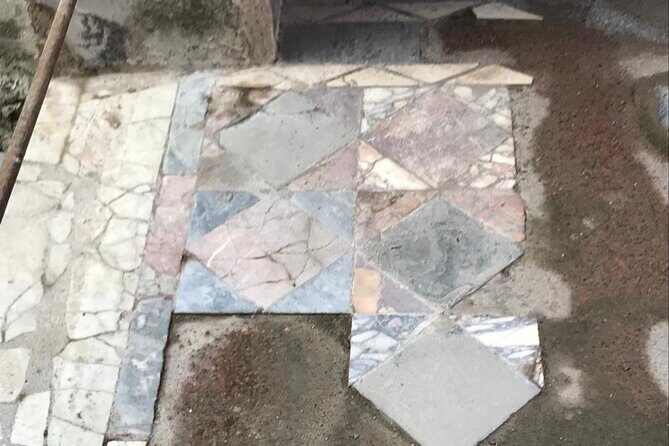
The final highlight hits hard in a quiet way. You’ll reach the ancient beach with skeletons of people taking shelter in some of the buildings on the seafront, plus a wooden boat that was found on the beach and is described as still perfectly preserved.
This is not the kind of stop that needs fancy storytelling. The physical presence makes it unforgettable. What your guide can add is context and careful direction—so you don’t just stand there staring, you actually understand why this section matters.
A practical tip: go into this part mentally prepared. It’s emotionally heavier than the house-to-shop progression. If you’re traveling with kids, it may be the moment to decide ahead of time how much detail you want to hear.
What kind of group this is best for
This is a private tour. That means it fits best if you want control over your pace and your questions. It’s also a great match if you’re traveling with a small group—friends, couples, or families—because you can split attention and keep everyone engaged.
It’s offered in English, and it says most travelers can participate. If you’re okay walking around ruins and taking in uneven ground and outdoor conditions, you’re likely set.
One more small reality check: because it’s a private tour with a fixed route and about 2 hours, you’ll want to show up ready to move. If your day is packed with multiple stops, build in some breathing room so you don’t feel rushed.
Price and value: what you’re actually paying for
Let’s talk value in plain terms.
- $162.56 per person for about 2 hours
- Admission ticket included
- Private format: only your group participates
- English-speaking guide
- Mobile ticket (less hassle)
If you compare this to a generic self-guided visit, the difference is clear: you’re paying for interpretation and organization. In a site like Herculaneum, that interpretation often makes the visit feel longer and more satisfying because you’re understanding the scenes instead of guessing.
If you’re a solo traveler, the private format may feel less cost-friendly. If you’re splitting the price among a group, it can become a very practical way to see the best parts without losing half the day to confusion, lines, or missed connections.
Weather and comfort: plan like a smart local
This tour requires good weather. That doesn’t just mean comfort; it also affects how enjoyable it is to walk between stops outdoors.
Wear comfortable shoes. You’ll be on your feet through a route that includes houses, street scenes, and the seafront area. Bring a light layer even in mild seasons, because coastal air can change how warm you feel.
If you’re traveling with a tight flight schedule, remember one recent experience included a guide adapting when a flight was delayed. That suggests the operator is at least willing to work with real-world travel hiccups.
Should you book this Herculaneum private tour?
I’d book it if you want a guided, calm, highlight-focused visit. This isn’t about doing everything. It’s about seeing the main houses, street life, baths, and that seafront moment with the boat—without wasting your time figuring out what matters.
Skip it if you prefer total freedom and want to wander slowly with no structure, or if you want an all-day archaeology deep dive. At roughly 2 hours, you’ll leave with a strong overview, not a doctorate.
My recommendation: if this fits your schedule, and you like the idea of skip-the-line entry plus a private English guide, it’s a solid value for getting the most meaningful parts of Herculaneum without the usual stress.
FAQ
What’s included with the Herculaneum private tour?
Admission is included, and you’ll also have a guide (the tour is offered in English) as part of the private experience.
How long is the tour?
It runs for about 2 hours.
Is this tour skip-the-line?
Yes, skip-the-line admission is included.
Is it a private tour or shared with strangers?
It’s private. Only your group will participate.
What language is the tour offered in?
The tour is offered in English.
Do I need a paper ticket?
No. The tour uses a mobile ticket.
Are service animals allowed?
Yes, service animals are allowed.
Is the meeting point near public transportation?
The tour is listed as being near public transportation.
What happens if the weather isn’t good?
The experience requires good weather. If it’s canceled due to poor weather, you’ll be offered a different date or a full refund.
Is free cancellation available?
Free cancellation is available. You can cancel up to 24 hours in advance for a full refund.