REVIEW · NAPLES
Pompeii: Private Tour with an Archaeologist
Book on GetYourGuide →Operated by Askos Tours · Bookable on GetYourGuide
Pompeii feels close-up when it’s personal. This private Pompeii tour takes you through the western part of the city—forums, baths, theaters, and homes—while a certified archaeologist-guide explains what you’re seeing in plain language and often with very human stories. Two big wins: you get skip-the-line admission and you’re not stuck doing the same quick loop as everyone else. The one watch-out is that Pompeii is a lot of walking in uneven ancient stone for 3 hours, so comfortable shoes are not optional.
You’ll meet at Porta Marina Superiore, in front of the Hortus bar-restaurant (look for the building with lemons and oranges hanging outside), and you’ll end back near the same area. The route is designed to make you feel like you’re wandering through a town that was paused in time—because that’s exactly what happened after Vesuvius erupted in 79 A.D.
In This Review
- Key things that make this tour worth it
- Pompeii in 3 hours: why a private archaeologist changes everything
- Meeting at Porta Marina Superiore: start where the city still makes sense
- The western route: gates, gods, and the city’s public heartbeat
- Stop-by-stop: what you’ll see and what to pay attention to
- Stop 2: Porta Marina (Pompeii’s western gateway)
- Stop 3: Temple of Apollo
- Stop 4: Foro Civile di Pompei (the civic center)
- Stop 5: Basilica
- Stop 6: House of Menander
- Stop 7: Forum Baths
- Stop 8: Lupanare (Pompeii’s brothel)
- Stop 9: House of the Faun
- Stop 10: Large Theatre
- Stop 11: House of the Vettii
- Stop 12: Amphitheater of Pompeii
- Stop 13: Finish near Scavi di Pompei ticket area / Porta Marina Superiore
- What the archaeologist-guide focus really means for you
- Price and value: what $508.15 buys (and how to judge if it’s fair)
- Best for: who this tour fits and who should think twice
- When to go and what to expect on-site
- Should you book Pompeii: Private Tour with an Archaeologist?
- FAQ
- FAQ
- How long is the Pompeii private tour?
- Where do I meet my guide?
- What’s included in the price?
- What should I bring?
- Are umbrellas or pets allowed?
- What languages are available for the live guide?
- Is the tour wheelchair accessible?
- Is entrance free on any day?
Key things that make this tour worth it
- A certified archaeologist-guide who can connect ruins to real daily life, not just dates
- Skip-the-line admission fees, so you spend more time walking Pompeii and less time waiting
- Western Pompeii focus, including gates, forums, baths, and several major houses
- Stops built around contrasts, from public buildings to private homes and the Lupanare
- Small-group feel in practice, with plenty of room for questions and pacing
Pompeii in 3 hours: why a private archaeologist changes everything
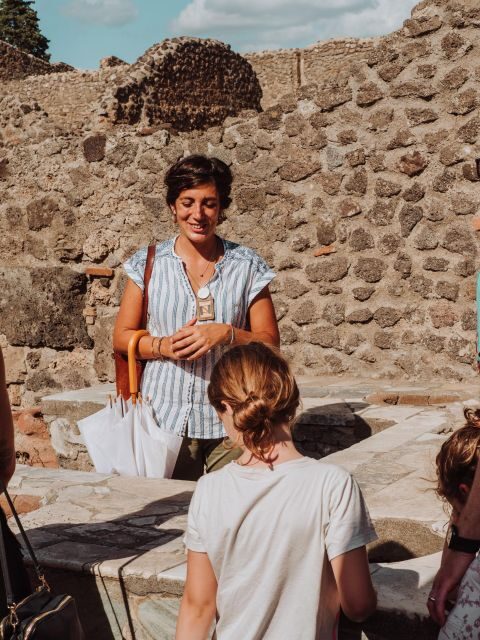
Pompeii is huge, and it’s easy to get lost in the wow-factor. You can stand in front of a doorway, stare at a fresco, and still miss what it meant to the people living next to it. What you want is someone who can point out how the city worked and why each place was important.
That’s where the private archaeologist-guide makes a real difference. The best part is not just being told facts—it’s learning to see. The guide approach here emphasizes details: the way spaces connect, how public life spills into everyday life, and what the archaeology can tell us about routines, beliefs, and status.
There’s also a practical advantage. With a private tour, you can slow down when something grabs your attention. That matters in Pompeii, because the most interesting things are often small—inscriptions, floor patterns, or layout clues that only show up when someone teaches you how to look.
If you're still narrowing it down, here are other tours in Naples we've reviewed.
Meeting at Porta Marina Superiore: start where the city still makes sense
You’ll meet your guide at the Pompeii main gate called Porta Marina Superiore, directly in front of the Hortus bar-restaurant. The landmark is hard to miss: lemons and oranges hanging outside.
This start point helps you “get oriented” quickly. Instead of entering Pompeii cold and guessing your route, you begin with context—what this gate area suggests about movement into the city and how people would have approached Pompeii’s western side.
You should also plan for the weather. The tour runs in any condition. Rain is common enough in the region that the operator advises a raincoat and/or small umbrella in bad weather, but umbrellas are listed as not allowed—so I’d strongly lean toward a raincoat you can manage without equipment.
The western route: gates, gods, and the city’s public heartbeat
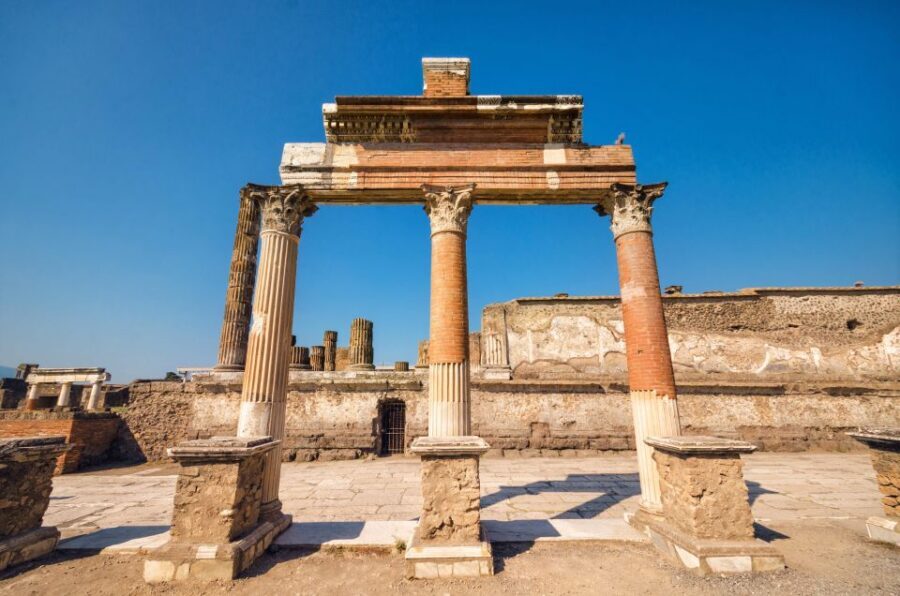
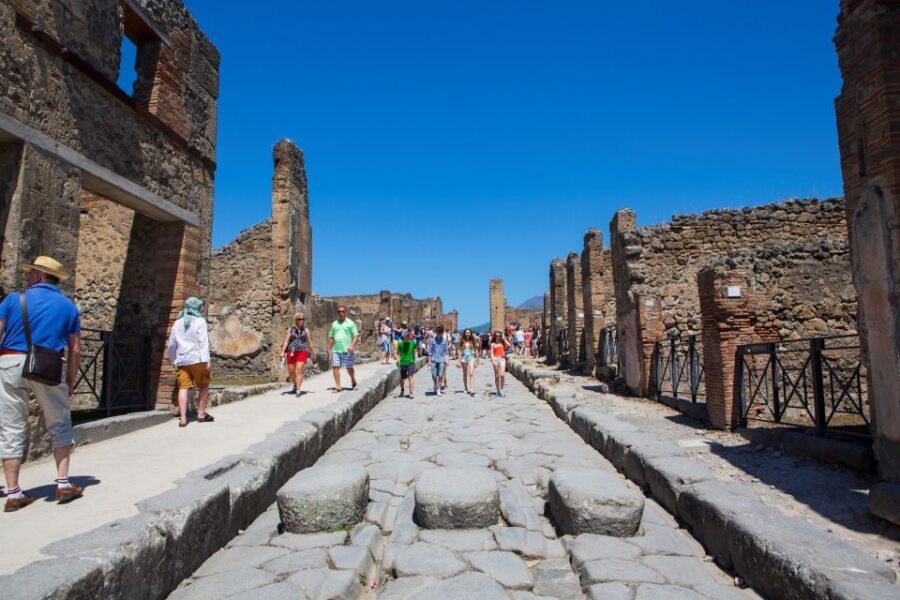
The tour is paced as a connected walk through major public spaces and signature neighborhoods. You’ll move from entrances into civic power, from temples into daily routines, and then into households where you can almost picture the noise and smells of life.
Even after many passes through Pompeii’s ruins, the site has a way of confusing your sense of direction. The guide’s job is to prevent that. You’re not just taking pictures—you’re building a mental map of where you are and why it matters.
One more thing I like: the route doesn’t stay only in grand monuments. It balances the “big wow” stops with the places where the Romans ate, bathed, traded, gathered, watched, and flirted.
Stop-by-stop: what you’ll see and what to pay attention to
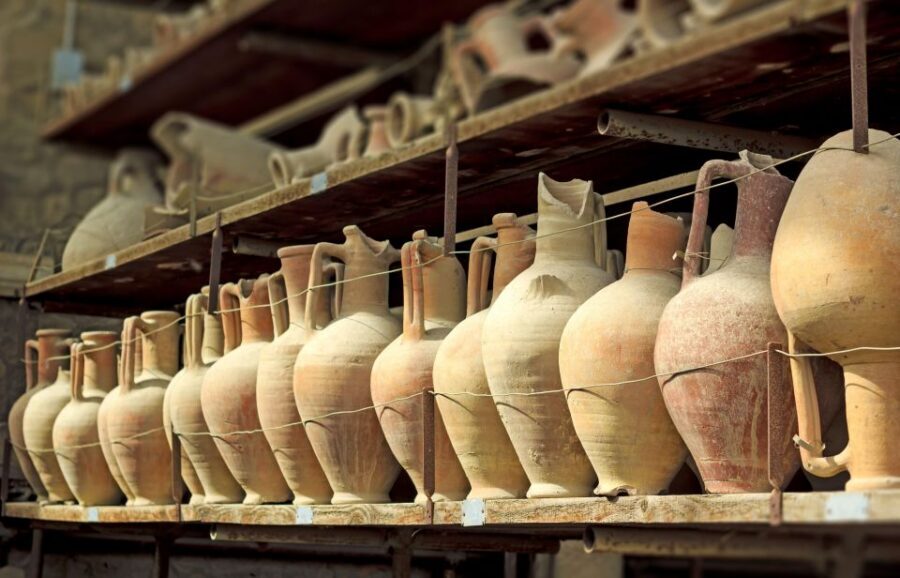
Below is the feel of each stop, and what makes it meaningful. Pompeii rewards attention, so treat these like checkpoints for learning how the city functioned.
Stop 2: Porta Marina (Pompeii’s western gateway)
At Porta Marina, you’re at a boundary between outside and inside—exactly the kind of place where you should listen for city-plan context. Gates aren’t just entrances. They’re about controlled movement, public visibility, and how the city organized flow.
If you like architecture details, watch how the gate fits into the surrounding street rhythm. Your guide will connect this to what the Romans needed the city to do.





Stop 3: Temple of Apollo
The Temple of Apollo is one of those stops where it’s easy to think, okay, it’s a temple. The trick is learning what the space was for and what Apollo represented in civic life.
Temples in Pompeii aren’t isolated art pieces. They sit within social systems—who showed up, what ceremonies mattered, and how belief lived alongside commerce and politics.
Stop 4: Foro Civile di Pompei (the civic center)
Next comes the Foro Civile di Pompei, the civic heart where public decisions and daily public life shared space. This is where you’ll start to feel Pompeii as a functioning community, not just preserved stone.
As you stand in the forum, pay attention to how the buildings face inward and outward. Your guide helps you understand why the layout pushed people into interaction—hearing news, seeing authority, and participating in city routines.
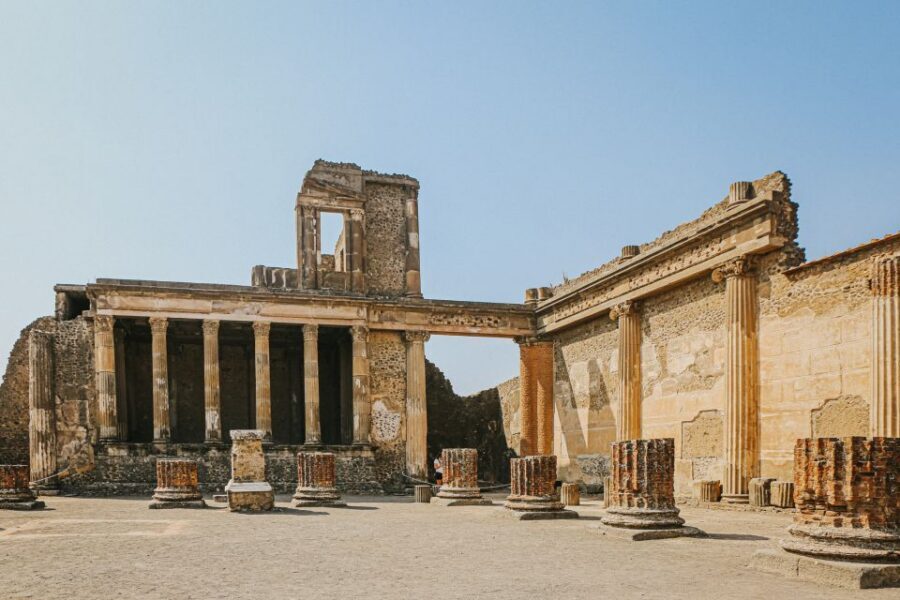
Stop 5: Basilica
The Basilica is a strong “watch how people used space” stop. It’s tied to administration and public gatherings, which means it’s about movement and behavior as much as it is about architecture.
When you’re inside or near it, look at how people would have arranged themselves. That’s often where the guide’s explanations make the room feel less empty and more active.
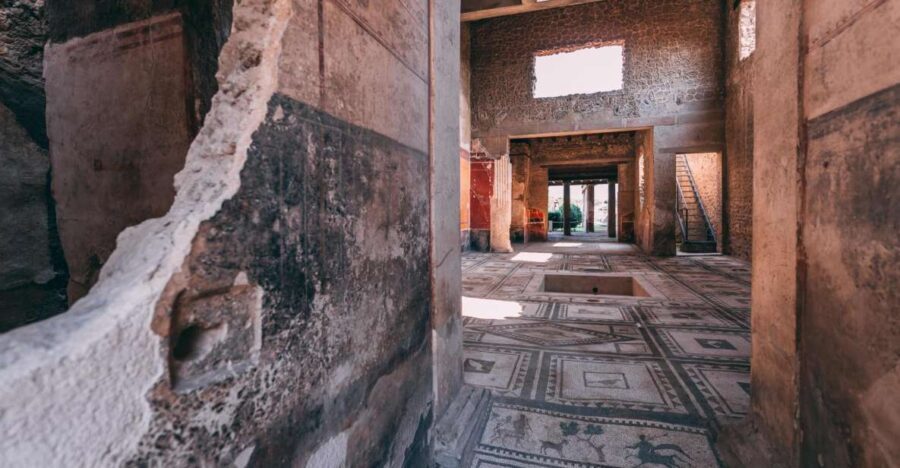
Stop 6: House of Menander
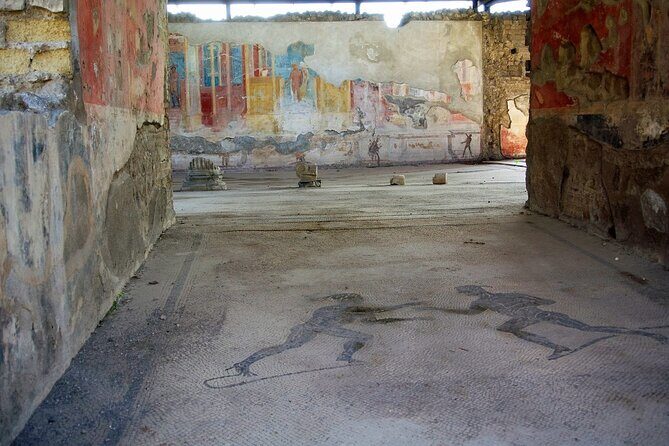
Then you shift from public architecture to a private residence: the House of Menander. This is where Pompeii becomes personal fast. Frescoed walls and household layout stop feeling like museum objects and start feeling like someone’s real home.
I like this stop because it teaches you to read a house. You’ll learn how rooms worked together, what certain decorated areas likely signaled, and how wealth or taste showed up in daily life.
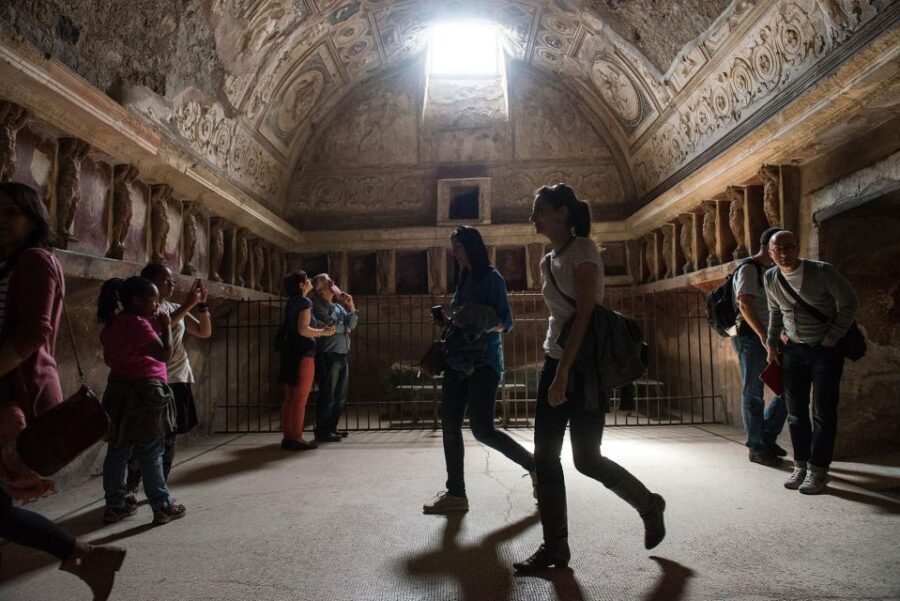
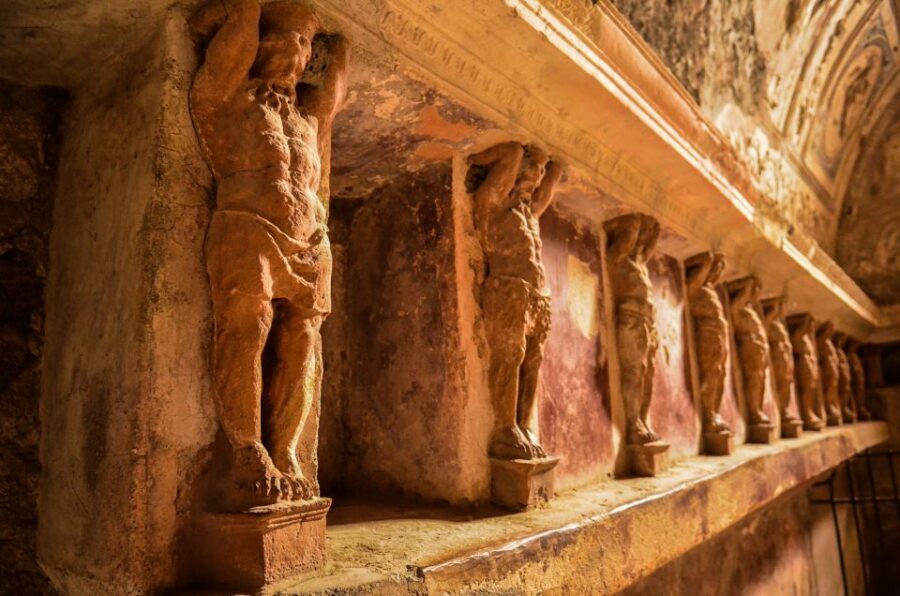
Stop 7: Forum Baths
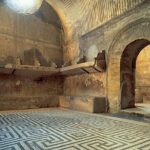
The Forum Baths are a great contrast stop. Romans didn’t treat bathing as purely hygienic; it could be social, routine, and status-related. A baths complex is also a reminder that “public” doesn’t always mean government or politics.
As you move through the baths areas, listen for the sequence of rooms and what people did there. The point is to see a full cycle of activity, not just view walls.
Stop 8: Lupanare (Pompeii’s brothel)
The Lupanare is one of the most discussed sites in Pompeii, and your guide will frame it with context rather than shock value. It’s part of understanding Roman city life as it actually was, including spaces dedicated to adult entertainment.
If you’re sensitive to adult themes, this is the stop to mentally prepare for. Still, it’s also one of the most important archaeological windows into how Pompeii worked socially.
Stop 9: House of the Faun
The House of the Faun is a major household stop, and it tends to deliver big visual impact. But the real payoff is how the guide connects the layout to wealth, household management, and the role of art and space.
Look for the way the home’s design supports how people moved through it. A guide can also help you understand which elements were decorative versus functional.
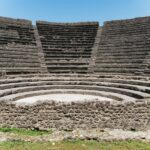
Stop 10: Large Theatre
The Large Theatre is where civic life turns into spectacle. Pompeii’s entertainment scene helps you understand what people did for fun, how crowds gathered, and how culture fit into the rhythm of the city.
If you like performance spaces, focus on the scale and sightline logic. Your guide helps translate the structure into the experience of watching something together.
Stop 11: House of the Vettii
The House of the Vettii is another standout residence, known for its decorative richness. This is a good stop if you want to understand how art, identity, and household branding showed up in everyday settings.
Pay attention to how the guide points out visual cues and what they likely meant socially. This is where Pompeii stops being “old stuff” and starts feeling like a window into human ambition.
Stop 12: Amphitheater of Pompeii
Finally, you reach the Amphitheater of Pompeii, built for mass events and communal viewing. This is the end of the public entertainment arc and one of the strongest “big crowd” spaces in the city.
Even without reenactments, the archaeology helps you picture how spectacle worked here. If you’re a person who likes thinking about crowd behavior and city logistics, this stop will click.
Stop 13: Finish near Scavi di Pompei ticket area / Porta Marina Superiore
The tour ends back near the meeting point, with drop-off options listed around Scavi di Pompei Biglietteria and Porta Marina Superiore. That’s handy if you’re planning to keep exploring on your own after the guide leaves you with a clearer map of what to target next.
What the archaeologist-guide focus really means for you
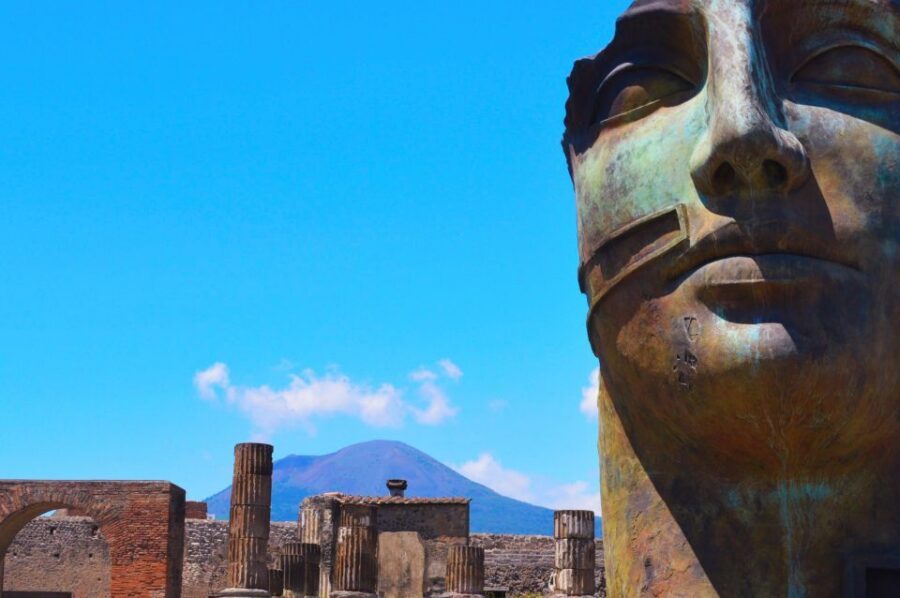
Private guides often sound like they’ll talk a lot. The difference here is that the guide style is built for explanation through specifics.
From guide examples you may encounter—names like Nicoletta, Patrizia, Jasmine, Silvia, Serenella, Annalisa, Laura, Diego, Andrea, Paola, Mena, Antonella, Michele, and Monica—the common thread is the ability to connect ruins to real people. Guides are praised for spotting small details, telling stories that feel grounded in human life, and answering questions without brushing you off.
So if you’re the type who asks why a forum is shaped a certain way, or what a household layout implies, this tour format is likely to work well. And if you’re there with kids or teens, the human-story approach can keep attention from drifting.
One practical note: the tour is described as guided by a certified archaeologist-guide, but there’s at least one mixed concern in the background about whether the guide matched that expectation. If you care deeply about the archaeologist credential, confirm the guide’s role when you book, so you get exactly what you’re paying for.
Price and value: what $508.15 buys (and how to judge if it’s fair)
The price shown is $508.15 per group up to 1, which means this is very much a “you’re paying for privacy” product. If you’re traveling as two or more and the operator allows additional people under the same booking, the value story changes fast. If it truly caps at one person, it’s pricey—yet still can be worth it when you want maximum time on the ground with minimal waiting.
Here’s what you do get for the money:
- Skip-the-line admission fees, so you’re not stuck in ticket bottlenecks
- A guided tour by a certified archaeologist-guide
- Disposable earphones are available for bigger groups
- A route that hits major western highlights within about 3 hours
For me, the value test comes down to how you like to travel. If you love structure, context, and Q&A, the guide time is the core value. If you’re more of a “wander and read plaques” person, you might not need private guidance. But Pompeii is one of those places where a good guide can cut confusion in half—and confusion is what makes expensive time feel wasted.
Best for: who this tour fits and who should think twice
I’d book this if:
- you want Pompeii with context and interpretation, not just sightseeing
- you care about how Romans lived—public buildings, baths, homes, and entertainment
- you want to move at your own pace and ask questions as you go
I’d think twice if:
- you have limited walking tolerance. The experience is described as intense on foot, and it’s a 3-hour walk through ancient surfaces
- you’re expecting a fully step-free experience. The info also contains conflicting notes about wheelchair suitability, so confirm ahead of time if mobility is a concern
- you’re traveling with pets. Pets aren’t allowed
- you rely on umbrellas. Umbrellas are listed as not allowed, and rain planning matters
When to go and what to expect on-site
You’ll be outside for the duration, and the tour runs in any weather condition. Pompeii can be a lot under full sun, and it can be slippery under rain, so plan clothing and footwear accordingly—again, comfortable shoes are the key item the operator calls out.
One timing bonus: on the first Sunday of each month, entrance is free of charge. But tickets can’t be reserved ahead, and entry isn’t guaranteed. If you’re visiting on that date, keep expectations flexible.
Should you book Pompeii: Private Tour with an Archaeologist?
I’d book it if you want Pompeii to feel guided, focused, and personal. This tour’s strength is that it combines skip-the-line access with a true interpretive lens—forums, temples, baths, houses, theaters, and the amphitheater—so you leave with a better sense of how the city worked before Vesuvius froze it in time.
Skip it if you’re on a tight budget and you’re happy reading at your own pace without help. Pompeii is unforgettable either way, but private guidance is where the experience gets clearer, faster.
If you do book, do one thing that pays off instantly: wear your best walking shoes, show up at Porta Marina Superiore on time, and come ready to ask questions. Your 3 hours will feel like the “right” parts of Pompeii, not just the parts you happened to reach.
FAQ
FAQ
How long is the Pompeii private tour?
It lasts about 3 hours.
Where do I meet my guide?
Meet at the Pompeii main gate called Porta Marina Superiore, in front of the Hortus bar-restaurant (the building with lemons and oranges hanging outside).
What’s included in the price?
You get a guided Pompeii tour by a certified archaeologist-guide, disposable earphones for bigger groups, and skip-the-line admission fees.
What should I bring?
Bring comfortable shoes.
Are umbrellas or pets allowed?
Pets aren’t allowed, and umbrellas aren’t allowed.
What languages are available for the live guide?
The tour offers live guidance in Japanese, English, Spanish, Italian, German, French, Portuguese, Chinese, and Russian.
Is the tour wheelchair accessible?
The details list it as wheelchair accessible, but it also notes it is not suitable for wheelchair users. Confirm suitability with the provider before booking.
Is entrance free on any day?
On the first Sunday of each month, entrance is free, but entry isn’t guaranteed because tickets can’t be reserved ahead of time.