REVIEW · NAPLES
Pompeii and Naples Half-Day Guided Tour from Naples+Skip-the-Line
Book on Viator →Operated by Discover Italy dmc · Bookable on Viator
Pompeii and Naples, packed into one smooth morning. I love that Pompeii entry is included, so you avoid the ticket hunt and stress. I also love the licensed guide storytelling, which helps you read the ruins instead of just looking at stones. One possible drawback: the Naples sightseeing is fairly fast, so if you want slow, deep wandering, this won’t feel like that.
You’ll start around 8:00 am from the Naples meeting point, then spend about two hours at Pompeii with your guide. The full day runs about 6 hours, using an air-conditioned vehicle, and it operates in all weather (so pack for sun and sudden shade).
In This Review
- Key Things to Know Before You Go
- Naples-to-Pompeii in Six Hours: The Smart Shape of This Tour
- Price and Value: What $166.83 Buys You (and What It Doesn’t)
- Castel Nuovo to Posillipo Hill: Naples From the Viewpoints That Matter
- The 1642 Church Stop and the Greco-Roman Road Story You’ll Actually Remember
- Castel dell’Ovo and Borgo Marinari: Nightlife Views With a Legend Attached
- Piazza del Plebiscito, Teatro San Carlo, and Galleria Umberto I
- Pompeii With Included Admission: What Two Hours Really Covers
- The Pompeii ID rule that can make or break entry
- Practical Tips for Timing, Heat, and Comfort (Your Future Self Will Thank You)
- Who This Tour Fits Best (and Who Might Prefer Something Else)
- Should You Book This Pompeii and Naples Half-Day Guided Tour?
- FAQ
- What is the duration of the tour?
- What time does the tour start?
- Is Pompeii admission included?
- Is lunch included?
- What language is the tour in?
- Do I need a photo ID for Pompeii?
- What’s the meeting point?
- Is there a mobile ticket?
- How big is the group?
- Is cancellation free?
- Is the vehicle air-conditioned?
Key Things to Know Before You Go
- Pompeii admission included: no waiting or buying on the spot
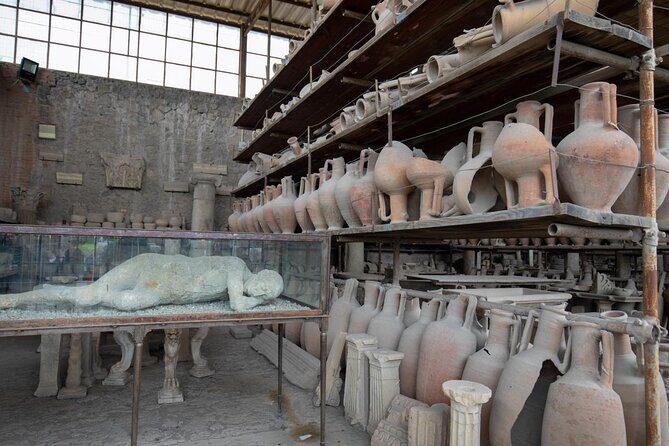
- A real guide in Pompeii: you get context for streets, homes, theaters, and everyday life
- Big Naples views, short stops: you’ll see a lot from key vantage points
- Port-to-ruins flow: designed for cruise or port schedules, then back to the meeting point
- Photo ID is mandatory for Pompeii: ticket details must match your passport/ID exactly
Naples-to-Pompeii in Six Hours: The Smart Shape of This Tour

This tour is built for one goal: get you from Naples into Pompeii with minimal friction, then come back for major city landmarks. The pacing is what makes it work. You don’t spend hours trying to coordinate entry times. You don’t lose the day to logistics. Instead, you get a structured route with guided commentary and set photo moments.
It’s also the kind of tour that helps if you’re short on time. If Pompeii is the big priority but you also want a taste of Naples—views, squares, and iconic buildings—this hits that sweet spot. You’ll come away with an overview you can build on later, rather than feeling like you missed the “important stuff.”
That said, it’s still a group tour. Expect some “shared-schedule energy,” like pickup and regrouping, plus standing around briefly for explanations and viewpoints. The upside is you’ll cover ground efficiently; the tradeoff is you won’t have unlimited freedom to linger.
If you're still narrowing it down, here are other tours in Naples we've reviewed.


Price and Value: What $166.83 Buys You (and What It Doesn’t)

At $166.83 per person for roughly 6 hours, the value comes from three things that are included: entrance fees, a professional licensed guide, and a guided Pompeii visit with admission. For Pompeii specifically, that matters. Tickets can be confusing, lines can be unpredictable, and admission rules include ID requirements. This tour wraps that uncertainty into the package.
You also get a guided Naples intro. You’re not just in a bus staring out the window. You’ll stop at scenic spots around Naples, plus major landmarks in the center. For most people, that’s enough to get bearings fast—especially if you’re new to Naples or only have a limited port window.
What it doesn’t include is flex time. There’s no lunch included, and Pompeii is only about two hours. If you’re the type who wants to study frescoes calmly, explore deep into lesser-visited corners, or read every sign, you’ll likely want a longer Pompeii plan on another day.
Castel Nuovo to Posillipo Hill: Naples From the Viewpoints That Matter

Your day starts with Naples sightseeing from a comfortable, air-conditioned vehicle, which is exactly how you want to do Naples if it’s warm. The route moves you toward Naples’ historic core areas, including a panoramic ride near Castel Nuovo (Maschio Angioino Castle).
Castel Nuovo is more than a big medieval photo backdrop. The tour’s commentary highlights how the ancient core came back into view through restoration and archaeological work. You also hear the political story behind it—Charles I of Anjou defeating the Swabians in 1266 and helping shift the capital from Palermo to Naples. That’s the kind of context that makes the city feel like it has a timeline, not just layers of buildings.
Then comes Posillipo, a hill stop for Gulf-of-Naples views with Vesuvius in the frame. This is where you can slow down a bit. Take photos. Get your bearings. Stand where the sea looks close enough to touch, and you’ll understand why Naples has always been a coastal magnet for artists, traders, and visitors.
Potential drawback: Posillipo is also a reminder that this is a sightseeing day. You’ll do some standing. If you’re not comfortable with short walks and warm-weather pauses, wear shoes that don’t punish you after 30 minutes.
The 1642 Church Stop and the Greco-Roman Road Story You’ll Actually Remember

One of the more interesting “in-between” stops is a church whose foundation dates to 1642. The tour doesn’t just say when it was built—it ties the location to earlier patterns of settlement. The site was described as scarcely urbanized at the time, made up of four rural villages connected to Mergellina by an ancient Greco-Roman road.
Then you get the story of the friars: conventual friars of the third order founded a church and a small convent with an early role as a kind of sanatorium. Even the foundation stone text is referenced, giving you a grounded sense that you’re not just passing by a pretty facade—you’re looking at a place with documented intent.
Why this matters: stops like this turn Naples from scenery into a place with purpose. You start to notice how neighborhoods grew, how roads guided movement, and how institutions like convents served real needs long before modern hospitals.
Downside to be aware of: this stop isn’t a “museum-level deep dive.” It’s part of a route, so the explanation is time-limited. If you want a full stop with more reading and slower pace, you’ll do that better on a longer independent Naples day.
Castel dell’Ovo and Borgo Marinari: Nightlife Views With a Legend Attached

Next you ride along one of Naples’ famous sea-view stretches, where you’ll see marinas, local restaurants, and the mix of everyday life and big-league glamour that Naples does so well. The route also passes by Castel dell’Ovo, described with its nickname tied to a legend.
Here’s the story you’ll hear: a Latin poet named Virgil is said to have hidden a magic egg in the castle’s dungeons. The egg was believed to keep the fortress standing. If it ever cracked, the legend says, the castle and then the city would suffer disasters.
It’s a fun legend—yet the real value is the viewpoint. From here, the gulf panorama connects the coastline, the old stone, and the city’s scale. Castel dell’Ovo is presented as one of the most striking elements in the famous panorama of Naples’ gulf.
Also, this area is tied to Borgo Marinari, which the tour frames as the center of nightlife—so you’re getting Naples not just as a postcard, but as a living city with energy.
If you’re sensitive to “constant photo stopping,” note that this stop is built for photos and views. You’ll have moments to look and shoot, but not a long wander unless you’re very quick.






Piazza del Plebiscito, Teatro San Carlo, and Galleria Umberto I

Back in the city center, you reach Piazza del Plebiscito, one of Naples’ most important and largest squares in Europe. The tour uses the space for panoramas—especially views toward Santa Lucia and Via Parthenope, which sits at the end of the Caracciolo promenade.
Two big monuments are highlighted here: San Francesco di Paola’s Cathedral and the Royal Palace. Even if you’ve never visited Naples before, this is the moment where you feel the city’s grandeur. Squares like this are where Naples “does official power” in stone.
Then the tour touches Teatro di San Carlo, noted as an opera house founded in 1737 and still active. You won’t sit down for a performance on this tour, but even a quick stop matters. Seeing the exterior helps you connect the opera-house story to the city’s cultural reputation.
Finally, you visit Galleria Umberto I, a commercial gallery built between 1887 and 1890. The architecture is the star: two streets crossing at right angles under an iron-and-glass structure, plus surrounding palaces and access from a central octagon. This is the kind of place where, even during a short visit, you can feel the cleverness of design—spaces made for strolling, shopping, and meeting.
If you’re expecting this to be a slow, shopping-friendly stroll, adjust your expectations. The stops here are brief, designed for orientation and highlights.
Pompeii With Included Admission: What Two Hours Really Covers

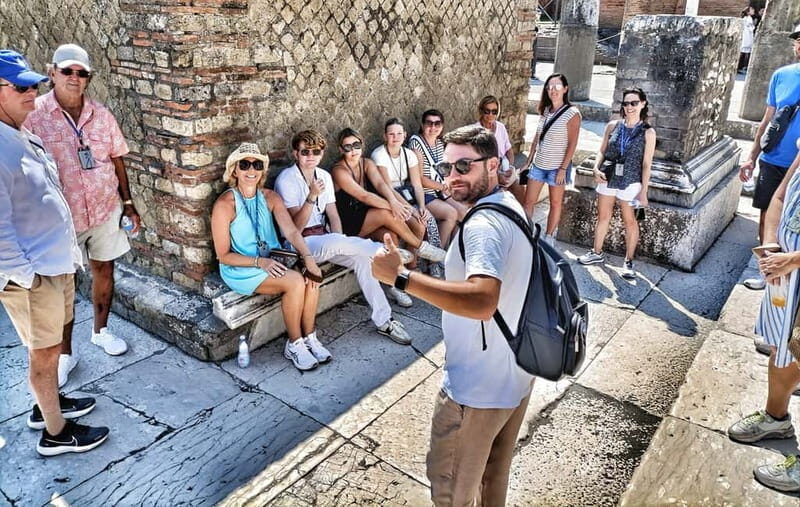
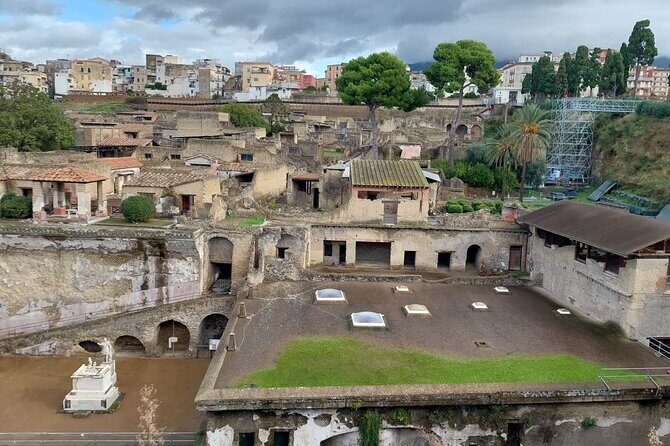
Now for the main event: the Archaeological Park of Pompeii. You head there accompanied by your guide, and admission is included, which is a huge practical benefit.
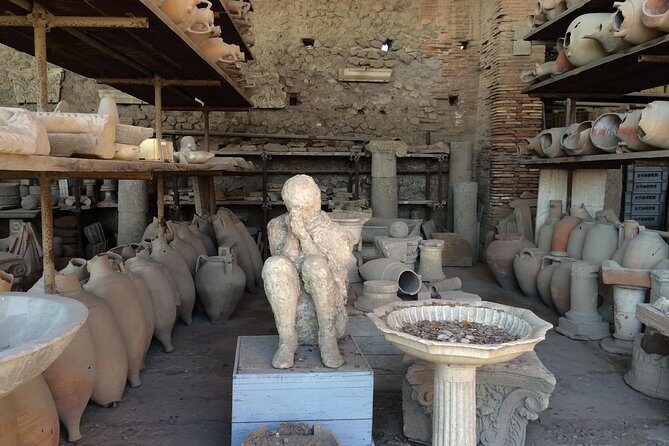
Pompeii’s story is the same for everyone: in 79 AD, Vesuvius destroyed and buried the city under lava. What changes with a guided visit is how you interpret what you’re seeing. Instead of treating Pompeii like a pile of ruins, you’re guided through everyday categories—streets, shops, theaters, and even brothels—plus the sense that real people lived here, worked here, and argued here.
Time matters a lot. Pompeii is vast. A guided visit of about two hours gives you a foundation and a sense of “where things are.” It does not provide enough time to see everything deeply. If you’re specifically hoping to spend extra time on areas like the Lupanare or certain domus with famous frescoes and mosaics or the large arena, you’ll likely want to do those on your own with a longer plan. This tour gives you the best overview in the time it has.
The upside of the two-hour structure is clarity. You’ll leave with names and themes that make any later self-guided walking far more satisfying. You’ll know what you’re looking at—and why.
The Pompeii ID rule that can make or break entry
Pompeii tickets are nominative, meaning your ticket name must match your ID. You must carry a valid photo ID on the day of the tour, and the personal details you provided must match exactly (spelling errors included). Site staff can refuse entry if there’s a mismatch, and there’s no guarantee the tour provider can fix it on the spot. This is the one rule you should treat as serious.
Practical Tips for Timing, Heat, and Comfort (Your Future Self Will Thank You)
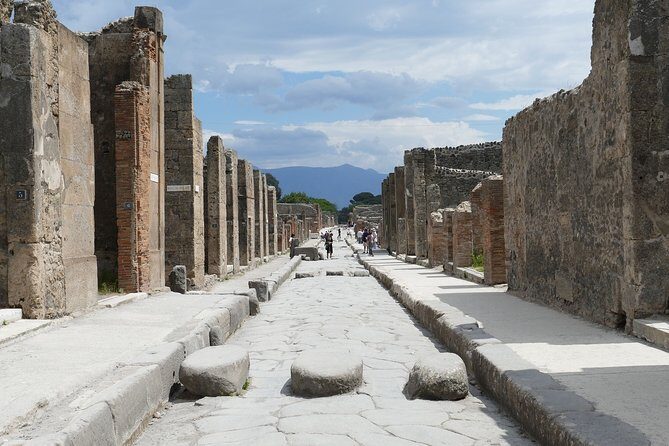
This is a walking-and-standing day more than a “sit on a coach all day” day. Pompeii especially demands comfortable shoes. Even “light walking” inside an archaeological park can feel longer than expected because uneven ground and shade gaps are common.
Weather-wise, the tour runs in all conditions. Bring a light jacket and an umbrella idea, just in case. Naples can be sunny and then suddenly not.
Also plan for shared-tour rhythms. You should arrive at the meeting point at least 5 minutes early. That helps prevent the kind of chaos that happens when groups regroup across a busy port area. If your schedule is tight, build in buffer time.
Group size is capped at 50 travelers, which usually keeps things manageable. Still, in Pompeii, it’s not about getting every photo angle. It’s about listening, then following your guide through the key stops.
Finally, bring a “what’s my priority?” mindset. If Pompeii is your main goal, focus on learning the layout and themes first. If Naples is equally important, use the scenic Naples pauses to lock in photos and names, then don’t expect hours of free roaming.
Who This Tour Fits Best (and Who Might Prefer Something Else)
This tour makes sense if you:
- Want an efficient way to see Pompeii without organizing tickets
- Like getting structure and explanations rather than just wandering
- Want a day that includes major Naples highlights in the same block of time
- Have a port schedule (or just limited hours) and want a guided plan that returns to the meeting point
It may not fit you if you:
- Want a long, unhurried Pompeii visit with time for lots of specific compartments
- Prefer lots of free time in Naples to explore at your own pace
- Get frustrated by group pickup timing and short stops
The best way to think about it: this is an overview tour that’s designed to make the next steps easier—either by inspiring you to return to Pompeii for more, or by giving you enough Naples orientation to explore on your own afterward.
Should You Book This Pompeii and Naples Half-Day Guided Tour?
Yes, if your priority is easy entry, guided clarity, and a balanced taste of Naples plus Pompeii in one shot. The big value is that Pompeii admission is handled and you get a guide to connect ruins to real life. If you go in with realistic expectations—two hours is an intro, not a full Pompeii master class—you’ll likely feel like you got your money’s worth.
If you’re the type who wants every major Pompeii highlight and lots of time in each zone, consider booking Pompeii for longer separately. But if you want the “best hits” fast, this tour’s structure is built for you.
FAQ
What is the duration of the tour?
The tour is approximately 6 hours.
What time does the tour start?
The start time is 8:00 am.
Is Pompeii admission included?
Yes. Pompeii entrance fees are included.
Is lunch included?
No. Lunch is not included.
What language is the tour in?
The tour is offered in English.
Do I need a photo ID for Pompeii?
Yes. You must bring a valid photo ID. The name details provided at booking must exactly match the ID because Pompeii tickets are nominative.
What’s the meeting point?
The start meeting point is R7Q4+9X, 80133 Naples, Metropolitan City of Naples, Italy.
Is there a mobile ticket?
Yes. The tour includes a mobile ticket.
How big is the group?
The tour has a maximum of 50 travelers.
Is cancellation free?
Yes. You can cancel up to 24 hours in advance for a full refund.
Is the vehicle air-conditioned?
Yes. An air-conditioned vehicle is included.