REVIEW · SORRENTO
Skip the line Ticket Herculaneum Guided Tour 4 hrs
Book on Viator →Operated by Buyourtour di Amo Italy Travel · Bookable on Viator
Herculaneum is a Roman city preserved in ash. This 4-hour guided tour pairs skip-the-line admission with an authorized English-speaking guide who helps you understand what you’re seeing. You’ll also get headsets, which makes the on-site explanations much easier to follow.
What I especially like is how the ruins don’t feel like random stones. The guide’s walk is paced to connect daily Roman life with the 79 A.D. eruption story, and the route hits the houses and decorated spaces that most visitors miss. One consideration: the official ruins time is about 1.5 hours, so you may feel a bit rushed if you prefer slower, more free-form wandering.
In This Review
- Key things that make this tour worth your time
- Herculaneum’s ash-preserved reality: why it feels so different
- 4 hours total: how bus pickup and the pacing work
- Skip-the-line and headsets: the difference between hearing and just guessing
- The route: what each stop teaches you (and where it may feel fast)
- Parco Acheologico Di Ercolano (about 1.5 hours)
- House of the Hotel (about 10 minutes)
- Sacello degli Augustali (about 10 minutes)
- Casa dei Cervi (about 10 minutes)
- Casa del Salone Nero (about 10 minutes)
- Casa dello Scheletro (about 10 minutes)
- Casa di Nettuno e Anfitrite (about 10 minutes)
- The art and artifacts you’ll want to pay attention to
- Comfort tips: what to wear, what to bring, and how to handle the short stops
- Value check: does $90.31 make sense for a 4-hour experience?
- Should you book this Herculaneum tour?
- FAQ
- How long is the Herculaneum guided tour?
- Where does pickup happen for this tour?
- Is the entrance ticket included?
- Does the tour include a guided explanation?
- Is lunch included?
- What language is the tour offered in?
- What happens if weather is poor?
Key things that make this tour worth your time
- Skip-the-line entry: your ticket is included, so you’re not stuck lining up.
- Small-on-the-ground group feel: it runs with a 30-seater bus, and the overall group size is capped at 100.
- Headsets for clear English: you hear the guide without craning your neck.
- A tight, smart route: you cover multiple key houses and monuments in one pass.
- Preservation details you can actually notice: this is one of those sites where the explanations change how you see the walls.
Herculaneum’s ash-preserved reality: why it feels so different
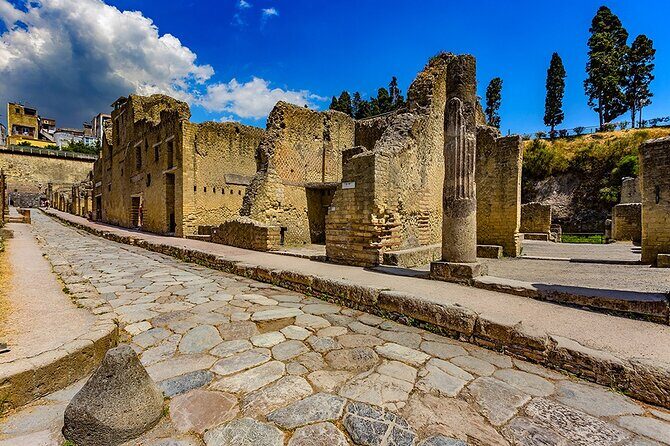
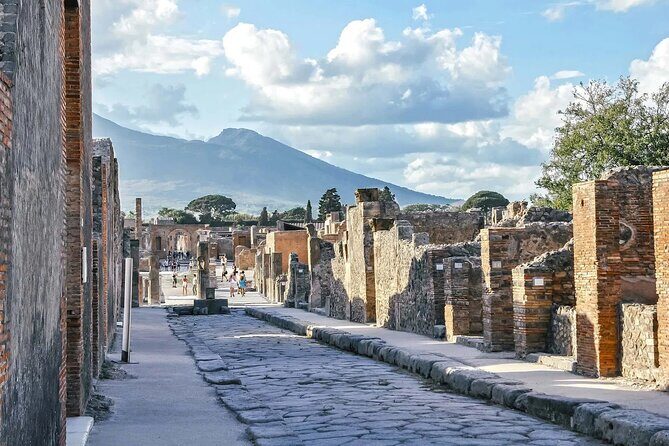
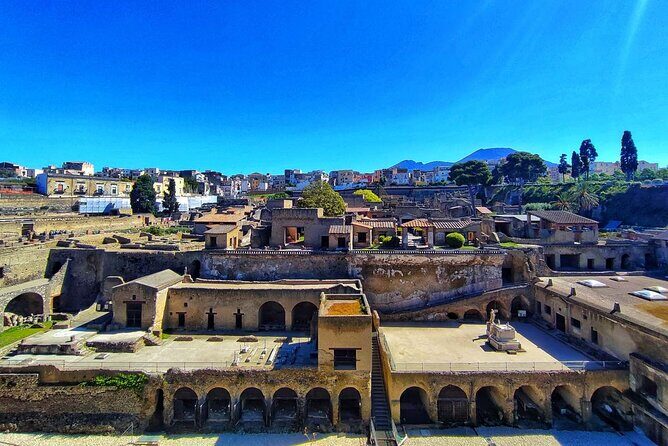
If Pompeii is the louder neighbor, Herculaneum is the quiet shocker. This site was buried under meters of ash and pumice during Vesuvius’s catastrophic eruption in 79 A.D., and that covering helped keep buildings remarkably intact.
What I like about visiting with a guide is that you don’t just see remains—you start recognizing what you’re looking at. You’ll be able to picture the streets, houses, and villas as functional spaces, not just a museum floor plan. And because the city is preserved, the “what happened?” story sticks in your head as you move from one preserved room or façade to the next.
You also get a good sense of Roman life in a smaller, more concentrated setting. Each stop is short, but the overall route is built to show you how people lived—where they ate, where they posed guests, and how wealth showed up in decoration and architecture.
If you're still narrowing it down, here are other tours in Sorrento we've reviewed.


4 hours total: how bus pickup and the pacing work
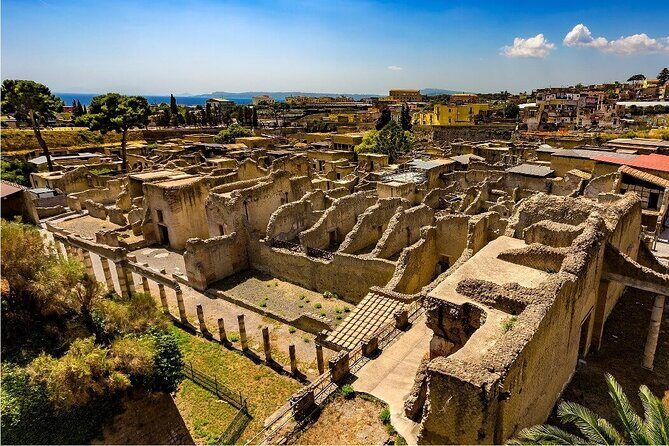
This tour is designed for people who want structure without losing the day. You’ll start with pickup at a meeting point in Sorrento or Naples, then ride to the archaeological area on a 30-seater bus.
Time matters here. Your on-site guided portion at the main archaeological park is listed at about 1.5 hours, and the rest of the tour is a sequence of short stops (often around 10 minutes each). That makes the whole experience feel efficient, but it also means you won’t linger long in any one doorway or garden.
This is a tour format that works best when you’re okay with “see the highlights, learn what they mean.” If your travel style is more “pause, sketch, and read every inscription slowly,” you may want to plan extra time elsewhere after the tour.
A small but real comfort detail: since the coach leaves on time and the group stays focused, the day usually runs without the start-and-stop chaos you can get on longer, free-wheeling tours.
Skip-the-line and headsets: the difference between hearing and just guessing
The biggest practical win is that your entrance ticket to Herculaneum is included, and the tour is built around skip-the-line access. That matters at busy sites because time spent waiting doesn’t turn into memories.
On top of that, you get headsets. In a site like Herculaneum, there’s often wind, foot traffic, and uneven sound. With headsets, you can actually keep track of the guide’s explanations as you walk. It’s a small technology detail, but it changes the experience.
Also note: this is guided by an authorized English-speaking guide for the 1.5-hour ruins portion. So you’re not just paying for entry—you’re paying for interpretation that helps you connect the physical remains to the story of the eruption and the everyday Roman world.
Finally, the itinerary can vary slightly based on guide discretion. That’s normal for a live walking format, but it also means you should expect the experience to be flexible rather than painfully rigid.
The route: what each stop teaches you (and where it may feel fast)
Parco Acheologico Di Ercolano (about 1.5 hours)
This is the anchor stop: the visit of the ruins with your authorized guide. You’ll get the core context—how this small and sophisticated Roman city was buried under ash and pumice after Vesuvius’s eruption in 79 A.D.
The value here is that the guide frames what comes next. Instead of you trying to decode architecture alone, you get a “map in your head” for later stops—streets, houses, and villas as living spaces.
If there’s a drawback, it’s that 1.5 hours disappears quickly once you start noticing details. Still, it’s a smart length for most people, especially when you’re also traveling from Sorrento or Naples.

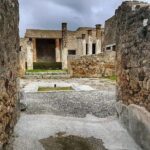
House of the Hotel (about 10 minutes)
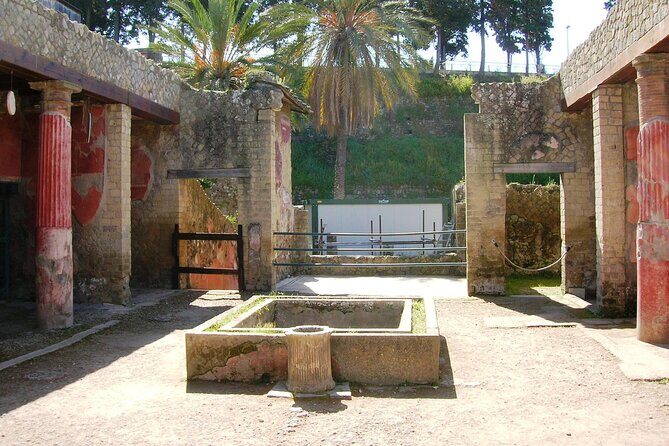
This large Roman residence sits in a panoramic position near the hill edge. It’s often described as Herculaneum’s largest house discovered so far (listed as 2,250 square meters), and it was called a “hotel” early on because it included a spa district.
In other words, you’re looking at more than a wealthy home—you’re seeing Roman ideas of luxury and leisure. The short time here can feel quick, but the spot is picked for a reason: it helps you understand how the wealthy structured daily life with bathing and status.
Sacello degli Augustali (about 10 minutes)
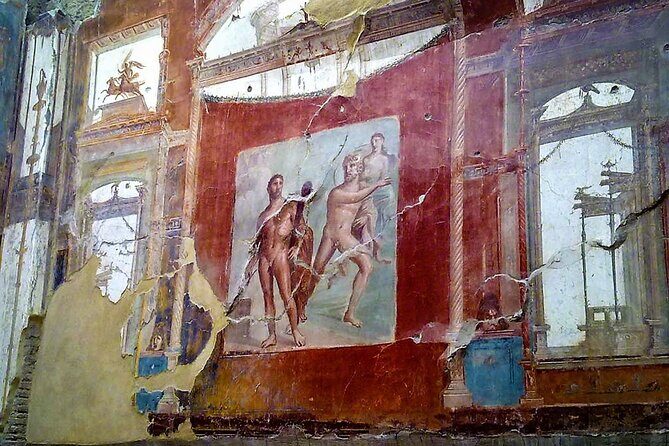
This small sanctuary near the forum is famous for its frescoes. The quadrangular building preserves artwork showing Hercules entering Olympus, in the company of Jupiter, Juno, Minerva, and Hercules against Achelous.
There’s also a striking discovery linked to this space: a janitor’s skeleton was found in his room lying on the bed. That detail can be unsettling, but it’s also part of what makes Herculaneum so powerful. You’re not just seeing art—you’re seeing the human aftermath of disaster.
Casa dei Cervi (about 10 minutes)
Named for the deer statues in the garden, this house belonged to Q. Granius Verus (a slave freed shortly before Herculaneum’s destruction). The deer were attacked by a pack of dogs in the sculptural composition, which is exactly why the house carries that name.
The short stop is useful because it tells you something important: even in private homes, art often carried strong themes—myth, hunting, status, and power imagery. If you walk in expecting only “ruins,” this kind of detail redirects your attention to how people decorated the spaces around them.
Casa del Salone Nero (about 10 minutes)
This house is named for its black-painted party hall, including geometric patterns. It’s the kind of interior detail you’d probably miss without a guide, because from the outside it’s not obvious what makes it special.
You also get an artifact-centered story here: waxed tablets belonging to L. Venidius Ennychus were found. The tablets relate to eligibility for an Augustale role, the purchase of a slave, and the birth of a daughter.
Even on a quick stop, this is one of the most important stops for understanding Roman society beyond architecture—social roles, legal status, and household life.
Casa dello Scheletro (about 10 minutes)
The “skeleton house” gets its name from human remains found in a second-floor room in 1831. The stop is brief, but it serves a purpose: it reminds you that these were real buildings holding real people.
This can be heavy. If you prefer light, purely aesthetic tours, you might find this stop more emotional than expected.
Casa di Nettuno e Anfitrite (about 10 minutes)
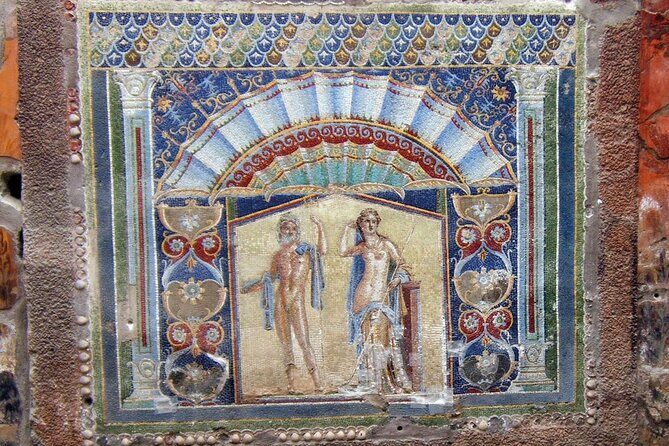
This is the art-and-craft stop. The mosaics are described as glass paste mosaics, with floral and hunting scenes. At the center is a mosaic of Neptune and Amphitrite.
For me, what makes this stop special is that it answers a question you’ll have while looking at ruins: how did they create these effects with the materials and techniques of the time? Here you can see why some decorations were expensive and time-consuming—these weren’t casual embellishments.
The art and artifacts you’ll want to pay attention to
Herculaneum is where decoration isn’t just decoration. Roman art showed identity, status, and beliefs, and this route gives you examples of all three.
- Fresco scenes at the Sacello degli Augustali help you connect the myth world (Hercules, Olympus, divine figures) to public religious space.
- Interior color and room function at the Casa del Salone Nero show how household gathering spaces could be dramatic, even painted entirely in black.
- Mosaics as storytelling at Casa di Nettuno e Anfitrite add the visual “wow,” but the guide’s role is what turns it into meaning: floral and hunting themes plus a central mythic couple.
- Written evidence via waxed tablets at Casa del Salone Nero adds another layer. Seeing artifacts tied to a specific person (L. Venidius Ennychus) helps you think beyond general history.
And yes, the discoveries like the janitor’s skeleton or the remains in Casa dello Scheletro can shift your mood. But they’re part of why Herculaneum feels unusually human compared with ruins that are only partially preserved.
Comfort tips: what to wear, what to bring, and how to handle the short stops
Because much of the day is walking outdoors across uneven archaeological terrain, wear comfortable shoes. You’re not dealing with museum floors.
Bring water, even though lunch isn’t included. The tour doesn’t promise a meal stop, and the site experience can run long enough that you’ll feel it.
Also consider the timing strategy you’ve probably heard for hot sites: starting early helps with heat and crowds. The tour format here is built to run efficiently, and you’ll likely appreciate the sense of momentum before the afternoon gets too intense.
Finally, keep your expectations aligned with the pacing. You get many distinct highlights, but each one is short. I’d treat it like a curated ruins sampler—then decide afterward if you want to spend more time in the areas that grabbed you most.
Value check: does $90.31 make sense for a 4-hour experience?
At $90.31 per person, you’re paying for more than just entry. Your ticket to Herculaneum is included, and the tour also includes pickup from Sorrento or Naples, a 30-seater bus, and an authorized English-speaking guide for about 1.5 hours. The headsets are another real value item, because they protect your ability to follow the explanations without strain.
If you were to buy admission on your own and then try to manage the guide interpretation afterward, the time cost usually catches up with you. This tour is designed so you get the “how to read the ruins” part immediately while you’re still standing in front of the remains.
Where the value can feel less perfect is if you’re the type who wants deep time in one location. Since the route includes several 10-minute stops, the price buys variety and guidance, not long unbroken free time.
Should you book this Herculaneum tour?
Book it if you want a focused English-guided visit to one of Italy’s most preserved Roman sites—and you like learning what you’re looking at while you’re still there. The combination of skip-the-line admission, headsets, and an authorized guide makes this a practical choice when your schedule is tight.
Don’t book it if you’re chasing hours of quiet solo exploration. With about 1.5 hours of guided ruins time plus short stops, this tour is more efficient than leisurely.
If you’re traveling from Sorrento or Naples and you don’t want to spend your day figuring out logistics, this one is built for exactly that: get in, get oriented fast, and leave with a clearer sense of Roman life under volcanic ash.
FAQ
How long is the Herculaneum guided tour?
The tour is listed at about 4 hours total, including the guided time at the archaeological site and the series of shorter stops.
Where does pickup happen for this tour?
Pickup is available at the meeting point in Sorrento or Naples.
Is the entrance ticket included?
Yes. Entrance to Herculaneum is included, and your tour uses a mobile ticket.
Does the tour include a guided explanation?
Yes. You’ll have an authorized English-speaking guide for the guided ruins portion (about 1.5 hours), plus headsets so you can hear clearly.
Is lunch included?
No. Lunch is not included.
What language is the tour offered in?
The tour is offered in English.
What happens if weather is poor?
This experience requires good weather. If it’s canceled due to poor weather, you’ll be offered a different date or a full refund.