REVIEW · ROME
Private Guided Day Tour to Pompeii and the Royal Palace of Caserta
Book on Viator →Operated by Enjoy your Italy tour · Bookable on Viator
A day like this is all about ancient scale. You get Pompeii with a private English guide and then trade cratered streets for Caserta’s royal rooms and park. It’s a long day, but the rhythm works if you like being out early and back before dinner.
My favorite parts were the way Pompeii gets explained street-by-street, and the fact that Caserta isn’t just a building—it’s the full palace complex, staircases, chapels, and those big park fountains. One caution: you’re covering two major sites in a single day, so you won’t be able to absorb every corner like you could if you had a full week.
In This Review
- Key takeaways
- A 7:00 am start that keeps the day under control
- Private transportation and a driver who can read the room
- Pompeii: La Casa del Fauno and the feeling of a real city
- A quick reality check on time
- Villa dei Misteri frescoes, the Lupanare, and the odd honesty of Pompeii
- Stabian Baths and Cave Canem: mosaics, routines, and small details that stick
- Caserta Royal Palace: staircase to chapel to apartments
- Audio guide in Caserta
- Caserta Park: waterfalls, sculptures, and big-fontain thinking
- Lunch break: plan it like you’re on a timetable
- Is the price worth it? Where the value comes from
- Who this day trip is best for (and who should reconsider)
- Should you book this Pompeii and Caserta day tour?
- FAQ
- What time does the tour start?
- Is pickup included?
- How long is the day trip?
- What language is the tour in?
- Are tickets included for Pompeii and Caserta?
- Is lunch included?
- Do I get a guide in both places?
- Is free cancellation available?
Key takeaways
- Private Pompeii guiding: A live guide helps you connect monuments to daily life fast.
- Audio in Caserta: You can move at your pace through the palace while still having structure.
- Stabian Baths and Villa dei Misteri: Real standouts for people who like details, not just big views.
- Grand Staircase to Chapel: Caserta’s interior sequence is designed to feel ceremonial.
- Early start, long drive: The schedule is manageable, but plan to stay flexible with energy.
A 7:00 am start that keeps the day under control
This is a 9-hour day that starts around 7:00 am, which is the only way it works. You’re leaving Rome for the Campania region and returning the same day. If you’re the type who hates rushing, you’ll still need a little speed here—just not chaos.
The payoff is that you hit Pompeii while the morning is still working in your favor. And when you get to Caserta, you’ve got enough time to enjoy the palace sequence and then step outside for the park. The itinerary is not built for lingering all day. It’s built for seeing a lot without losing your bearings.
If you're still narrowing it down, here are other tours in Rome we've reviewed.


Private transportation and a driver who can read the room
You’ll have private transportation, not a bus cattle-call. Group size matters here: up to 3 people ride in a car, and 4 to 7 people use a 7-seater SUV. That’s a nice setup for families, friend groups, or anyone who wants the day tuned to their pace.
One practical bonus from real-world experience: having a driver who handles Rome traffic without stress. In one shared experience, the driver—Andrea—was punctual, spoke excellent English, and kept the day moving smoothly through traffic. Even better, he didn’t just drive. He offered smart food guidance so you’re not guessing when you’re hungry and tired.
Pompeii: La Casa del Fauno and the feeling of a real city

Pompeii is massive. That’s true in every sense—distance, density, and what your eyes are trying to process. The best way to enjoy it is to get a few anchor points that explain how the city worked.
Your Pompeii time focuses on major sights with a guide, including La Casa del Fauno. This villa covers about 3,000 square meters, which makes it one of the most important stops in the park. More than size, it’s the kind of place where you start to notice how Roman households organized space: rooms that imply status, social areas meant for public display, and decorative elements that weren’t for show alone.
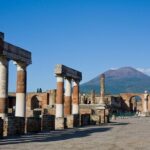
From there, you’ll visit the Forum of Pompeii, often described as the nerve center of daily life—and that’s exactly how it feels. It’s where civic power and everyday movement meet. If you’ve ever wondered what people meant when they talked about public life, this is your answer in stone.
A quick reality check on time
Your Pompeii stop is about 2 hours. That’s enough to learn the story and see the highlights, but it’s not enough to “finish” Pompeii. Use the guide to prioritize. Ask questions. And don’t try to take in every wall carving like you’re building a museum catalog.
Villa dei Misteri frescoes, the Lupanare, and the odd honesty of Pompeii

Pompeii is famous for being well preserved, but what really lands is how human it feels. You get that from the major villas and the places tied to social life.
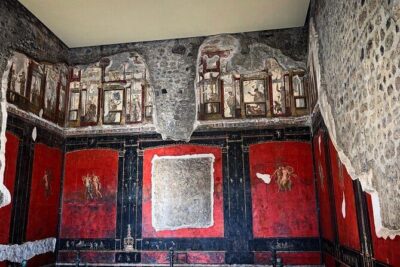
One of the most striking stops is the Villa dei Misteri, known for its life-size fresco figures. The paintings don’t just decorate walls; they stage scenes. As you stand there, you start to feel how Romans used art to communicate—belief, performance, identity. It’s the kind of detail that turns a ruin into a story you can follow.
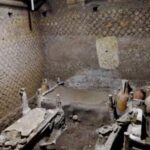
Then there’s the Lupanare, a site associated with erotic frescoes. It’s not a comfortable stop for everyone, but it’s undeniably part of the city’s reality. Pompeii doesn’t edit itself. If you’re a sensitive traveler, you may want to mentally prepare for that content ahead of time and then decide how long to linger.
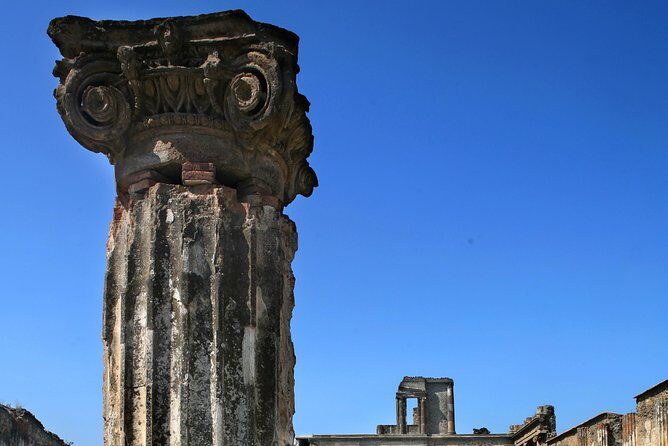
You also see the Temple of Apollo, including a bronze statue kept inside. This is where Pompeii’s sacred spaces start to make sense. You’re not just looking at columns—you’re seeing how religion sat inside everyday geography.
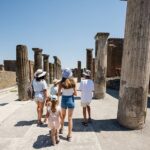




Stabian Baths and Cave Canem: mosaics, routines, and small details that stick

Pompeii isn’t only grand monuments. It’s also routines. The stops that underline daily life tend to be the ones you remember later.
You’ll visit the minor amphitheater—a reminder that entertainment wasn’t reserved for the biggest venues. The baths are a standout too: the Stabian Baths, described as the oldest complex in the city. This is where you can picture how people moved through the day: gyms for exercise, changing rooms, latrines, and swimming pools. It’s practical archaeology at its best.
And then comes the kind of moment that feels almost playful: the Cave Canem mosaic—the dog warning in the mosaic floor—associated with the House of the Tragic Poet. It’s one of those details that makes Pompeii feel less like a distant civilization and more like a place where someone once told a joke, or a warning, right at the doorstep.
If you enjoy visual clues, mosaics, inscriptions, and the way Romans used space for everyday behavior, this portion is worth your full attention.
Caserta Royal Palace: staircase to chapel to apartments

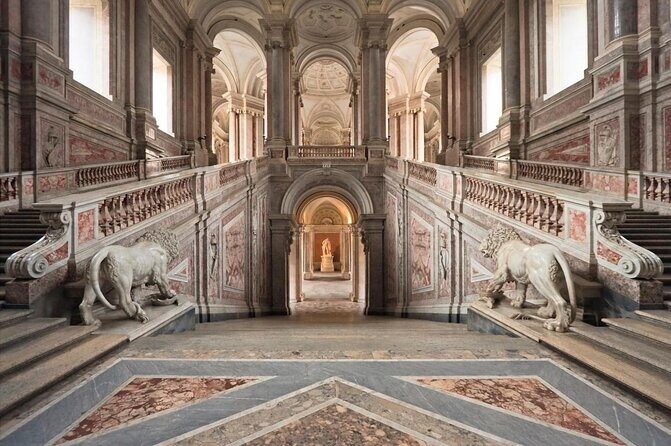
After Pompeii, the drive to Caserta takes about 50 minutes, which is just enough time to reset. Then you’ll focus on the Royal Palace of Caserta, an enormous site with around 1,200 rooms spread across about 47,000 m². Of course, you won’t see everything. The value here is that you get the key sequence that makes the palace feel like a place of power.
You’re welcomed by the Grand Staircase, which leads you into the Vestibule, then onward through the royal apartments and the Palatine Chapel. That sequence matters. The palace is designed like a narrative: you move through increasingly important spaces and start to feel the formal rhythm of court life.
Highlights include rooms such as Sala di Alessandro, Sala di Marte, and Sala di Astrea. You’ll also visit private rooms connected to figures like Francesco and Murat, then the Court Theater, and finally the Library and Reading Rooms. One detail that helps the rooms feel real is the reference to 1752, when the foundation stone was laid—so the architecture stops being abstract and starts sounding like a moment in time.
Audio guide in Caserta
Caserta is visited with an audio guide, which is a smart choice for a palace this size. You can pause when something catches your eye, then move when you want to keep momentum. It also means you’re not stuck in constant group pacing.
If you’re the kind of traveler who loves context, do yourself a favor: before you start, decide what you want most—art, architecture, or palace life—and let the audio guide support that focus.
Caserta Park: waterfalls, sculptures, and big-fontain thinking

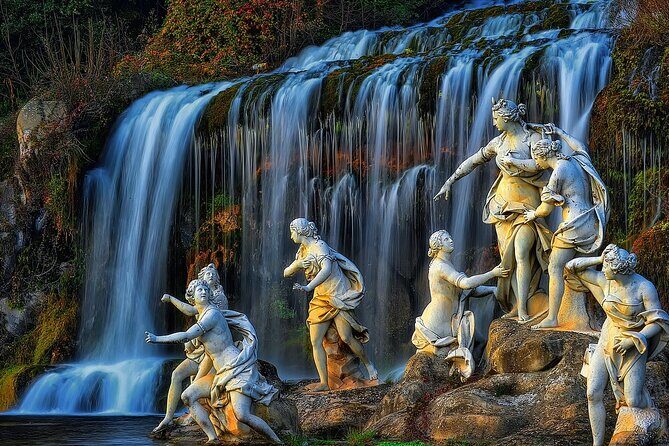
The palace alone is impressive, but the Parco della Reggia is a big part of why Caserta works. It’s considered one of the most beautiful parks in Europe, and you’ll get a chance to enjoy that outside space with time for waterfalls, sculptures, and monumental fountains.
The park layout makes it easier to breathe after the indoor rooms. And it’s also where the day’s scale becomes fun again. One highlight described firsthand is the fountain concept fed by a waterfall—it’s the kind of engineering detail that sounds simple until you see it functioning as a system, not just a decoration.
Even if you’re not a park person, this is worth paying attention to because it ties directly to the palace’s story: court life was not only in chambers. It spilled into gardens, water features, and public display grounds.
Lunch break: plan it like you’re on a timetable

Lunch is not included, but you do get about one hour for it, with plenty of nearby options. The schedule gives you just enough time to eat without turning the whole day into a wandering quest.
A smart approach: ask your driver for a place close to where you’ll be. In one real day experience, the driver recommended a spot near Caserta called PizzArt, and the result was a very easy, very local-feeling meal. You don’t need to copy that exact choice—just use the same strategy. Eat near your next stop, not across town.
Also, keep expectations realistic. After Pompeii, you’ll likely be ready for something simple. If you want a “sit-down feast,” build in extra time—this day doesn’t.
Is the price worth it? Where the value comes from

At $506.35 per person, this is not a bargain tour. It’s a premium day trip, and the value comes from what you get alongside the sightseeing.
Here’s what you’re paying for:
- Private transportation from Rome and back
- Private guided time in Pompeii (the guide part is often where a day trip becomes meaningful)
- Admission tickets included for your time at both Pompeii and Caserta
- English support, plus mobile ticket access
Where the costs fall on you:
- Lunch is not included
If you’re traveling as a couple or a small group, the private setup can actually feel like good value compared to piecing together separate transport and buying your own tickets while trying to coordinate timing. And if you’re a first-timer who wants the “what to see and why it matters” framework, paying for guidance can save you from wasting your limited time in two huge sites.
Just don’t expect this price to buy you unlimited time. You’re paying for focus, not duration.
Who this day trip is best for (and who should reconsider)
This tour fits you well if:
- You want Pompeii highlights with real context, not just a walk through ruins
- You also want Caserta’s palace-and-park experience in the same day
- You prefer private logistics over bus schedules
- You’re okay starting early and keeping a steady pace
You might reconsider if:
- You dream of spending half a day in Pompeii alone, reading every corner
- You hate mornings and don’t like early starts
- You want a slower, restaurant-heavy day where transit times don’t matter
This is a “see a lot, learn a lot, keep moving” kind of day. If that sounds like your style, you’ll enjoy it.
Should you book this Pompeii and Caserta day tour?
I’d book it if you’re doing Rome as a base and you want a big contrast day: Pompeii’s street life and Caserta’s formal palace world. The private Pompeii guiding, plus the way Caserta is structured with an audio guide, gives you both explanation and independence.
I would not book it if you need a laid-back schedule or if you want to thoroughly explore every section of Pompeii. The time is smart—but it’s still limited.
If you’re traveling with friends or family and you want a driver who can keep things smooth through traffic (and help you find a meal nearby), this is exactly the kind of private day that pays off.
FAQ
What time does the tour start?
It starts at 7:00 am.
Is pickup included?
Pickup is offered, and the driver is expected to be waiting. You’ll receive confirmation at booking time.
How long is the day trip?
The duration is about 9 hours.
What language is the tour in?
The tour is offered in English.
Are tickets included for Pompeii and Caserta?
Yes. Admission tickets are included for your visits at Pompeii and at the Royal Palace of Caserta.
Is lunch included?
No. Lunch is not included, but you have about one hour to have lunch in a restaurant or other local options.
Do I get a guide in both places?
In Pompeii, you have a private guide. At the Royal Palace of Caserta, you visit using an audio guide.
Is free cancellation available?
Yes. You can cancel for a full refund up to 24 hours in advance. If you cancel less than 24 hours before the start time, the amount paid is not refunded.