REVIEW · NAPLES
Pompeii the Ancient City (Tour+Transfer)
Book on Viator →Operated by Sesto Continente Tours · Bookable on Viator
Pompeii can feel like a pile of stones until someone points out the story, and this tour does that for you with a licensed guide-led route. I like the simple round-trip shuttle from several towns near Naples, which cuts the stress of figuring out transit. The one catch: the Pompeii entrance ticket is not included, so you’ll still budget €22 per person.
The pacing is built for a first visit: about 4 hours total, with short guided stops at the big names and time to walk the spaces yourself. You’ll keep the group small—this runs with a maximum of 25 travelers—and you’ll get a mobile ticket for the tour portion.
If you’re sensitive to walking and sun, bring your basics: hat, water, sunscreen. And if you were hoping for a specific language like French, plan around the fact that the guide support is set up for English/Italian.
In This Review
- Key takeaways before you go
- Hitting Pompeii with a vintage van and zero transit headaches
- The guide-led route: why the quick order works
- Pompeii entrance at the archaeological park: budget for €22
- Stop-by-stop: what you’ll see and what to watch for
- Pompeii’s Forum: the city’s main public square
- The Macellum: where people shopped like it was routine
- Casa del Fauno: an aristocratic home with scale and art
- Teatro Grande: theatergoing before the sky fell
- Via dell’Abbondanza: Pompeii’s lively main street
- Price and value: what $70.89 really buys you
- Practical tips so the day feels easy, not exhausting
- Language and guide setup: English/Italian, check if you need French
- Who should book this Pompeii tour with transfer
- Should you book Pompeii the Ancient City (Tour+Transfer)?
- FAQ
- How long is the Pompeii tour?
- Is the Pompeii entrance ticket included?
- What language is the tour guide?
- Do I get a mobile ticket?
- Where does pickup happen, and do you pick up from Naples?
- Are there multiple start times?
- Is lunch included in the price?
- What is the maximum group size?
- Is there free cancellation?
Key takeaways before you go
- Vintage classic van transport + private transportation so you’re not piecing together local rides.
- Small group size (max 25) keeps the guide’s attention useful during quick stops.
- Forum, Macellum, major houses, and the theater cover what most first-timers want to see.
- Via dell’Abbondanza gives you the “main street” feel, linking major sights across town.
- Entrance ticket is separate (€22), so total cost is more than the $70.89 price.
Hitting Pompeii with a vintage van and zero transit headaches
This experience is designed around one big idea: you shouldn’t have to solve logistics before you get to the ruins. You ride in a vintage classic van, and the service includes private transportation plus a free shuttle that brings you from your pickup area back to where you started.
Pickup is available from a long list of places around the Sorrento-facing part of the Bay of Naples area and nearby towns, including Castellammare di Stabia, Torre Annunziata, Pompei, Scafati, Sant’Antonio Abate, Angri, S. Maria la Carità, Gragnano, Lettere, Pimonte, Agerola, Vico Equense, Seiano, and Meta. If you’re staying in Naples city itself, note the key limitation: NO pickup from Naples.
A practical detail you should plan for: the shuttle works in sharing mode, so the pickup time is a window. They’ll confirm your pickup time after booking, but you should assume pickup starts at the listed time and can run for the next 30 minutes. That’s not a flaw so much as how shared shuttles stay efficient.
Also, the tour starts with a scheduled 9:00 am departure. If you like mornings, you’ll be happy—Pompeii is much more pleasant when you’re not starting in the hottest part of the day.
If you're still narrowing it down, here are other tours in Naples we've reviewed.


The guide-led route: why the quick order works
This is not a “wander wherever your feet want” day. It’s a guided highlights loop built to show you the most meaningful parts of Pompeii in a short window.
The structure looks like this: after pickup and arrival, you get an accompanied visit starting at the Pompeii Archaeological Park entrance, then you move through major urban nodes—Forum, market area, standout private houses, the theater, and the main street linking everything together.
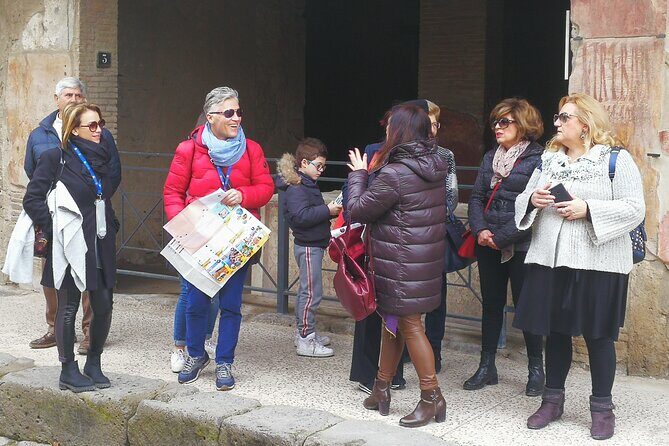
Each stop is timed (you’ll see around 15 minutes at several sights). That might sound short, but it’s actually smart for first-timers. Pompeii covers a lot of ground. Without a plan, you can spend your limited time walking in circles and missing what matters. With a guide, you get the interpretive layer fast—what you’re looking at, what it used to do, and why it survived.
One more reason this route works: you’re not only looking at buildings—you’re seeing how spaces relate. Forum first gives you the civic center. Then you move to commerce (the Macellum). Then you shift to the elite domestic world (Casa del Fauno). Finally, you end up with cultural and daily-life spaces (theater and Via dell’Abbondanza).
Pompeii entrance at the archaeological park: budget for €22

The tour includes the guided arrival experience at the Pompeii Archaeological Park, but the actual entrance ticket is not included. The listed entrance ticket cost is €22.00 per person.
You’ll also want to think about how the park entrance fits into your day. The first stop is brief—about 5 minutes—because most of your time is spent walking the highlights once inside. That means you should plan to arrive ready to go, not lingering at the gate.
If you only remember one logistics note from this review, make it this: your final spend won’t stop at $70.89. Add the Pompeii ticket, and if you choose food on-site (not included), you’ll also want cash or a card plan.
Stop-by-stop: what you’ll see and what to watch for

Pompeii’s Forum: the city’s main public square
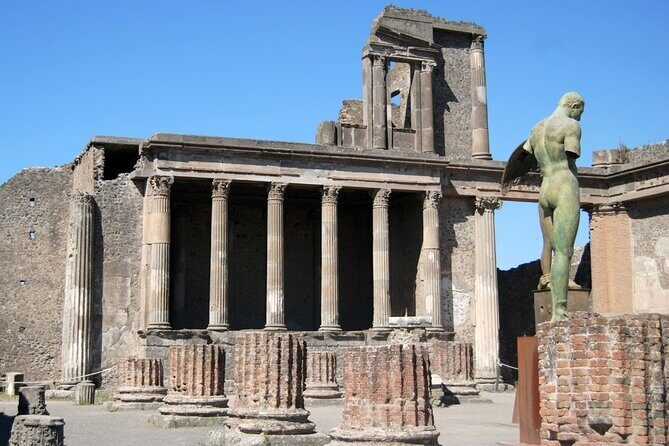
The Forum of Pompeii is the beating heart of the city’s political, economic, and religious life. It’s also a place where the layout helps you understand ancient routines—this was where announcements happened, negotiations took place, and debates played out.
This stop is free for the purposes of the tour (your entrance to the park covers it), and the time on-site is about 15 minutes. In that short window, don’t try to read every inscription or scan every corner. Instead, look at the overall space: this is the kind of “center of gravity” that structured daily life.
If you’re visiting Pompeii for the first time, the Forum is a great starting point because it gives you landmarks. After this, the rest of town feels less random.






The Macellum: where people shopped like it was routine
Right in the orbit of the Forum was the Macellum, basically the market building. The Macellum matters because it shows you the practical side of city life: provisioning, food trade, and everyday buying.
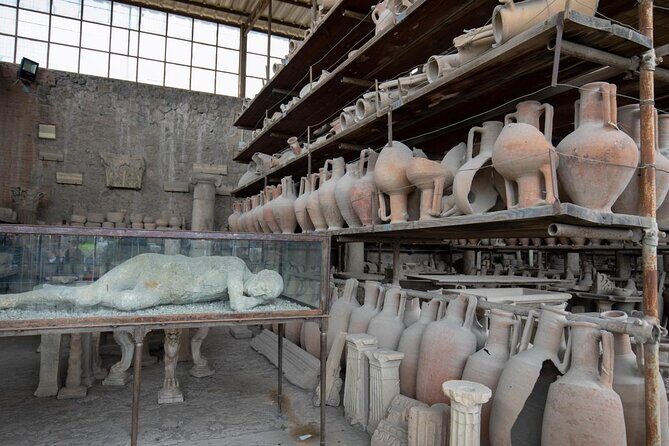
What’s interesting here is the building story. Pompeii suffered an earthquake in 62 CE, which damaged parts of the city. The Macellum was damaged too, and excavations show it had not been fully repaired by the time of the eruption in 79 AD. That makes this stop more than a pretty ruin. It’s a snapshot of a city stuck mid-recovery.
You’ll get around 15 minutes at this stop. Use it to orient yourself within the market setting—think about where goods would have circulated and how people moved through the space.
Casa del Fauno: an aristocratic home with scale and art
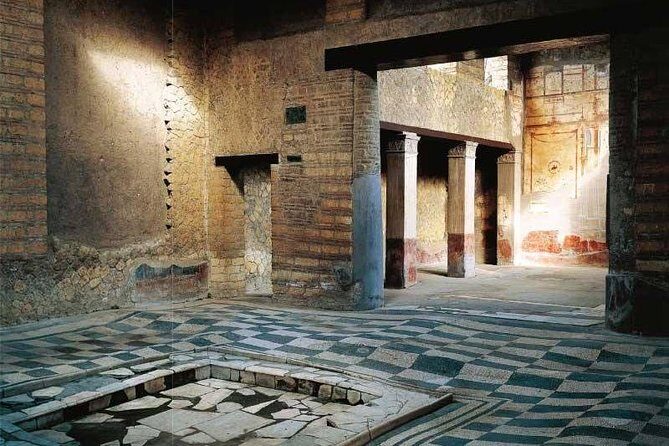
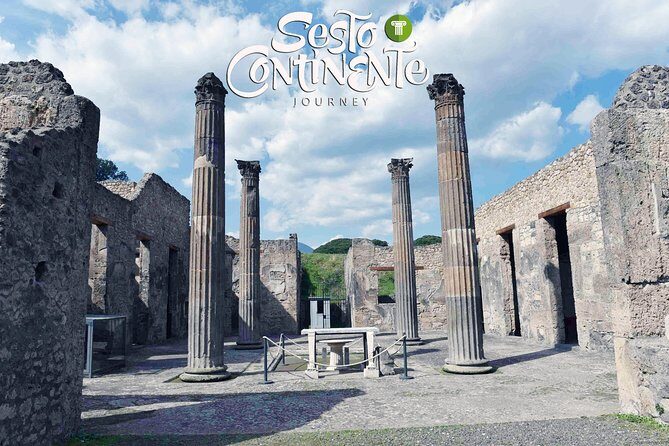
The House of the Faun (Casa del Fauno) is one of Pompeii’s standout private residences. It dates to the 2nd century BC, and it was huge by Pompeian standards.
This is the stop where you shift from public life into elite domestic life. The house is described as one of the largest and most impressive residences in Pompeii and known for holding major pieces of art. Even without reading every detail, you can feel the social message: this is wealth displayed in built form.
Expect about 15 minutes here. That’s enough time to grasp scale and the general layout, but not enough for a deep museum-style inspection. So don’t panic if you can’t absorb everything at once. The value is in learning what kind of home it was and why it represents the Roman Republic period so well.
Teatro Grande: theatergoing before the sky fell
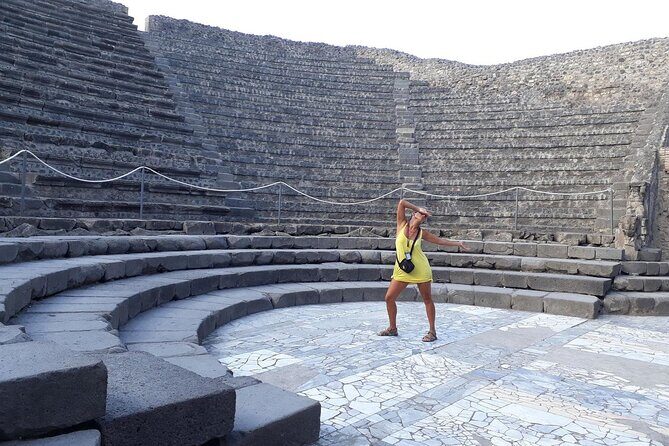
The Teatro Grande is a Roman theater buried by Vesuvius and uncovered through excavation. You’ll hear it described in terms of performances—comedies, mimes, pantomimes, and the atellane.
This stop helps you picture Pompeii as a living entertainment culture, not only a place where people worked and ate. A theater also tells you about community rhythms. People planned their evenings around these kinds of public events.
You’ll have around 15 minutes at this stop, so again: focus on the shape and function. Where would an audience sit? What would it have meant to gather in this space? Even a quick glance can make the city feel more human.
Via dell’Abbondanza: Pompeii’s lively main street
The tour ends at the Via dell’Abbondanza, Pompeii’s Lower Decumanus. The name comes from a bas-relief on a fountain early in the route near the Forum. That tiny detail is exactly why a street visit can be so rewarding: you’re not only seeing structures; you’re seeing how the city expressed itself through decoration.
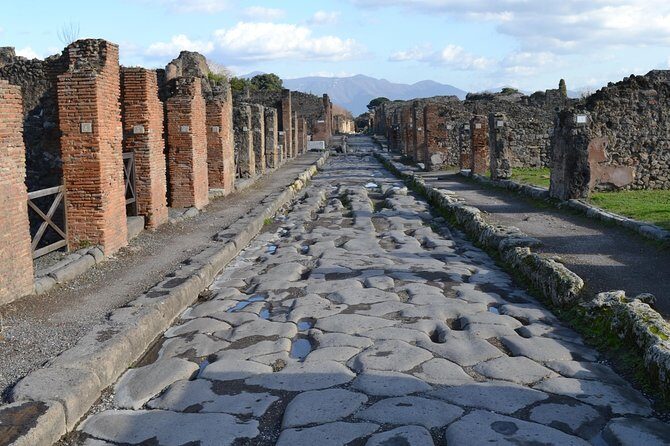
This road connects major zones between the Forum and Porta Sarno. Along it, you can pass by or reference key city areas like the Stabian Baths, the Temple of Isis, and the Amphitheater. It’s also known for houses with striking features, some with two floors—residences associated with wealthier Pompeian families.
You’ll get about 15 minutes here. It can feel like a lot of “things at once,” especially if you’re trying to identify every house. Instead, use this as your big-picture walk. By the end, you should feel like you understand Pompeii as a network, not separate ruins.
Price and value: what $70.89 really buys you
At $70.89 per person, this tour isn’t trying to be the cheapest way into Pompeii. It’s paying for convenience and interpretation.
Here’s what you’re getting in the price:
- A ride on a vintage classic van and private transportation
- A guided experience at Pompeii’s key highlights
- Mobile ticket access for the tour portion
What you still pay separately:
- Pompeii entrance ticket: €22.00 per person
- Lunch
So how do you judge value? I think it’s strong if:
- You’re staying within the pickup coverage areas and want a simple start-to-finish plan.
- You’re a first-timer who wants the “best of Pompeii” in a controlled time frame.
- You care about context more than wandering solo for hours.
If you want to spend a full day at your own pace, you might find this style limiting. But if your goal is to see meaningful highlights with less planning, you’re paying for that structure.
Also, the maximum group size (25) matters. A smaller group usually helps you actually hear what the guide is saying during brief stops.
Practical tips so the day feels easy, not exhausting
Pompeii is outdoors and in stone. That’s why a few basics make a big difference:
- Wear comfortable shoes. You’ll be walking on uneven surfaces.
- Bring water, plus sunscreen and a hat.
- If you get wind burn or feel cold easily, pack a layer; open ruins and coastal weather can switch fast.
- Plan to move with the schedule. Drop-off depends on keeping the program moving.
A final practical note: your pickup time is in a window because it’s shared. If you’re cutting it close at the hotel, build in a little buffer so you don’t lose minutes waiting.
Language and guide setup: English/Italian, check if you need French
The tour includes a licensed multilingual tourist guide with English/Italian support. The experience is also offered in English.
If you’re counting on French interpretation, don’t assume it. The setup is clearly not built around French as a default. If that language is essential for you, confirm at booking.
Who should book this Pompeii tour with transfer
This fits you best if:
- You’re in the pickup zones around Castellammare di Stabia, Torre Annunziata, Pompeii area towns, and parts of the Sorrento side.
- You want a guided “greatest hits” experience in about 4 hours.
- You’re traveling with someone who needs logistics handled.
You might choose differently if:
- You want several hours of self-guided wandering beyond major highlights.
- You’re traveling from Naples city center and don’t want to rely on the alternative train option mentioned by the provider for those outside pickup coverage.
Should you book Pompeii the Ancient City (Tour+Transfer)?
I’d book this if you like your Pompeii experience structured: quick transport, a guide to explain what you’re seeing, and a route that hits the Forum, elite homes, the theater, and Via dell’Abbondanza without wasting time.
I’d think twice if you already plan to purchase a ticket and do Pompeii entirely on your own, or if you’re chasing a slower pace with lots of unhurried photo time. In that case, you may prefer a longer self-guided plan.
For most first-timers in the area, this strikes a solid balance: less planning stress, more understanding of what you’re looking at, and a day that ends before you feel totally cooked by the sun and stone.
FAQ
How long is the Pompeii tour?
The tour lasts about 4 hours (approx.).
Is the Pompeii entrance ticket included?
No. The entrance fee is not included, and the Pompeii ticket is listed as €22.00 per person.
What language is the tour guide?
The guide is a licensed multilingual tourist guide with English/Italian language support, and the tour is offered in English.
Do I get a mobile ticket?
Yes, you receive a mobile ticket.
Where does pickup happen, and do you pick up from Naples?
Pickup is offered from several listed towns and areas around Naples (including Castellammare di Stabia, Torre Annunziata, Pompei, Scafati, and others). The meeting information states there is no pickup from Naples.
Are there multiple start times?
Yes, several convenient start times are available to suit your schedule (the example start time shown is 9:00 am).
Is lunch included in the price?
No, lunch is not included.
What is the maximum group size?
The tour has a maximum of 25 travelers.
Is there free cancellation?
Yes. You can cancel up to 24 hours in advance for a full refund.