REVIEW · NAPLES
Herculaneum Small Group Tour and Ticket With an Archaeologist
Book on Viator →Operated by Askos Tours · Bookable on Viator
Herculaneum feels like a city frozen mid-sentence. On this 2-hour small-group walk, an archaeologist guide points out what matters in each mansion and bathhouse, with skip-the-line entry and headsets so you’re not stuck in queues or straining to hear.
I especially love how guides can turn stone and floor plans into daily life. When Luciano Leone (and other archaeologist-guides like Michaele/Michele, Paulo, Julia, and Gennaro) connects domus details to what people ate, worked, worshiped, and socialized with, you start noticing things you’d miss on your own.
The main trade-off is physical: this is a walking, standing-heavy tour with little sit-down time, and if timing runs long you may have less flexibility to linger in the onsite museum.
In This Review
- Key points before you go
- Why Herculaneum’s houses work so well on a guided walk
- Price and value: what $53.81 buys you in real terms
- Meeting at the ticket office in Ercolano: easy to find, quick to start
- The 2-hour route: what you’ll see, and why each stop matters
- House of the Deer: learning through small naming clues
- La Terrazza di M. Nonio Balbo: how patrons shape cities
- College of the Augustales: religion, politics, and social rank
- Casa del Rilievo di Telefo: when a house connects to baths
- Partem Domus lignea: the surviving wooden partition
- House of the Skeleton: the human side of discovery
- Central Thermae: bath architecture with separate entrances
- House of the Black Salon: carbonized door remnants
- Casa Sannitica: Samnite-style domestic design
- Casa del Bel Cortile: a courtyard with a stair and balcony
- House of the Grand Portal: a central showcase of scale and finish
- Why the archaeologist guide changes everything
- Pacing, comfort, and weather: manage the walking load
- After the walk: do you want museum time?
- Dogs and service animals at Herculaneum (what to know)
- Should you book this Herculaneum archaeologist tour?
- FAQ
- How long is the Herculaneum small group tour with an archaeologist?
- Where does the tour meet, and how do I get there?
- Is the tour offered in English?
- Does the price include the entrance ticket?
- Does the tour include skip-the-line access and headsets?
- How large is the group?
- Are dogs or service animals allowed?
Key points before you go
- Maximum group size of 20 keeps the pace human and the explanations clear.
- Headsets help you follow even if you have hearing aids or the group gets close to walls.
- A route built around major houses and thermae means you see the most informative spaces without guesswork.
- Archaeologist-style storytelling makes details like carbonized doorposts and surviving wooden partitions make sense.
- The ticket is bundled in, so you’re not separately sorting entry while also trying to meet your guide.
Why Herculaneum’s houses work so well on a guided walk
Herculaneum can be one of those places where you technically see a lot, but you still feel lost. That’s because the most interesting parts are often small: a doorway detail, a surviving wood element, a terrace view, or the way a building section connects to something next door.
That’s why a guided route matters here. The tour focuses on the kind of spots that reward careful looking, then uses an archaeologist guide to translate what you’re seeing into plain language. You’re not just moving from sign to sign; you’re learning what each building suggests about status, daily routine, and local customs.
Also, you get a good density of highlights in two hours. This is ideal if you’re trying to fit Herculaneum into a short Naples or Sorrento-based schedule without feeling like you’re sprinting through a theme park version of archaeology.
If you're still narrowing it down, here are other tours in Naples we've reviewed.
Price and value: what $53.81 buys you in real terms
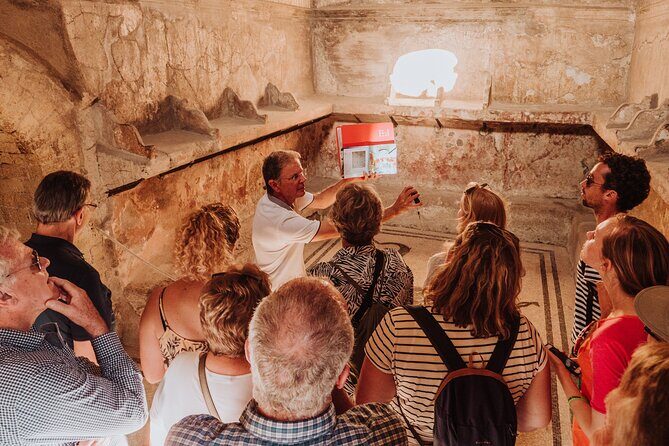
This tour lists at $53.81 per person and runs about 2 hours. The price matters less as a number and more as a bundle of time-saving plus interpretation:
- Entry ticket is included, so you’re not paying separately at the gate.
- A licensed guide with archaeological background does the heavy lifting of explaining.
- Headsets improve clarity, especially in busy areas or near tight building entrances.
- It’s designed as skip-the-line, which is a practical win when you don’t want to spend your short visit waiting.
To sanity-check value: the adult ticket for Herculaneum is listed at 16 euros. Your tour price is in the same ballpark once you account for the guide and headset setup. If you’ve ever done a self-guided walk through ruins, you know the “extra cost” is often just buying back your time and attention.
Meeting at the ticket office in Ercolano: easy to find, quick to start
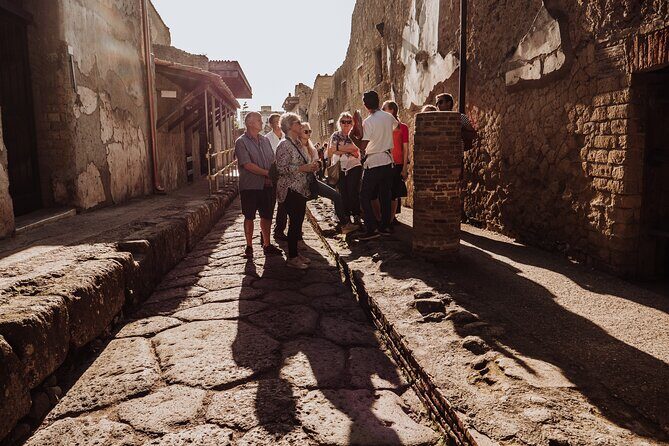
The tour begins at the Ticket Office of the Herculaneum ruins. From there, you head into the archaeological area for the walk.
Getting there is straightforward:
- By car: there’s not guarded parking very close to the meeting area (via Pignalver).
- By train: you can use the Circumvesuviana, then walk about 10 minutes from the station near Corso Resina 1.
The tour ends inside Herculaneum ruins, so you don’t have to retrace your steps to reach the exit after the final stop.
If you’re the type who likes to arrive early and settle in, do it. Two hours sounds short, but Herculaneum’s details reward a calmer start.
The 2-hour route: what you’ll see, and why each stop matters
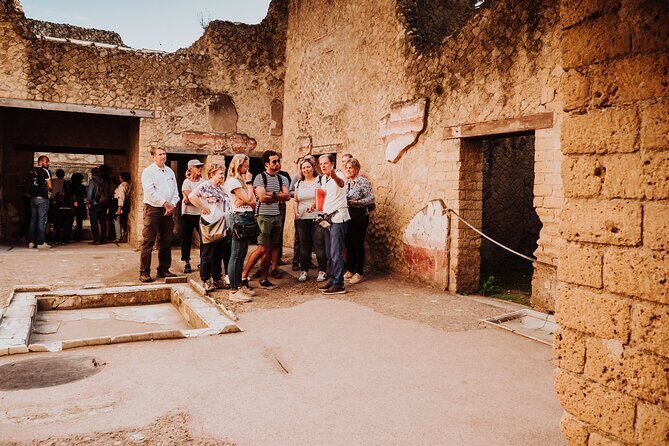
This tour moves room-to-room through the most instructional parts of Herculaneum. Each major stop is roughly 10 minutes, so expect a steady pace rather than long lingering.
House of the Deer: learning through small naming clues
You start at the House of the Deer, named for marble stag/deer statues found in the peristyle. It’s a great opening stop because it trains your eye: once you understand how archaeology names a place, you start spotting other meaningful fragments, too.


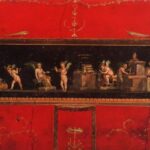

La Terrazza di M. Nonio Balbo: how patrons shape cities
Next is La Terrazza di M. Nonio Balbo. You’ll hear about M. Nonius Balbus as the city’s major benefactor, including the honors and the long inscription connected to his funeral altar.
This stop is especially useful if you want the “why” behind the buildings, not just what the buildings look like. Patronage was a big deal, and this is where the city’s public life connects to private power.
College of the Augustales: religion, politics, and social rank
At the College of the Augustales, you’ll look at a building tied to the cult of Emperor Augustus and the Collegium Augustalium (or possibly the local curia).
It’s a key stop because it shows Herculaneum wasn’t only about houses. There was organized civic and ceremonial life, and the architecture reflects that.
Casa del Rilievo di Telefo: when a house connects to baths
In Casa del Rilievo di Telefo, the discussion often centers on its association with leading benefactors (including Marcus Nonius Balbus) and a standout feature: it has its own private access to the adjoining Suburban Thermae to the south.
This is a moment where you’ll feel the value of a guide. The “private access” idea can be easy to overlook without interpretation, but it makes the building feel like a living system rather than isolated walls.
Partem Domus lignea: the surviving wooden partition
At Partem Domus lignea – Casa del Tramezzo di Legno, you focus on a major element: the surviving wooden partition. Even the fact that it’s still there sparks curiosity, and that’s exactly what the guide uses to explain how interior spaces worked.
If you like seeing evidence that something once felt normal and domestic, this is one of the most satisfying stops.
House of the Skeleton: the human side of discovery
Then comes the House of the Skeleton, named from human remains found in a second-floor room in 1831. This stop can shift the tone—because it reminds you that behind every floor plan there were real people.
It’s also a useful reminder that archaeology isn’t only about admiration. It’s about evidence, and the evidence has consequences.
Central Thermae: bath architecture with separate entrances
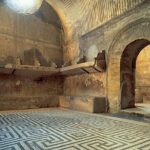
The Central Thermae were built around the beginning of the 1st century AD. You’ll see how the baths were divided into men’s and women’s bathing areas, each with separate entrances—a detail that makes daily social boundaries tangible in physical space.
This is one of the best stops for understanding routine. Baths were a social rhythm, not just hygiene.
House of the Black Salon: carbonized door remnants
The House of the Black Salon is one of Herculaneum’s more luxurious mansions. The guide points out the monumental entrance, including carbonised remains of the doorposts and lintel.
This is a “look close” stop. Without guidance, you might treat it as an impressive doorway. With a guide, it becomes a case study in how the site preserves traces.
Casa Sannitica: Samnite-style domestic design
At Casa Sannitica, you’ll see an arrangement tied to the Samnites, with a splendid atrium and a gallery with Ionic columns, plus decorated rooms with frescoes.
It’s helpful if you enjoy cultural cross-currents in architecture. You get the sense that different communities and styles influenced what “home” meant here.
Casa del Bel Cortile: a courtyard with a stair and balcony
Casa del Bel Cortile is notable for its courtyard plus stairway and a stone balcony instead of an atrium. This stop helps you compare house layouts rather than treating them as a single category called mansion.
In plain terms: you’ll start understanding why people designed homes this way based on light, movement, and social space.
House of the Grand Portal: a central showcase of scale and finish
Finally, the House of the Grand Portal. This is in the center of the archaeological area and gives you a sense of scale, with collonati, frescoes, and charred remains of wooden parts.
It’s a strong closing stop because it pulls multiple themes together: status, design, and material survival.
Why the archaeologist guide changes everything
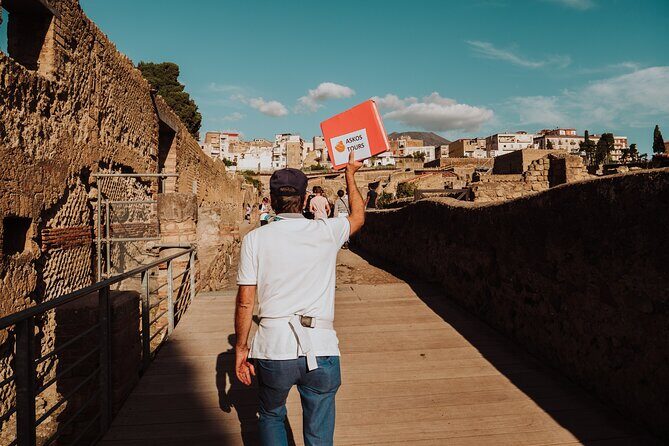
A good ruins guide does two jobs: (1) explains what you’re looking at, and (2) gives you a way to keep looking after the tour ends.
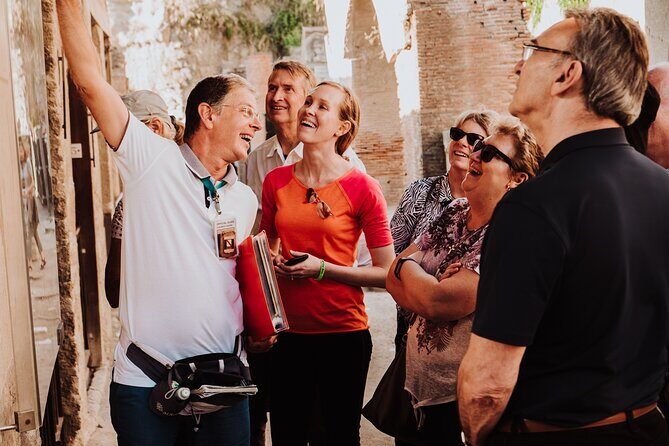
This tour’s biggest strength is that the archaeological background isn’t just name-dropping. The best guides on this route use engineering-style observation and clear cultural context to connect building features to real life. Luciano Leone, for example, has been described as using reconstructions showing how buildings looked around 2,000 years ago—using images he created himself. That kind of “before your eyes” help is hard to get from a sign or an audio device.
You’ll also notice attention to pace and audio comfort. In past tours, guides have adjusted for hearing aids, and the headsets make a real difference when you’re standing close to walls or walking through tighter passages.
Pacing, comfort, and weather: manage the walking load
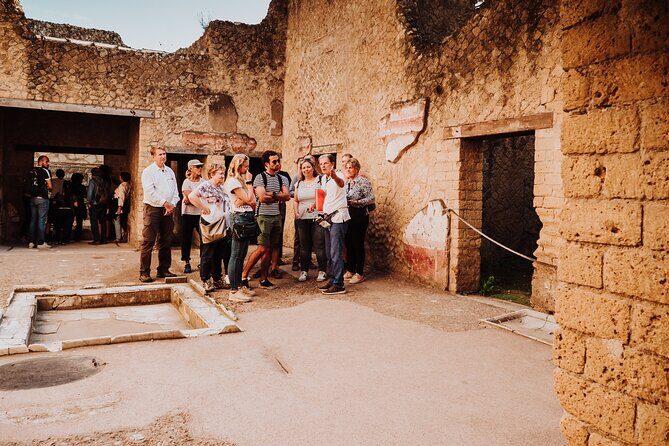
The tour is built as a steady march through multiple major buildings. Expect standing and some walking with limited chance to sit. If you have mobility limits, plan accordingly.
The upside: you cover a lot of meaningful ground in a short window. The downside: it’s not a slow museum stroll. Wear comfortable shoes and bring a light layer even if Naples feels mild—because rain can turn stone surfaces slick.
This experience operates in all weather, so bring what you need. A compact umbrella or rain jacket can save your mood.
After the walk: do you want museum time?
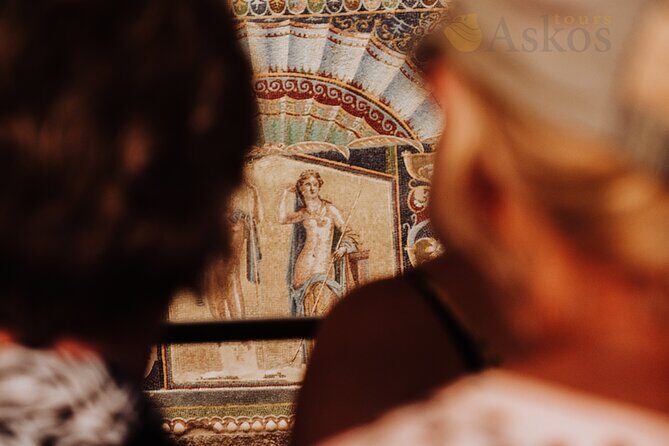
The tour ticket includes the Herculaneum entry, and people often recommend using the onsite museum time afterward. One common tip is to check the recovered objects displayed after the ruins portion—things like jewelry and furniture recovered from the site.
If you have a timed train or a busy day plan, keep your schedule flexible. On one occasion, a guide ran overtime and it affected museum time, so don’t plan to sprint right afterward.
Dogs and service animals at Herculaneum (what to know)
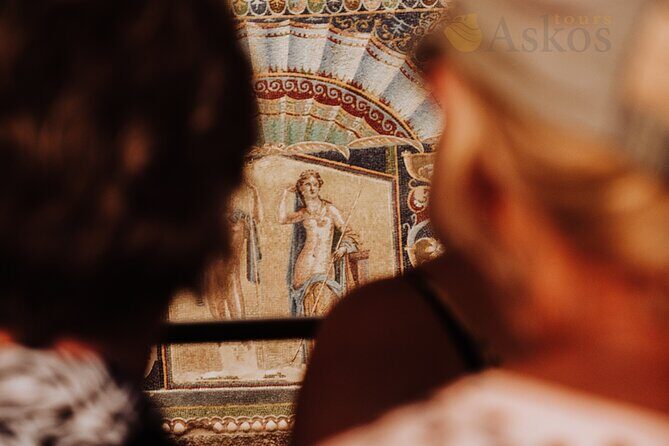
Service animals are allowed. Dogs are also allowed at the Herculaneum Archaeological Park, but there are rules:
- Dogs must be leashed or muzzled and you must have bags for droppings.
- Inside certain areas, like the Antiquarium premises, Boat Pavilion, and domus featuring mosaic floors, access is limited to dogs carried in arms or in an appropriate carrier.
If you’re traveling with a dog, it’s worth planning how you’ll handle those restricted indoor areas.
Should you book this Herculaneum archaeologist tour?
Book it if you want your time to count. This is a smart choice when you:
- want skip-the-line entry and a guided route rather than wandering,
- like architecture and everyday-life details explained in plain language,
- prefer a small group (up to 20, with some groups running much smaller),
- value good audio support via headsets.
Skip it if you:
- need lots of sitting time (this is mostly standing and walking),
- can’t handle a tight schedule inside the ruins and museum areas,
- prefer self-guided reading over a living guide who talks continuously.
If you’re torn between Herculaneum and a Pompeii day, this tour is also a strong “choose this instead” option. The route emphasizes houses, baths, and the kind of artifacts you can walk to and connect to a story as you go.
FAQ
How long is the Herculaneum small group tour with an archaeologist?
It runs for about 2 hours.
Where does the tour meet, and how do I get there?
The meeting point is the Herculaneum ruins Ticket Office. You can reach it by car via via Pignalver (parking nearby) or by train using the Circumvesuviana station, about a 10-minute walk from Corso Resina 1.
Is the tour offered in English?
Yes, it is offered in English.
Does the price include the entrance ticket?
Yes. The tour includes the Herculaneum entry fee.
Does the tour include skip-the-line access and headsets?
Yes. It includes skip-the-line tickets and provides headsets.
How large is the group?
The tour is capped at a maximum of 20 travelers per guide.
Are dogs or service animals allowed?
Service animals are allowed. Dogs are allowed in the park with leash/muzzle and required droppings bags, but some areas have restrictions, including the Antiquarium premises, the Boat Pavilion, and domus with mosaic floors.
If you tell me your travel dates and whether you’re pairing Herculaneum with Pompeii or Naples city time, I can help you shape the best order and timing for your day.