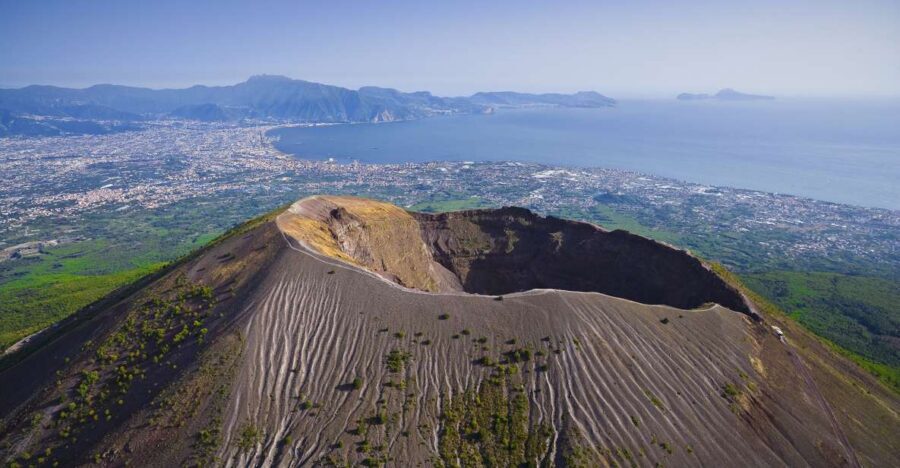
A volcano day without the usual slog. You get e-bike help to reach the national-park area, then a manageable hike to the crater for up-close time at Vesuvius. I love how this mixes motion and scenery instead of turning into a single straight climb, and the crater visit gives you that classic “I’m really here” moment.
What I like most is the way the route stays in nature while still getting you to the crater without needing superhero legs. Seeing the summit with an optional aperitif option (Spritz and Neapolitan tarallo) adds a fun payoff when you’re done working for it. One possible drawback: the e-bikes and brakes are the key pieces here, and on steep or loose surfaces you’ll want to be alert to battery level and brake feel.
In This Review
- Key things to know before you ride
- Getting to Vesuvius from Naples: trains, a short ride, and a ticket setup
- E-bike ascent to Quota 800: why it changes the whole day
- The ride through the park approach: Strada Matrone and Via Cifelli
- The hike to the crater turnstiles: short, steady, and view-heavy
- Crater time: self-guided exploration with an optional Spritz payoff
- The return plan: descent on foot, then bike again near Boscotrecase
- Price and what $70 really buys (and what it doesn’t)
- What to bring and how to prep so you enjoy it
- Who this tour is for (and who should skip it)
- Final verdict: should you book the Vesuvio Bike Tour?
- FAQ
- How long is the Vesuvio Bike Tour?
- What’s included in the price?
- Is there a guided tour inside the National Park?
- Do I get lunch or food included?
- Is the crater visit guided?
- Is the Spritz and tarallo option included?
- Where do I meet for the tour in Naples?
- What should I bring and wear?
Key things to know before you ride
- E-bike assist to the 800-meter area, so you can save your energy for the crater walk
- A real crater visit window (self-guided) of about an hour from the turnstiles
- Two active segments on foot, plus a return bike ride through the lower area
- Optional Spritz and tarallo on the summit if you choose that add-on
- Your day is paced for a mixed effort: easy climbing vibes, then a short steady hike
- Bike-condition matters on gravel: check battery and brakes before you roll
Getting to Vesuvius from Naples: trains, a short ride, and a ticket setup
This tour starts with an organized meet-up in Naples. You’ll gather at Napoli Centrale where you pick up tickets and get your info inside an agency located within the station. Then you take the train toward Torre Annunziata (about 45 minutes).
After you arrive, there’s a short bus/coach transfer (around 15 minutes) to the Vesuvius Drive meeting point. That’s where you pick up the e-bikes and get your final directions for the route.
The “Naples to volcano” part is genuinely useful because it reduces driving stress and turns the day into a simple rhythm: train to the coast area, short transfer, ride and hike, then train back to Naples. If your starting option is Via Panoramica, 26 at inStazione services, it’s the same idea—your day still revolves around rail and a short road transfer.
E-bike ascent to Quota 800: why it changes the whole day
The e-bike portion is the engine of this experience. You start by receiving the bike at Vesuvio Drive, then ride out toward the Vesuvius National Park entrance area. The ride time is listed around 35 minutes to get to the park entrance zone, and the goal is to get you up to the 800-meter altitude area so the hike doesn’t become a brutal grind.
This is where the tour’s value shows. At $70 per person, you’re not just buying a crater ticket. You’re buying an easier route to the start of the crater climb, which means more time enjoying views and less time suffering.
Two practical notes from real-life experience: first, steep terrain and loose gravel can be tough even with e-assist. Second, battery and brakes are the weak links on mountain terrain. Some people have praised the ride as easy enough due to the power assist, but others have reported situations like a battery getting low faster than expected and a brake problem on one bike. My advice: when you get your e-bike, do a quick sanity check before you move far—squeeze both brakes hard, test response, and confirm battery level. If something feels off, say so immediately.
The ride through the park approach: Strada Matrone and Via Cifelli
Once you’re on the bikes, you’ll follow a route that feels more “scenic road” than “busy commuting.” The path goes along Strada Matrone and the Via Cifelli route, with the ride working like the runway that positions you for the hike.
This matters because the day isn’t just about the crater. You’re also paying for a different angle on Vesuvius: the transition from road and approach paths into a more quiet natural setting. You should expect that the surface and grade can vary as you near the park entrance area.
If you’re prone to getting tired quickly, the good news is that you’re not relying on pure leg power to get you there. The e-bike segment takes the edge off the hardest early climbing, so you reach the hike ready to enjoy it instead of already spent.
Also, go in expecting markers and guidance. One review highlighted how they used markers to make sure they went the right way. That’s a big deal in a volcano setting where it would be easy to second-guess yourself.
The hike to the crater turnstiles: short, steady, and view-heavy
From the moment you leave the e-bikes at about 800 meters, you’re on foot. The hike is described as panoramic and nature-focused, designed to feel doable with minimal physical effort. Realistically, you’ll still feel that you’re on a volcano approach: it’s not flat, and your pace will depend on heat and footing.
The hike time is listed around 45 minutes (and also described as about 40 minutes in the day flow) to reach the crater turnstiles. That’s long enough to get a sense of progress, but short enough that most people can stay in a comfortable rhythm—if you wear proper shoes and don’t rush.
This is where I’d treat your “packing list” seriously. Comfortable shoes are the one must-have item called out. Add your own common sense layer: bring water, especially if it’s warm. One clear tip from a past participant was to bring at least three small bottles or two larger ones. There’s a spot at the top selling drinks and snacks, but you’ll feel better if you’re not relying on the shop for hydration during the hike.
If you’re traveling in hot months, plan to move slower than your instinct says. The tour is active, but it’s built to be manageable. Your job is to not turn it into a race.
Crater time: self-guided exploration with an optional Spritz payoff
Once you reach the crater turnstiles, you enter the big moment: exploring the crater area up close. The crater visit is self-guided with a time window of about one hour.
That self-guided format is actually a plus for many people. You can linger when something catches your eye, step aside when crowds bunch up, and move at your own pace around viewpoints. You’re getting guided structure to reach the right place, then freedom to explore once you’re there.
If you want a little extra celebration, there’s an option for an aperitif on the summit: Spritz and Neapolitan tarallo. Even if you don’t choose it, the crater-and-rim setting is the payoff itself. The experience is less about learning every geological detail and more about being physically close to something rare and intense.
One more practical thing: crater areas can be windy and changeable in comfort. Bring whatever makes you feel steady—good shoes matter, and taking it slow at your first viewpoints helps. Also, you’ll likely be grateful for that hour once you’re up there. It’s enough time to feel you got your money’s worth without being stuck for ages.
The return plan: descent on foot, then bike again near Boscotrecase
After crater time, you head back down. The itinerary includes another walk segment of about 45 minutes. This return on foot is the moment to watch your footing. Descents on volcanic terrain and gravel approaches can be slippery if you rush.
Then you move into the biking phase again. The plan includes an electric bike ride in the Boscotrecase area (listed around 1 hour for the bike segment), followed by the bus/coach transfer back to the train and the return train ride to Naples (about 45 minutes).
This loop is nice because it keeps the day from feeling like a one-way effort. You climb with help, hike for the views, then you get to “flow” back with the bike rather than just walking all the way.
Just keep one thing in mind: if a bike brake or battery felt marginal on the way up, it’s smart to remember that condition for the return ride too. Loose gravel and steep sections can test equipment twice in one day.
Price and what $70 really buys (and what it doesn’t)
At $70 per person, you’re paying for a lot more than the crater ticket alone. The Vesuvius entrance ticket is listed at 11.68 €, and it’s included in the total price. You’re also getting the e-bike ascent up to the 800-meter area, plus the full transportation loop by train and coach.
Two things aren’t included. First, there’s no guided tour of the National Park of Vesuvius. You’re getting access and logistics, not a narration-style guide walking you through the park. Second, lunch isn’t included, so plan to cover your own meal or snacks on the day.
So is it value? I’d say yes if your goal is this specific combo: powered bike access + a real crater visit + a hike that doesn’t require days of training. If you’re the type who wants deep spoken interpretation and a fully guided nature walk, you might feel the crater portion is the only true “destination story,” since the park tour isn’t included.
The duration is listed as 4.5 to 7 hours, depending on starting times and pacing. For that timeframe, you’re getting a full, active loop that would be hard to replicate easily on your own without timing the train and entrance ticket.
What to bring and how to prep so you enjoy it
The tour calls out one big item: comfortable shoes. That’s not optional. You’ll be on foot for long stretches, plus you’ll be navigating uneven ground near the crater route and during any gravel sections.
Beyond that, I’d plan like this is an all-weather day with real effort:
- Bring water. A strong tip from the experience was to pack enough bottles so you’re not counting on the top shop mid-hike.
- If you’re booking for warmer months, expect heat. The tour is manageable, but heat changes everything.
- Wear layers you can adjust. Summit areas can feel different from the lower roads.
- Consider arriving early if your schedule allows. One participant reported that when they arrived early, staff helped with tickets and getting pointed to the right train, and also helped them find the correct track. That kind of hand-holding can save time and confusion.
Also, you might see communication about your pickup time. One person specifically mentioned that you should pay attention to text messages if you plan to arrive early. Do it. It helps you get your bearings fast.
Who this tour is for (and who should skip it)
This is a bike-and-walk day, so it fits best if you’re comfortable with basic physical activity and can ride an e-bike confidently.
It’s not suitable for:
- People with back problems
- People who can’t ride a bike
- Wheelchair users
- People under 4 ft 6 in (140 cm)
- People over 287 lbs (130 kg)
You should also take the terrain seriously. Even with e-assist, some people have pointed out that bikes may not feel optimized for steep, loose gravel. If you’ve got balance issues on uneven ground, or you hate the idea of riding on rough surfaces, this might not be your best fit.
On the flip side, if you want a volcano experience without a full-on endurance trek, the format makes sense. The hike is described as manageable, and the e-bikes do the heavy lifting before you ever hit the crater approach.
Final verdict: should you book the Vesuvio Bike Tour?
Book it if you want the classic Vesuvius crater experience in a way that feels practical and active, not punishing. You get a setup from Naples with train and short transfers, e-bike support to reach the key elevation area, and then a real hour to explore the crater yourself. That combination is hard to beat for $70, especially since the entrance ticket is included.
Skip it if you’re expecting a fully guided National Park experience with lots of interpretation, or if you’re worried about bike quality on steep gravel. Also, if you’d rather avoid any possibility of battery or brake issues, you’ll want to choose this only if you’re comfortable doing quick checks and speaking up right away.
If you’re fit enough for a brisk day and you’re excited to stand close to a live volcano, this is a strong way to spend your time around Naples. Just bring good shoes, carry water, and take five minutes to make sure your bike feels safe before you start climbing.
FAQ
How long is the Vesuvio Bike Tour?
The duration is listed as 4.5 to 7 hours, depending on available starting times and how the day runs.
What’s included in the price?
The included items are the e-bike ascent to the 800-meter area and the Vesuvius entrance ticket.
Is there a guided tour inside the National Park?
No. The price includes access and logistics, but a guided tour of the National Park of Vesuvius is not included.
Do I get lunch or food included?
Lunch is not included. There is mention of drinks and snacks available at the top, but you should plan your own meals.
Is the crater visit guided?
The crater visit is self-guided, with about one hour to explore once you’re at the turnstiles.
Is the Spritz and tarallo option included?
It’s optional. If you select that option, you can enjoy an aperitif with Spritz and Neapolitan tarallo on the summit.
Where do I meet for the tour in Naples?
The meeting point can vary depending on the option booked. One listed meeting setup is inside Napoli Centrale, and another is Via Panoramica 26 inStazione services turistici.
What should I bring and wear?
Bring comfortable shoes. Water is also a practical idea for the hike, since hydration needs come up during the walking parts.